THE LORD OF THE RINGS: THE TWO TOWERS
 Last Friday my mom and I went to Wolftrap to see a Lord of the Rings concert. They have an orchestra play all the film music (choirs and soloists included), while projecting the film The Two Towers in HD on a huge screen. We went to the same concert last year for first Lord of the Rings film, The Fellowship of the Ring, and I blogged about the experience here.
I don’t have much else besides praise for the concert; watching a film like that is just fantastic. I will say a few things though:
The brass was quite loud. In the soundtrack recordings, I’m sure they can mix the orchestra sound a bit so the strings have more of a voice, and perhaps the acoustics of Wolftrap’s Filene center have an effect, but when it came to the brassy action parts, the brass was quite loud, drowning out a lot of the orchestra, and sometimes the character’s voices. The percussion could be quite loud at times too, especially instruments like the bass drum. But this is not complaint; I love the sound of a booming bass drum.
The speakers popped every now and then a little before and after intermission, which was really annoying.
The choirs were amazing. I really loved the elvish choir music. The strings and choirs sounded especially dynamic and full and rich when hearing them live.
There were many moments in the film in which the story was so engaging that I forgot that the music was live. This is both a testament to how well the music was played and just what a good story it is.
As I mentioned last year, it was a lot of fun to watch the film with a huge audience that also loved the film. Hearing them laugh and cheer at moments was kind of exciting (though I myself kept silent the whole time).
Actually, watching the crowds made me kind of want to be a film composer; there’s just such a huge audience out there. It’s easy to forget how big the world is.
Lastly, I kind of wish the Filene Center allowed popcorn and soda inside. It would of course make a mess that they’d have to clean, but I do quite enjoy munching on popcorn while watching a film.
Next year I hope to see The Return of the King in a similar manner!
LAPTOP FAILURE
 A few days ago, all the applications on my laptop, from Firefox to Microsoft Office programs, kept crashing. Then I’d often get the bluescreen of death saying something about a physical memory dump and then restarting the computer. I was sure it was a RAM issue, and thought one of my sticks of RAM was bad and needed to be replaced. So I took out one of the laptop’s RAM modules and, voila, it worked! Though I was out 2 GB of RAM. I wanted to go buy some more RAM just for the quick fix of it, but my father insisted that I call Dell support. So I did (well, actually, he did, and then handed me the phone) and, by switching the working RAM into the other slot as support told me to, I discovered the problem wasn’t with the RAM, but with the motherboard; it couldn’t communicate with that RAM port for some reason.
So sometime this week or next week or whenever, a Dell guy should come to my house and replace the motherboard, which will hopefully go smoothly. In the meantime, I’ll only have 2 GB of RAM, but everything should at least run smoothly without crashing. My music composing might be impaired a bit, since I often do use up a lot of RAM loading up virtual instruments, but 2 GB should still be manageable.
The laptop (an Alienware M17x) gets really hot when playing games. Like, burning hot. Like, you could fry an egg on it. Okay, maybe not that hot, but, still, it gets really hot. Which is fine with me because it plays games really really well; highest resolution (1920 x 1200) on highest settings and the frame rates stay high. It’s just awesome. But I’m wondering if it’s all the heat it produces that damaged the motherboard? Eh… who knows…
READING
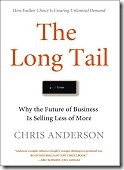 Last week, I finished reading Long Tail, The, Revised and Updated Edition: Why the Future of Business is Selling Less of More
That said, I’m not sure reading an entire book on the subject was worth it. It’s a short book, only around 230 pages, but it certainly seemed repetitive. The idea of the “Long Tail” isn’t too hard to understand: there’s a definite market for niche products, so if you can offer a lot of choices to buyers (without, obviously, spending too much money yourself), you can definitely make a profit. Great subject for a magazine article (which is what I believe it started as), but for a book it seems just a bit stretched. Makes for easy reading at least.
PROJECTS
 I also recently started some projects with a friend. The first idea was to create cartoony shorts, similar to PowerPoint presentations we used to give in high school. You can see our first animation here on YouTube.
Some problems with this project are: the animation is very rough and the recent-event subject is time-sensitive. I think such shorts could find an audience if we could keep them up, but with just two people creating them, neither of which are quick or experienced animators, it would probably be infeasible, unless we had a lot more time to dedicate to it each week.
What I’d like to do eventually is use this similar method of animation (creating animation frames in PowerPoint, since I know how to draw best in it) to create something longer, and non-political. Two years or so ago, my sister and I planned out a kid-friendly comedy-fantasy story with the hope of one day turning into a series of cartoons. At the time, I had just bought Flash and had high hopes of gaining awesome animation skills with it. Using PowerPoint didn’t cross my mind, because I am stupid. But now that I am reminded, maybe it will be something to try in the future. I especially like the idea of writing music to it, and being able to take a long time polishing an animation.
Anyway, the other project we started was the writing of a novel. But I can not yet say anything about it due to a non-disclosure agreement.
SCHOOL WORK
I don’t go to school anymore, so I don’t have any.
 .
. I suppose much of it can seem like cliche self-help and marketing blither; certainly MacLeod’s thoughts are not unique or revolutionary. But at the same time I find them quite encouraging and inspiring. Even if you immediately agree with MacLeod’s writings, they might be easy to forget, because so many people in the world act as if they don’t agree.
 last week, and posted some quotes on my
  I’m now reading
  by Jennifer Michael Hecht. I read somewhere (maybe on the author’s website?) that the author originally wanted to call the book “A History of Atheism” or something. That’s basically what it is, the history of the questioning of religion, or doubting it. That said, it’s not a book of “why atheism is correct” or “why religion is correct” … it doesn’t really seem to make any religious judgments itself, it’s more a “history of religious philosophy” book. For someone like me who doesn’t know much about history, or religious history for that matter, it’s very educational.
 One could cheat, and go in circles. “Why are you the boss?” “Because I tell people what to do!” “Why?” “Because I’m the boss!” Of course, such circular logic is considered a logical fallacy. But real logic isn’t always much more helpful, even though it seems to make more sense to the mind. But if logic isn’t circular, is it linear? A line that goes on forever? That’s just as useless as a circle! In fact, just about every shape logic could be in is useless. (Well, depending on what you’re using it for.) The whole cause and effect, one thing from another, dominoes of logic . . . ultimately I think it’s a flawed way of looking at the universe, of trying to discover truth. But right now I have no earthly (or heavenly or hellish) idea of what it could be replaced with.
 On an unphilosophical note, I had a weird dream a few nights ago. Near the end of it, a bunch of people gave me a bunch of presents, and it wasn’t my birthday or Christmas or anything. Being quite astounded at my good fortune, I thought “this must be a dream! I’m going to wake myself up!” and with some strange mysterious semi-lucid mental process, I awoke myself. It was like my uncontrollable subconscious willingly giving control back to the my real conscious self. It was a really strange strange experience.
 There are a couple reasons I felt compelled to write such a post. Firstly, I’m reading quite an interesting psychology book called
 , which sort of reminded me I wanted to blather about these thoughts. It’s a good book, though it’s really not as much about the craft of writing as the other books I mentioned in my last post are. In many ways it’s more about life philosophies and how they relate to writing. It’s extremely funny at times, and has some very poignant moments. I’m not sure I agree with all of Lamott’s thoughts, but it might just have to do with my interpretation of her words. She almost seems to encourage people to delve into their sufferings for material; to bathe in the unpleasantness they’ve experienced in their life for their writing. While I do agree with a lot of the other things she says (and really enjoy how poetically and humorously she says them), the suffering issue somewhat inspired this post.
 These thoughts are somewhat random… I’m not sure I’m trying to make any overall point, I’m just making observations and suggestions to myself for the most part. Hopefully it won’t sound too corny. But let’s face it: deep down in our hearts we’re all corny and sentimental. (Get it? Cuz that’s, like, sentimental right there?) Anwyay, here I go:
 I know there are plenty of artists who use art as a way to “release their emotions” … I guess it’s kind of a self-therapy. I guess whether or not such an act is useful depends on how it’s done. I think sometimes it can help the artist find answers to his problems. I like to think that writing literature is, in a way, searching for answers within oneself. That might sound corny, but I think it’s really true. Where else are you going to find any moral answers you can believe in? (That’s not an argument for moral relativism, by the way!) But I think “letting it out” can also help an artist to continue to hurt himself if the artist becomes dependent on such feelings to produce art, if that makes any sense, or if it just encourages the artist to dwell on terrible feelings.
 I don’t know how it emerged, but at some point having a “dream” became a very romantic thing. Children are raised being encouraged to “follow their dreams” and even adults are encouraged to continue to pursue them. Woah!! Doesn’t it matter at all what the dreams are? I think it does. I’ve talked to artists who long dreamed of becoming rich and famous, of having their work influence thousands or millions. And then their dream doesn’t come true and they become bitter and think about giving up. I guess the real problem is that it became more of an expectation than a dream. It became something they expected to achieve, and something they were depending on to find happiness. That’s just stupid!! I can understand the natural desire to want fame and fortune, but if you’re secretly expecting such things and depending on them for happiness, you’re an idiot. Just stop wanting them! Stop! Now!
 and
and  by Ayn Rand
 and
and  by Orson Scott Card
 I can’t say I agree with all of Ayn Rand’s philosophies, but I’ve found her writing to be quite immersive. In my opinion, she’s fantastic at describing characters’ motivations and attitudes. Her stories also have very strong themes, which I think is lacking in some of the fiction I read. So much fiction these days is purely about the action and has nothing to say beyond that. It’s like the author saw an action movie and just wanted to regurgitate it with different characters. Anyway, Ayn Rand talks all about themes and how they relate to plotting.
 As I stated above, I find that characters can be quite tricky. Fortunately, Orson Scott Card wrote an entire book on the subject: Characters and Viewpoint. However, don’t let the title trick you into thinking this book is about a small subject in fiction. Characters without stories and stories without characters are extremely hard to find; they’re very strongly linked. Thus, in my opinion, learning about creating characters is learning how to create a compelling story. So it’s not like you’d get this book and then say “Oh, now I need a book on plot!” . . . though Card doesn’t talk about it by itself, you’ll still find that it relates strongly to characters (character development, duh!). That said, this book is part of a series called Elements of Fiction Writing, the other books by other authors. I found this addition to the series to be the only one worth buying.
 , and I have a few quotes from it to put up on my
  I also finished reading a fantasy book by Kage Baker called
  . It was a short book that came out in 2004, and I think it’s out of print now. I wanted to read a book by Kage Baker because I had read a few of her short stories and enjoyed her style. It was pretty light reading; the plot never got extremely thick or dark and the world never seemed very complex, but it was still engaging and believable and very humorous. Not a bad read at all.
 , a nice all-in-one volume I got for Christmas, but now I’m also reading T. H. White’s
  , the book of the legend of King Arthur, which has definitely been enjoyable so far, especially since I already know how parts of the story go, and this book kind of fleshes things out.
 First, I mention that my short story Oberon’s Paradise has once again been rejected because it’s such a terrible story.
 – I orchestrated a tune called The Cornish Wassail for the free album
  I am almost finished reading a boring book called