TuneSage progress update 12

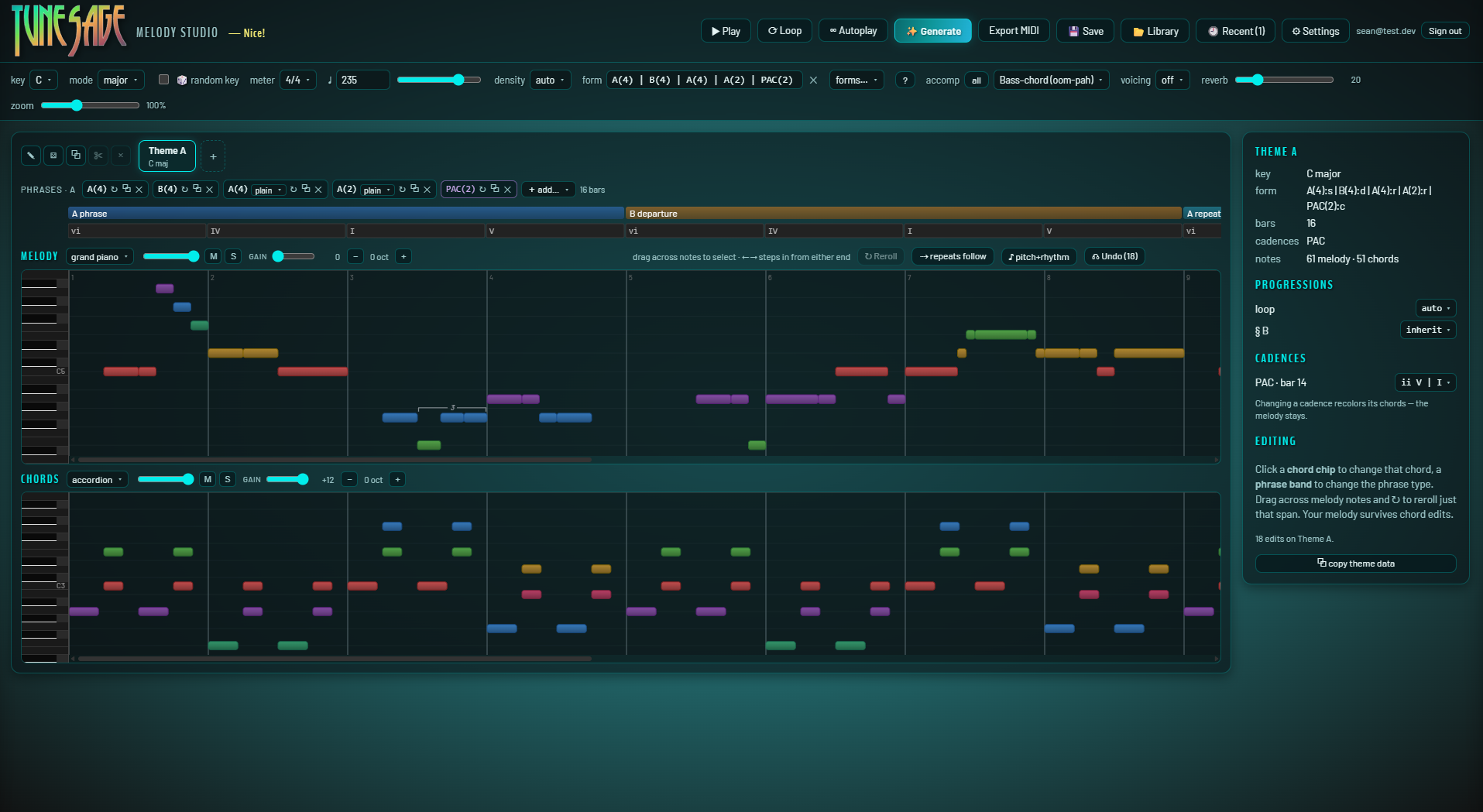
I’ve recently been working on a “pop” style for melodies, but they still sound a bit generic at this point. (There are plenty of samples in the video below.) With melodic styles having a lot of overlap, I’m not quite sure how or where I’ll end up drawing distinctions. But I’m less focused on delineating styles at the moment, and more focused on broad capabilities, making sure new things it learns remain compatible with what it’s already learned. For now, it’s got two new “forms”: a 4-bar phrase that repeats, and a 2-bar phrase that repeats twice followed by a 2-bar closing. It’s also does some minor syncopation now and then, and I’ve added a setting that allows users to set the “note density” to fine, medium, or coarse. (Fine means: more syncopation, more 16th notes, sounds better at slower tempos. Coarse means the opposite: less syncopation, no 16th notes, sounds better at faster tempos.)

I also added “theme blocks”, the idea being that one can write a mockup for a whole song by stringing together multiple themes.

Still much work to do, including what I mentioned last time: allowing the user to “lock in” part of a melody and have TuneSage regenerate the rest. I need more forms, especially ones longer and shorter than 8 bars. I’d like to allow the user to generate chord progressions separate from the melody, or supply their own chord progressions.

Even with such a lot of remaining work to do, I’d really like to release the app as soon as possible, despite its initial shortcomings, just to see if anyone out there is even interested in paying for such a thing, and if so, get some real user feedback. I’m aiming for releasing it at the end of July or early August. I’m tempted to continually put it off later and later as I add more capabilities, but I could probably continually do that for years, and I’ve already spent way too many years just getting my initial music theory ideas to this current state. Stay tuned!

(P.S. I’m also making the devlog videos on YouTube to help me practice presenting, as I don’t think I am very good at it.)

TuneSage progress update 11

Haven’t blogged in a while! Does anyone read blogs anymore anyway?

Also haven’t made an update about TuneSage in a few years. But I’ve been working on it on and off, trying a lot of approaches and doing a lot of experiments that ultimately failed. Lots of trial and even more error.

But I finally have a completely overhauled algorithm that is both extremely fast and much easier to iterate on (unlike previous versions), so I’m excited and finally feel like I’m making good progress once more (despite the emergence of a vocal anti-AI crowd that didn’t much exist 10+ years ago).

Anyway, I’ve just made a YouTube video demonstrating TuneSage as it is at the moment:

As I mention in the video, the three main things I want to add before launching the product:

  • Melodic styles (right now the melodies are purposefully very random and generic sounding)
  • The ability to write melodies more or less than 8 bars long, and the ability to string melodies together for larger forms
  • The ability to edit individual notes or chords, and the ability to “lock” notes or chords in place while re-generating the rest

Plus, I’ll probably move the chordal accompaniment to a separate track so that the user can choose different instruments for both.

Still, the app will focus only on generating melodies with chords at first. I’ll work on expanding the accompaniment generation abilities after the app is actually launched.

(P.S. As of this writing, tunesage.com is down because I switched hosts and still haven’t reuploaded the landing page… I should do that soon.)

Some thoughts on the nature of prayer

Praying for Money!

Here are some thoughts in response to this post: Answered Prayer Seems Implausible

This practice of answering prayer seems to require far more knowledge and efforts than would be required to more strongly direct the overall human trajectory, which they apparently choose not to do. So what gains could result from all this extra effort?

By assumption, these powers could favorably change the world around those who pray, but instead tend to choose not to do so in the absence of appropriately “sincere” prayers. This gives advantages to humans who are more popular, and also to those who are richer, as it seems quite possible to pay money to induce more sincere prayers.

I actually agree with the post in itself, but that’s because it’s (as far as I can tell) confining the concept of prayer and “higher powers” to a specific understanding. The post makes no mention of God, with all that concept implies. The nature of prayer will naturally go hand-in-hand with one’s conception of God (or lack thereof).

The concept of God (or a higher power) listening to prayers and then answering some lucky set of them by favorably changing the local world around them comes with the a lot of presuppositions about the nature of God (or higher powers) and prayer.

For instance, consider the idea of God “listening to prayers” in itself. If one already accepts a Christian worldview, this can be easy to take for granted, but what’s really going on? I’d argue God is not a third-party consciousness mind-reading you, and so is not “listening” to your inner-self-speak in a human-sense. Rather, God in His very nature already knows all your inner thoughts (even your pre/sub/un-conscious “thoughts” that we cannot access) as He is creating and powering your very consciousness at every moment. (He is outside of time, so present tense is misleading, but I’d say it’s better than past tense, as you cannot exist independently.) He is the source of your very being (and all being, for that matter).

Since God exists outside of time, “answering a prayer” need not consist of actually “changing” anything; outside of time, this reality may as well be one instant from His perspective. He could just as easily bake the “answer” to a prayer into the fabric of the universe at the time (from our POV) of the Big Bang.

In this sense, the greatest use of prayer is indeed to change your own perspective, your foundational “filters” for how you see and process the world, how you make decisions, how you find meanings in things, including causation. And therein you find the “answer” to prayers: not necessarily in some physical miracle, or suddenly getting what you desire (although those might be valid interpretations of one’s experience), but in changing or priming your heart / mind to perceive and react to the world in a certain way.

(Similarly, one can “pray” to pagan “gods” or demons, which will also influence the way one sees the world, and reality can get very dark very quickly. So, you know, don’t do that. But that’s a whole other topic.)

In this sense, no, you can’t get the same results without honest prayer, or honest belief in God for that matter. Yes, you could possibly win the lottery or get lucky in some sense without praying for it, but obviously you will not then consider it an “answer to a prayer”, and so it cannot influence your perception and decision-making going forward. (Though I’d consider even something like “hoping for the best” to be a sort of prayer (perhaps a “proto-prayer”?); even without consciously acknowledging a religious-based “God”, it is a mindset that primes your experience of the universe, and of course God “hears” it just as much.)

Along the same lines, what does it mean for God to give someone a gift? Again, we may tend to think of it in human terms, as a separate being going out of their way, by their own free will, to give you something or do something for you. And it may not necessarily do any spiritual harm for a Christian to think of it this way. (Though it may if you then blame God for denying you some desire given to others, like beauty or talent.) But one could also think of it as the reality of entire universe being setup (by God) from the very beginning in a way that’s positive for you, whether or not you recognize it or are grateful for it in the present. Works out to the same thing, as far as I can tell.

But isn’t this all superstition? The question itself points to belief and perspective, so no one can really answer it but for themselves. It’s like asking whether some meaningless sounds you hear another person make are silly gibberish or another language; you will have to make a judgment and go from there. (That is, you could say, “It’s gibberish” and ignore it, or “It sounds like there might be some meaning there, and I want to know what it is.”)

From a Christian perspective, none of this is to deny that God could change anything if He wanted to, local or otherwise, or that some physical miracle could happen in answer to a prayer. But as such modern instances tend to be personal and anecdotal, this usually doesn’t help a skeptic much.


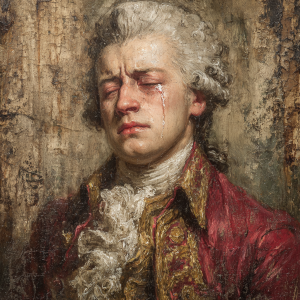
Answer to a prayer?