Freedom to Learn by Peter Gray

I recently came across this blog: Freedom to Learn by Peter Gray.

There are a bunch of interesting articles there, and I haven’t read them all. But I really appreciate some of them; they echo what I’ve been saying all along, and it’s always nice to feed my confirmation bias.

In one article, Gray writes:

We can use all the euphemisms we want, but the literal truth is that schools, as they generally exist in the United States and other modern countries, are prisons. Human beings within a certain age range (most commonly 6 to 16) are required by law to spend a good portion of their time there, and while there they are told what they must do, and the orders are generally enforced. They have no or very little voice in forming the rules they must follow. A prison–according to the common, general definition–is any place of involuntary confinement and restriction of liberty.

I recently talked to a teacher who was complaining about the things the school system made teachers do, and I asked: “Then why do you do it?” The answer was something like: “For the hope it might get better.” I said: “That’s pathetic!” but at least it wasn’t some BS about how much the teacher loved kids and knowledge and making a difference, etc. Some teachers will make a huge point of their pure intentions, as if that somehow absolves them of any wrongdoing. The truth, however, is probably quite apparent to most of us, it’s just considered rude to talk about: most teachers became teachers because they didn’t know what else to do.

I can certainly sympathize with the plight of getting out of college and not finding any jobs available that I would actually want. But becoming a teacher, especially if you have serious disagreements about how the education institution does things, seems pretty dumb to me. What should you do instead? I must admit, I’m not sure; not going to college in the first place might help.

But don’t you think an excellent way to make our education systems change would be to help them experience a shortage of teachers? I can’t imagine you being able to change too much from the inside, after you join a labor union which doesn’t agree with your position.

In another post, Gray responds to Daniel T. Willingham’s book Why Don’t Students Like School?, a book I blogged a bit about on my Book Quotes blog. Gray writes:

Willingham’s thesis is that students don’t like school because their teachers don’t have a full understanding of certain cognitive principles and therefore don’t teach as well as they could. They don’t present material in ways that appeal best to students’ minds. Presumably, if teachers followed Willingham’s advice and used the latest information cognitive science has to offer about how the mind works, students would love school.

Talk about avoiding the elephant in the room!

Ask any schoolchild why they don’t like school and they’ll tell you. “School is prison.” They may not use those words, because they’re too polite, or maybe they’ve already been brainwashed to believe that school is for their own good and therefore it can’t be prison. But decipher their words and the translation generally is, “School is prison.”

See? I told you so.

OK, most of Gray’s articles are not about schools being prison, but he does bring up the notion of “freedom” a lot from a psychological point of view, from the idea that a sense of freedom is an innate psychological desire for all humans, including children. And it seems right to me; I certainly have a sense of freedom and hate having to do stuff I didn’t choose to do. In fact, (and I’ve said this before) I’d say the common reason parents and teenagers clash is because the teenager is psychologically ready and thirsty for more freedom, but parents and society don’t give it.

Interesting movies for 2011

Here are the 2011 movies I’m most interested in. Some I definitely want to see in theaters (the ones with a star), and some I just want to keep an eye on and I’ll decide after watching previews and hearing other people’s reactions. (Animated films I almost always want to see in theaters.

rango-movie-image-9

March 4, 2011 – *Rango – Industrial Light and Magic finally tried its hand at animating its own feature instead of just doing effects work. I’m very interested to see what they’ve come up with. The movie seems to be about a chameleon who goes on and wild west adventure of some sort…

Mars-Needs-Moms5

March 11, 2011 – *Mars Needs Moms – These motion capture films always look a bit wonky to me, but I do have a special place in my heart for 3D CGI spaceships.

source-code-movie-photo-01-550x366

April 1, 2011 – Source Code – IMDb says: “An action thriller centered on a soldier who wakes up in the body of an unknown man and discovers he’s part of a mission to find the bomber of a Chicago commuter train.” Supposedly when he fails the mission, he gets to go through it again, so it’s like Groundhog’s Day sci-fi thriller style. Or maybe not, who knows… but it definitely sounds interesting.

Rio-movie-Poster-01-thumb

April 15, 2011 – *Rio – Finally some new stuff from Blue Sky Studios! Supposedly the plot of Rio was too similar to Pixar’s previously planned film Newt, causing its cancellation; the film is about a bird of rare species who must breed to save his kind. Nothing like an animated romantic comedy to make forced arranged marriage seem OK. But I have no idea if that’s really the story or not…

2011_pirates_of_the_caribbean_on_stranger_tides_001

May 20, 2011 – *POTC: On Stranger Tides – Yes, I know the sequels were awful, but maybe the absence of certain characters will be a blessing for this one. Plus I want to see what it’s like in 3D.

kung-fu-panda-2

May 27, 2011 – *Kung Fu Panda 2 – I actually haven’t seen the first one yet, but I’ve heard a lot of good things about it from my animation friends, so I will be sure to check this out.

ET Super 8

June 10, 2011 – Super 8 – I don’t know why J. J. Abrams thinks it’s so cool to not reveal plots before the movie comes out. I don’t find it interesting or compelling, I find it annoying. Maybe he doesn’t want people to pre-judge the logline, or maybe he just likes the mysterious attention it gives him? Anyway, the teaser during the Super Bowl looked interesting, so I’ll keep a watch on this one.  Personally, I think this is a film based on the classic Magic 8 Ball toy and has nothing to do with cameras, though I did find this description online: “Set in Ohio in 1979, the movie follows six kids who are using a Super 8 camera to make a zombie flick. One night, they end up filming near a set of train tracks and capture a calamitous wreck — the same one first revealed in last year’s teaser trailer — and the alien creature that emerges from the wreckage.”

cars2-550x307

June 24, 2011 – *Cars 2 – It’s Pixar, so I have to go, even though the idea of talking cars still seems too “Putt-Putt” for me.

cowboys-and-aliens-set-visit

July 29, 2011 – *Cowboys and Aliens – Because it’s cowboys and aliens. (So that’s where Thirteen has been…)

Now-set-5

October 28, 2011 – Now – From the director of the awesome sci-fi film Gattacca, this sci-fi film takes place in a world where people stop aging at 25 (why, that’s my age! ZOMG!), but then they die at 26 or something weird. And then this guy gets accused of murder or something. The details are sketchy to me. But I definitely want to see this one. (So that’s also where Thirteen has been…)

muppet_movie_cast

November 23, 2011 – The Muppets – I love the Muppets, but The Muppet Christmas Carol was the last good Muppet movie. Disney bought the Muppets and I’m sure they want to do something with the franchise. I just hope they can keep that “Henson charm” even though Henson has been gone for so long. These characters are so easy to ruin with the wrong kind of humor.

hugocabretimagea_thumb

December 9, 2011 – *Hugo Cabret – My family members were reading the book and recommended it to me. A children’s book?! I scoffed at such an idea. OK, not really. I started reading it, and was immediately pulled in to the magical mysteriousness of the world and the characters. It is truly a fun book, almost like Victorian steam-punk. But what really excites me about the movie is that it will be directed by Martin Scorsese, who is awesome.

tintin-movie

December 28, 2011 – Adventures of Tintin – I’m not sure about this at all, but it’s a Steven Spielberg directed motion capture animation, I think? I’ll be interested to see what it will look like, but I won’t hold my breath for a compelling story.

318px-kira_queen

Sometime 2011? – Power of the Dark Crystal – A sequel to the 80’s film Dark Crystal? It sounds interesting, but it would be easy to come up with a lousy story, so I hope they’ve got something compelling… IMDb says: “An evil mysterious girl named Thurma made of fire who lives in the blazing center of the planet steals a shard of the crystal in hopes of reigniting the dying sun! There is only one thing powerful enough to heal the star – a shard of the crystal.” Um… OK. Hmmm… and please don’t overdo the CGI. Keep it looking tangible?

Overall, looks like a fun year for movies!

UPDATE: I almost forgot, *Atlas Shrugged: Part I is scheduled to come out this April.  I’m hoping there will also be a part 2?  While I think the book is great, I have to admit that I don’t have a lot of faith in a film version; I just don’t think it will translate well.  It would be better as a TV miniseries.  Still, I’ll definitely watch it.

Oh, and I’ll also be looking out for *Death Note, based on the manga series.  (I never actually read the manga, though I’d like to someday; I only watched the anime series based on the manga series, which is awesome.)  The story revolves around a student who finds a powerful book (the “Death Note”) that allows him to easily kill people by writing their names in the book.  He can also control how they die (with limits).  So he sets off to use the book to rid the world of evil; what a lofty noble goal!  Meanwhile, the police realize something extremely weird is going on, and try to hunt him down.  This has the potential to be a brilliant film, but it also has the potential to be completely awful.  Not just because it’s easy to hire awful writers, but because the material itself is kind of… delicate, in my opinion.  That is, it’s easy to get the spirit of it wrong, if that makes any sense.  Anyway, I’m predicting this will actually be pushed back to 2012 or later or never, because I don’t think there have been any developments on the production at all; I think it’s currently in limbo?  We’ll see.  The franchise is popular, so I don’t think they’ll forget about it completely.  I just pray that they use some of the O Fortuna-esque choir music themes they used in the anime, but they probably won’t just to make me angry.  And really, to do the entire series justice, there should be at least a trilogy of films, but I’ll doubt they’ll do that.

Finally, I do want to see what Pixar director Brad Bird handles live-action with Mission Impossible: Ghost Protocol.

And there will be a Happy Feet 2?

What else did I miss?

Are 3D conversions actually better?

There’s an interesting blog post over on Blue Sky Disney about 3D. I do find it nice to see a blog post by someone who doesn’t seem to hate 3D as much as many other bloggers (just check out that post’s comments), but he also makes an interesting point:

A lot has been said about shooting 3D rather than post converting. Just because some studios wanted to rush a conversion and the conversions came out poorly, people have just assumed that all conversion is poorly done. The way conversion should be used is just like any other art form, it should be viewed like cinematography, editing, sound, it is essential to the picture to be done right. “Conversion is a artistic process, not a technical one” – Jon Landau.

If you’ve read some of my older posts, you’ll know that I’ve said that a live-action 3D movie should be shot in 3D, because 3D conversions look awful. I suppose I fell prey to a deductive fallacy; just because the conversions I’ve seen have been awful doesn’t mean that they’re all awful. I’ll still have to see the conversions myself to judge them, I’m not going to take anyone’s word for it, but the writer does make a good point that converting to 3D in post (when not rushed) gives artists much more control over the shot. I still have to wonder how they would convert something like a panning shot of a tree or a field of grass; there’s just so much stuff there to worry about. But if I were a director, it would be much easier to worry about depth perception after shooting, instead of having it hinder my cinematographic decisions during shooting.

Also, though the writer mentions the rise in popularity of 3D TVs, I still think they flicker too much and I’d rather not wear clunky expensive battery-powered glasses. Gimme the cheap movie theater glasses. And raise those frame rates. Maybe they need to sell 3D projector systems?

Animating a box lift – part 2

In our second part of animating a box lift, we space out the poses we did last time and add in betweens.  Unfortunately there’s really not much to show here, but I’ll blather about the process I’ll use for a bit.  Here’s a screenshot of what my workspace looks like in Maya:

[[insert screenshot here – eventually]]

I actually don’t worry about the timing between any of the poses until I started working on the inbetweens.  So I take two poses, spread them out, and think about what the character (Stewie) should be doing halfway between the two poses.  More often than not, his “mid-pose” won’t be exactly in the center of the two poses; it will “favor” the first pose or the second pose.  I use the sliders on TweenMachine to create this pose easily, though I still have to manually move some things around so that they will travel in arcs and not straight lines.  Move the hand down a bit, add a bit of drag on this rotation, move the foot to the side a bit more, etc.

Then I play through the poses and move them around time-wise to try to get the timing right.

Then I do the same steps on a smaller scale, between the first pose and the newly-created inbetween pose.

And I repeat these steps until I’m done, usually with only about 2 to 5 frames between the poses.  And I end up with this:

Isn’t that just great?  Yes it is.

But before moving on to the next step of polishing, we have our director or animation supervisor (or, in my case, my Animation Mentor mentor and fellow students) take a look at it and point out parts that could use some improvement.

Here’s my list of areas to improve:

1 – Around frame 74ish, the head pops back to looking forward too fast.

2 – When Stewie puts his arms under the box around frame 70, the box should sink just a bit into Stewie’s front hand — it should not look like it is magically trapped in space.

3 – Around frame 101 and 103, the box seems to slow strangely in it’s ascent — the timing needs to be reworked there.

4 – Head pop on frame 96 to 100!

5 – The front foot should not slow into it’s position on the floor on frame 151… it should hit the floor with a bit more speed; Stewie is *falling* onto that foot.

6 – Frame 160 to 183 — what the heck? It’s supposed to be a bit of an overshoot on the settle, but the timing doesn’t quite work, and the front hand on the top corner of the box goes a bit funky (especially on frame 167). That whole area needs attention.

7 – More drag on the front hand throughout, especially during its bigger movements.

8 – When Stewie moves to the side on frame 119 to 120, but more drag on the box; he can’t move it to the side that fast; it’s heavy!

9 – On frame 17 it looks like both hands hit the box at the same time.  Maybe one should hit before the other?

Here are some of the main phases this animation went through, ending with the final shot:

So, we tackle these issues, then go into our graph editor and spline it.  When we first spline it, a bunch of issues are obvious: unwanted overshoots, jiggers, and pops.  Some of these can be fixed visually by just looking at and fixing wonky curves in the graph editor.  But there were a few things I needed to give special attention to.

Firstly, the spacing on the head as Stewie comes up was full of pops and strange spacing.  The main problem was that the position of the head was the sum of the joints in the spine, which all bent at different times and speeds.  The only fix I could fine was really to go into each of those spine joint curves in the graph editor and try to orchestrate their changes in such a way that the spacing on the head was more or less even.  This was quite difficult.  The end result is passable, I think, but could’ve been better if I had had more time (and experience, for that matter).

Secondly, the elbows popped a lot, especially the back elbow near the beginning, when Stewie first starts tilting the box.  In the final shot, you can see that I bent his back sideways (towards the camera) – that’s just to make that back elbow not (without having to edit the hip translations).

The spacing on the box was also a problem, one that I never fully fixed.  You can see that in the first few shots the spacing was – weird.  It started going too fast too fast, then went too slow too fast.  Or something like that.  By the final shot it was much better, but still wasn’t quite right.  Oh well; it was due, so I had to turn it in.

I think the overall animation works, but with the spacing and timing issues it’s still a bit wonky, especially in the head and the box itself.  In the future, I will try to put in more inbetweens in the “blocking plus” phase, really trying to define the arcs and the timing and spacing more specifically before going into splining.  Really I need to do little “spline test” – spline a short duration of the shot just to see what exactly splining will do, then switch it back to stepped mode and make the changes I need.

And that’s the practice animation of a box lift!  Next up: practice animation of a heavy box pull and push.  Whew.

On giving advice as a successful person

This blog post is kind of interesting: Tough Love, Tomino Style.

A student dreams of becoming an artist, I guess drawing for anime, and asks a professional (Gundam creator Yoshiyuki Tominom, to be specific) for advice. The advice ends up being something like: “Turn back! Dreaming is not enough in this industry! It is too labor intensive! Abandon all hope and choose a more normal life with less ambition! And also remember to practice.” That’s my vague summation. It might be a bit wrong, but that’s the vibe I was getting.

I’ve actually had a similar experience (it was quite a bit different, but similar). When I was in college, I asked on a forum for advice about becoming a video game designer in terms of how to spend my time in college. The answer was something like: “You seem like you’re too lazy. Change your attitude, get good grades, work really hard, and maybe something will happen, but probably not.” (I don’t think very many successful people hung out on the forums. Usually successful professionals are too busy for forum visiting, eh?)

These responses are technically accurate. Achieving your dreams might take an enormous amount of work, and there might be no guarantee at all of success, especially if you want to become something very few people can statistically be, like a film director or a movie star or the CEO of a Fortune 500 company (we can only have, at most, 500 of those).

But I think these responses miss the point of the question. I don’t think the asker is asking for philosophical advice on balancing lofty dreams and ambitions with a healthy physical and mental lifestyle, or is assuming that the key to success is a simple matter of some unknown secret that a successful pro could write in a letter. (Though I guess there are a number of people out there who buy certain books for this reason.)

Instead, I think the asker is asking for practical advice; what school should I go to? What exactly should I study and practice? What sort of job might I start with?

The advice giver might have useful advice. For example, an animator might say “Check out Animation Mentor, they have a great animation learning program!” Perhaps the advice giver could recount how he got into the industry and found his position, even if it seems unlikely that the same path would work for anyone else. It might be a position that there is no direct path to because the field is highly competitive, such as film scoring. The advice giver could say that. “This field is highly competitive and there’s a lot of luck involved, so I can’t really give you much advice.”

Is that so hard?

Why do advice givers jump to assume that the asker needs the cold splash of reality that says “your lofty dreams probably won’t come true, so consider giving up.” What idiot sits there with broken dreams lamenting “why didn’t anyone tell me it would be so hard? I would’ve listened if only someone had only told me to give up!”

Are 3D movies inherently bad?

Earlier this month I wrote a post about people’s arguments against 3D films. Roger Ebert recently wrote this blog post: Why 3D doesn’t work and never will. Case closed.

Case closed? As if that will stop people from arguing or as if that excuses you from having to further defend your position in any way?

Ebert starts off by writing:

I received a letter that ends, as far as I am concerned, the discussion about 3D. It doesn’t work with our brains and it never will.

The notion that we are asked to pay a premium to witness an inferior and inherently brain-confusing image is outrageous. The case is closed.

Firstly, notice the first sentence of the second paragraph there. Why does he feel the need to mention price? Isn’t that a different (albeit related) argument?

Secondly, nothing can be inherently brain-confusing. Confusion is a psychological response to something; it can’t exist if there’s no brain to be confused. Since it’s completely psychological, it’s also completely subjective. A majority can certainly share opinions since human brains do have a lot of similarities, but you can never objectively close a case about what is and isn’t confusing.

The post is really about Walter Murch’s letter to Ebert, so Ebert then goes into mentioning Murch’s credentials. I’m tempted to scoff at the idea of giving off credentials for something like this; after all, we can all go see 3D movies and make our own judgments, but then I remembered what Ebert’s job was. Oh yeah. He probably feels the need to validate letters like this with credentials, even though, in a case like this, they’re meaningless.

Murch’s argument:

The biggest problem with 3D, though, is the “convergence/focus” issue. A couple of the other issues — darkness and “smallness” — are at least theoretically solvable. But the deeper problem is that the audience must focus their eyes at the plane of the screen — say it is 80 feet away. This is constant no matter what.

But their eyes must converge at perhaps 10 feet away, then 60 feet, then 120 feet, and so on, depending on what the illusion is. So 3D films require us to focus at one distance and converge at another. And 600 million years of evolution has never presented this problem before. All living things with eyes have always focussed and converged at the same point.

If we look at the salt shaker on the table, close to us, we focus at six feet and our eyeballs converge (tilt in) at six feet. Imagine the base of a triangle between your eyes and the apex of the triangle resting on the thing you are looking at. But then look out the window and you focus at sixty feet and converge also at sixty feet. That imaginary triangle has now “opened up” so that your lines of sight are almost — almost — parallel to each other.

My counter-argument:

Nope, I don’t mind 3D!

Well, there you have it folks! You can’t say “here’s the physiological response of doing what you’re doing, therefore it’s innately bad.” I don’t give a $%@! if it gives you headaches or confuses you subconsciously. My brain feels fine, and unless you show me statistical evidence that 3D movies cause cancer or something, you’re not going to sway my opinion.

Yes, the extra price on top of already-too-high ticket prices is stupid, but if that’s your issue, focus on that. Murch’s argument only supports your anti-3D argument if you get headaches or feel other harmful physiological aspects in yourself while or after watching a 3D film.

It’s kind of funny that Murch writes:

[3D film audiences] are doing something that 600 million years of evolution never prepared them for.

In his book, In the Blink of an Eye, Murch mentions that the same is true for many sorts of editorial cuts in general! He mentions that it’s fascinating the eye can understand such cuts at all considering how, before films, the eye never had a chance to experience and adapt to such cuts before (like over-the-shoulder cuts during a two-way conversation). Of course, there are still limits to what looks good to most audiences and what will undoubtedly confuse them; there are still rules that film editors have to work with for whatever effect they want to achieve.

Considering Murch himself knows this, shouldn’t he at least guess that young eyes and brains might have the ability to adapt to 3D, or that it might cause minimal or no harm or confusion in some brain-eye systems, like, gee, I don’t know… mine?

No “e”

Is it difficult to not push a particular button that sits in front of you? You know, a button you tap whilst typing day in and day out, whilst writing thousands… no… millions of words upon your digital contraption? Can you abstain from such an act? Actually, it’s not that amazing, but it can truly kick a brain into thinking constantly prior to coming up with and spitting out words for any occasion (normally communication, obviously). With a bit of toiling and playing around, you could possibly roll into a habit of constantly passing this button. Now and again, try it, astound your own brain with what you didn’t know you could accomplish! Woohoo! If you want to whip out a full-blown book without using this button, all I can say is: “Wow!” and “A man was victorious in such a mission many moons ago.” An old story known as Gadsby won this honor, so you cannot attain it first! Sorry! Too bad! But you can still savor this bit of fun that springs up from just writing a paragraph without this symbol. And that’s all I want to say! Carry on!

(I admit, this act might finally slip into monotony, but it’s worth trying for an instant or two.)

Why Chinese mothers are stupid

This is a response to the article Why Chinese Mothers Are Superior (hence my otherwise offensive title), an excerpt from a book. You’ll have to read the article to understand my response; I don’t feel like summing it up.

Right off the bat, I’ll make it clear that the phrase “Chinese mother” does not mean “all Chinese mothers” — like in the original article, the phrase refers to that particular Chinese mother’s specific strict parenting style. A mother could be a “Chinese mother” without necessarily being Chinese. (If you want to argue about the political correctness of such a phrase, go ahead. I’m an Irish blogger.)

By the way, this article is obviously quite controversial and has inspired responses from a multitude of writers and bloggers, so I don’t think my response here is necessarily anything new. This is an issue of parenting and education, which might as well be religion and politics considering the fervor with which people hold their vindications. I have problems with many of the other responses as well, but for this post I’m only responding to the original article.

What is success? How much is it worth?

My biggest problem with this article is not the Chinese mother’s strict unwavering parenting tactics, but her deep-down not-directly-stated beliefs about what life is about, and what one should do with it.

How does this Chinese mother define success? Her definition seems very limited. She doesn’t directly define it, so I can only guess at what it is based on what she says in the article. She seems to think that success comes from accomplishing something that not many other people do, but that other people would consider to be good. For instance, being a virtuoso on the piano or violin. They can be challenging instruments, and overall not very many humans become masters at playing them; that takes a lot of hard work and dedication. Another example is grades; the highest grade you can get is a 100 percent, an A+. Therefore, getting this grade means you are successful.

Does she ever think about a grander purpose? Why is learning the violin or piano that important? Why not a different instrument? Why not a different skill? Why are grades that important? Why are the school subjects that other people have to decided to grade your child on ultimately that important? (That’s not just a question to the Chinese mother, but to society in general. What is with so many parents’ blind support of good grades, regardless of the particular subject material?) Why is “success” important?

My guess at the Chinese mother’s answer (from reading the article): The difficult practice is only a necessary evil; of course it will be tough in the beginning. But it’s worth it. By the end, the child has a wonderful skill that will bring her joy and happiness, she has confidence and high self-esteem, and her skill makes her popular.

The real answer I feel from reading the article: the Chinese mother is just kind of stupid and never thought about these issues very deeply. She defines success through what she thinks other people want to see and doesn’t really think about what it means on a personal level. (I’m not saying that’s exactly true; that’s just what the article makes me think.)

(How I define success: You have a goal and you achieve it. Simple as that. The general definitions of success involving good grades, popularity, boat loads of money, etc., are, I think, ultimately empty, born of people comparing themselves to others, as if the value of a person’s life and achievements are somehow based on everyone else’s. They’re not. They’re completely intrinsic.)

The Chinese mother recounts a story in which she forces her daughter to practice the piano, a specific piece with a particularly challenging rhythm to it. At the end, the daughter learns to play it, and there is much merriment and joy. To me, it seems like the author is saying: “See? The end justifies the means!”

If you want to instill confidence in your children, if you want them to realize that they are capable of things they didn’t think they were, don’t you think there are ways that would be less painful for both of you? I’m not going to go into what those ways might be; I’m only wondering if the Chinese mother would even think about that question in the first place.

The value of choice

I also wonder what the children really feel. Not what they say they feel after a successful recital after there has been much applause, but what they truly feel. There may be love between the mother and daughters, but that doesn’t mean the relationship isn’t abusive. The mother may have good intentions, but that doesn’t make her innocent.

As people, I don’t think we can truly sum up our feelings. Our feelings and moods are fleeting; they’re here one moment, gone the next. This creates a problem. The only reason pain would be worth anything now is if it leads to joy later on (or the prevention of even worse pain). For example, you bear cold weather to chop wood and buy food to prevent the pain of freezing and starving to death. You drive through horrible traffic to get to a movie you really want to see. You practice drawing to draw well.

The problem is: how do you know your suffering now is worth it? Well, you can’t know. You’ll just have to decide.

Or your parents decide for you.

Obviously most parents might force their children to do things they don’t like: clean their rooms, eat their vegetables, don’t stay up all night, don’t hit your brother, etc. Though there can be grey areas, most of these are pretty obviously things children (and people in general) should and shouldn’t do (they apply to children because they apply to adults too, the adult just has more experience and discipline… usually).

But the Chinese mother takes it further with even stricter commandments, and her commandments seem stricter and not worthwhile to most of us.

(Another problem: you can’t decide whether or not it was worth it afterwards, because you can only experience one outcome. Afterwards you can only be happy or disappointed, but you can’t make a judgment on the worth of your past feelings; they’re gone.)

I can say with full honestly that I don’t sit here and regret that I’m not a master on the piano or that I didn’t get perfect grades in school. I suppose the Chinese mother would see me as a failure of a human were I her child. But I have been able to pursue my varied interests: computer programming, writing, music composition, and currently computer animation. And doing what I want in and of itself brings me infinite more satisfaction than making anyone else proud. (To get religious, one might say: “But what about God?! Shouldn’t you do what He wants?” Sure, but it’s more than that; you should want to do what He wants, that’s the entire point of free will. What would your good deeds be worth if you didn’t choose to do them yourself?)

Unfortunately the children of the Chinese mother cannot sing “My Way” with any vindication, though they could probably play it very well on the piano.

Motherhood

The Chinese mother makes a point that she thinks her children owe her pretty much everything, so all her apparent abuse is fine and moral and nothing to feel guilty about. I’d love to know what exactly she bases that belief on. Just tradition? It strikes me as a very selfish and morally wrong view of the parent-child relationship, but we really have to get into philosophy and religion to see why, and that’s opening up a whole new can of worms that I don’t really feel like opening. After all, there are books dedicated to the subject.

Ultimately I believe that all individuals deserve equal amounts of respect. The parent-child relationship is a particularly special one, but it doesn’t grant that much power to the parent.

Animating a box lift – part 1

I thought that this semester of Animation Mentor might be more interesting if I did a little more online chronicling of the work I put into an exercise.  For the next few weeks, I’m working on animating a box lift.  This will help me practice a few things: going from blocking to splining to refining and figuring out a work flow that will work for me, animating a character in which the weight distribution changes, and animating the subtle movements of the hands and feet.  There are probably plenty more; really the entire animation process is still less than a year new to me, at least in terms of actually doing it.

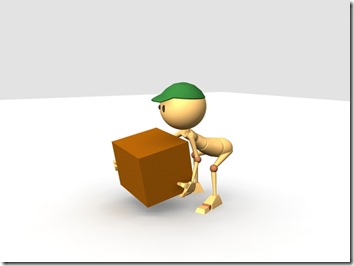
This is the first week of working on this exercise, so the only thing (and I’m going to be speaking in first-person plural) we’re going to worry about for now is getting some nice strong easy-to-understand storytelling poses for the shot, as if the shot was going to be told in comic book form.  We won’t even worry about timing yet.  I’ve already shot some video reference of myself picking up a box, and drew some horrible-looking sketches of the poses I think I might want to capture:

sketch1sketch2

(By the way, when shooting video reference for something like this, you must use a truly heavy box.  If you’re only pretending a box is heavy, your weight won’t shift realistically.  When you pick up a heavy box, you shift your weight to stay in balance.  If you shifted your weight that much with a box that is actually very light, you would fall down and go boom.)

OK, so we have nine poses there.  That should work nicely, yes?  There are some balance issues with a few of those (I’m not a great 2D artist), such as the last two, in which the feet are displaced too far in front of the hips.  But oh well!  Just as long as we don’t make those same mistakes in 3D.  I might another pose between the last two with him lifting up his front leg to help him get a grip on the box while he slides that front hand forward.  I had it in the video reference, but it didn’t make it to my sketches for some reason, but it could add some extra believability.

Here’s what we’re starting with:
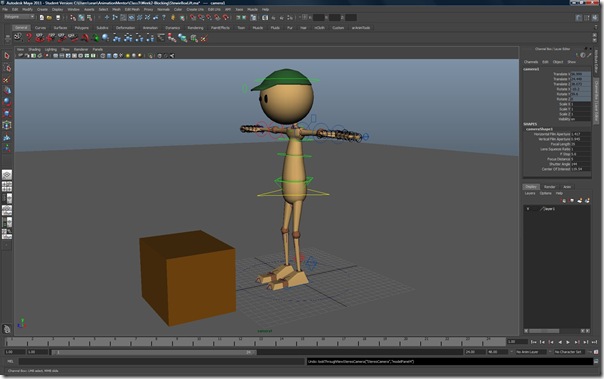
blocking1

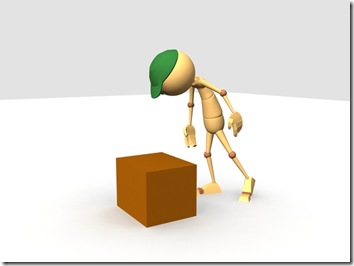
Our character in his T-pose.  Boring.  But I added a green hat and a brown box.  Maybe he works for UPS and this is his last shipment of the day.  He’s tired, but he’s happy this is the last piece of work for the day.  And it’s Friday and he gets the weekend off, so in a way he’s even a bit excited.  I also moved the camera to a bit more of an angle so it’ll be easier to see both legs at the same time.

OK, pose #1.  He’s looking down at the box, slightly hovering over it, getting a quick idea of its size and shape.  Oh, one thing we need to think about is whether to IK the spine or not.  In my last class, I always did; it just seemed to make animating something like a back flip or a quick slip easier.  But here we know we’re going to have our box resting right on torso by the final few poses, so the spine will really have to bend around the box.  So, for this shot, I think we’ll keep the spine in FK.  Besides, I should get some practice with FK spines anyway, yes?

OK, here’s what I got:
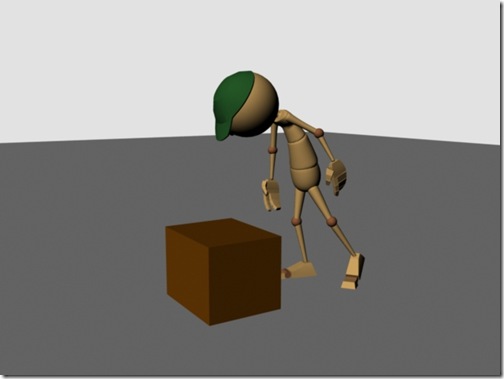
pose1

We’ll change the lighting and the exact camera framing later (the shadow on his spherical head look terrible and hides his eyes).  The front hand was hard to place; for the sake of an easier-to-read silhouette, I’ve placed it farther back and a little more outward than someone in real life probably would.  Other than that, I think it’s OK for now.

Pose #2 is quite a change.  His feet come forward, he bends way down, and he places both hands on the box, preparing to tilt it forward to see how much it weighs and to get a grip underneath the box.  But for pose #2, he’s just putting his hands on the box; he’s not yet applying any force to it.
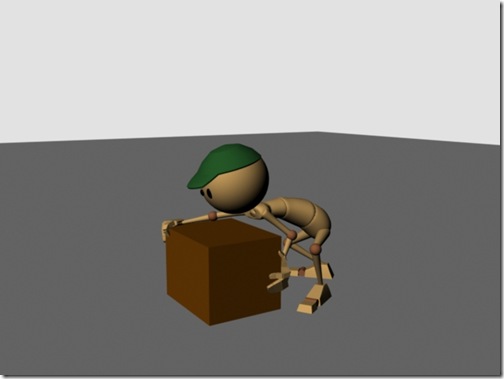
pose2

This was a difficult pose because the guy gets into such a little scrunched up form, yet we still want the position of the arms and legs to be clear.  It’s posing a form like this that really makes the character’s wacky geometry noticeable. His arms really are barely long enough to be wrapping themselves around a box that size, and he has to tilt his big old head way up there to prevent himself from smashing into the box.  (I could’ve just changed the box’s size easily enough, but I wanted to treat this shot as if I had been assigned it in a feature film and did not have that option.)  In my sketches, I had the hips much higher in pose #2, but here Stewie (as the character is called) has to have his hips farther down so that the arc of the spine can look OK without Stewie’s head going into the box.  The back leg is a challenge because we want its position to be clear, yet there’s so much stuff in front of it that can block it and intersect with it.

Pose #3 is very similar:
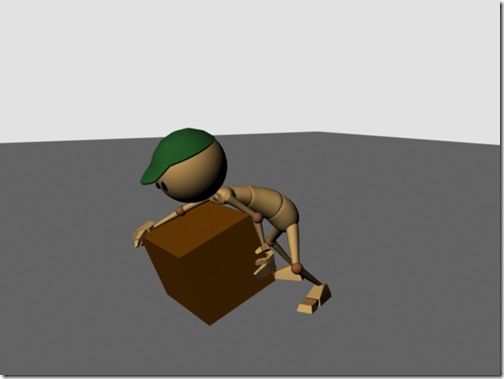
pose3

As we can see, the hands stay mostly the same (I did move the fingers around just a bit, especially the thumbs).  The back foot comes forward.  The hips go up and tilt up so that Stewie does not hit himself in the chin while tilting the box forward.  The back arm is kept straight.  Hopefully this will look much better with lighting so we can get some shadows on the ground.

Pose #4 mainly consists of Stewie shifting his hands.  He’s not yet lifting the box, but he’s preparing to.  The box is now tilted forward, so he can slide his front hand down to the bottom and wrap his fingers around the edge.  The back hand will slide to the other side, out of view.  While we’ll have to worry about that back hand’s position for the sake of the section of the back arm that the audience can see, we won’t have to worry about it’s rotation or the curl of the fingers; they will be invisible, so who cares?
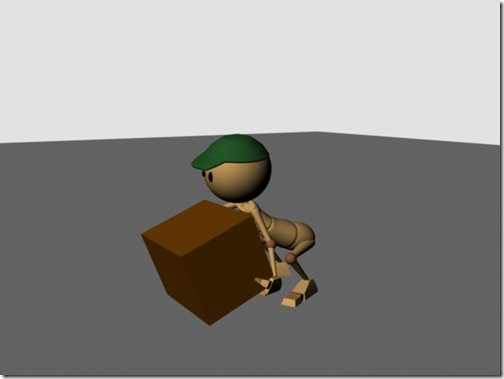
pose4-5

Pose #4 and #5 are really combined here.  The original intent was to have pose #4 show mostly just the hand shifts, and pose #5 would show the downward movement of the hips.  But due to Stewie’s wacko anatomy and short arms (compared to the size of the box), he has to move his hips just to be able to reach the bottom of the box; he can’t shift his hands without moving hips.  This is obviously going to be sheer torture to animate!  I originally also wanted to keep his spine in the same sort of curve as the previous poses, but that would case his head to go through the box, so his spine is going to have to change curve directions for this pose.

As we can also see, the back arm is completely hidden from view, except for just the very upper part of it, which we can see attached to the shoulder, so the placement does matter, though the curling and rotation of the fingers does not.  I’m also cheating with the arm; it’s actually intersecting with the box.  But it’s out of view, so who cares?

The back foot and leg was also quite tricky.  We don’t want them completely hidden from view, yet there’s hardly any room to show them.  I think what we’ve got here might work, but I’m still not 100 percent happy with it.  What other solutions are there?  I’m not sure at the moment.

OK, on to pose #6.  This will be fun; Stewie is now actually lifting the box.  We will have to shift his hips back to keep him in balance.  His hands will pretty much be in the same position, though perhaps we can shift the front hand forward a bit for a better grip.
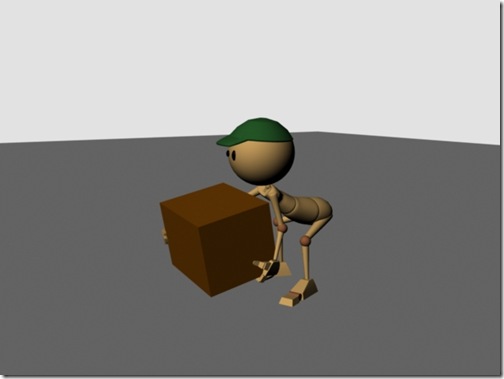
pose6

OK, so he only shifted his hand a little.  And I curled the very end of his back hand around the back edge of the box, so you can just see it.  A nice touch, perhaps?  Or perhaps it makes his arm look too long on that side?  Eh, we’ll leave it in for now anyway and we’ll see what my mentor says.

At first glance, this pose looks so similar to the last one, you might think it was quite simple to pose.  On the contrary; I found it the most difficult to pose yet, for two reasons: firstly, Stewie’s anatomy is just too small to pick up a box that size.  If you see the pose from another angle, you’d realize how much cheating is going on just to get that front arm to look OK and not intersect with the box.  That back arm is going almost completely through the box, and, as you can probably see by the position of Stewie’s shoulders, Stewie is really standing to the front side of the box.  Who would ever pick up a box like that?  Secondly, getting the balance right took forever.  We really have to do it by eye, and it’s almost like trying to draw a perfect circle; it always seems to look just a bit off and you feel like you could just sit there and tweak it forever.  A little back, a little forward, no, back again, a bit to the side, etc.  On and on.  It is easy to go mad.  At a quick glance, I think what we have here is at least good enough to move on to the next pose, but part of me still feels like something is still a bit off, still a bit out of balance.  Oh well; we do have a due date, so let’s move on.

Oh, I also don’t like the position of the back foot and leg; they are too hard to see.  However, I didn’t want to move the feet at all for this pose; Stewie is picking up the box, after all.  I can’t imagine someone one change his footing too much as he’s just starting to pick up a box.

Again, getting some light and shadows in the final renders should help; right now it’s difficult to tell how high he’s lifting the box.

Here’s the pose from another angle, showing all the cheating being done:
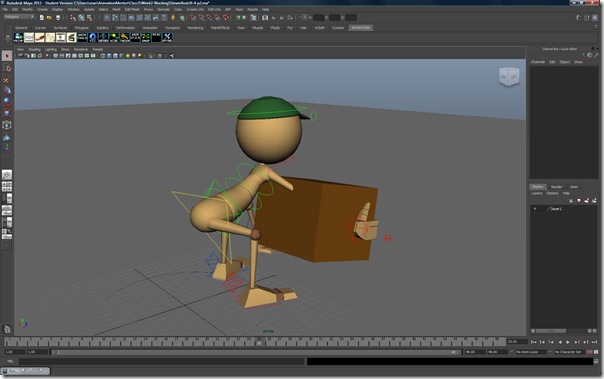
otherview

Yikes!

OK, on to pose #7.  The trick with #7 is that Stewie has lifted the box up past his waist.  In our last pose, Stewie is lifting the box with his arms and spine the most; in pose #7, he’ll be using more leg power to stand all the way up again, but he’ll also be changing the direction of the curve in his spine and using his arms to the bring the box in closer to his chest (so that, obviously, it will lean on his chest, and he’ll be thankful he’s not a woman).

pose7

This pose wasn’t quite as time consuming, but the balancing act was still tricky, and I’m still not sure I’ve got it quite right.  I also rotated the front foot out a bit to make the outline of the leg clearer, plus a foot between those two poses might add a touch of believability to the animation.  Similarly, I moved the back foot forward a bit, so that the leg didn’t look so much like it was coming out of the hand.  We still want to keep Stewie balanced, so there’s only so far we can move the foot like that, obviously.

Again, there’s some major cheating going behind the front of the box there.  Perhaps next week we’ll take out the tiny portion of the back hand that’s visible; it looks like he might need to have that hand on the bottom of the box at this point, instead of way over there.  But I’m not sure.

My favorite thing I did here was to lower that front shoulder and tilt it towards the camera a bit; it really makes it look like Stewie is putting some effort into keeping that side of the box up, which could be some good setup for pose #8.  It gives the tiny portion of the back arm some room to be seen, and helps make the outline of the front arm more visible.

All right, I think only two more poses are really needed.  In pose #8, Stewie will have his back more straightened out, really standing up as tall as he can with such a large object.  But to help him get a better grip with his front hand, he’s going to bring his front leg up a little and let the box rest on it just for a second so he can shift his arm easily.  Which means – a one leg balancing act.  Oh boy.  Ugh.

pose8

The invisible hand behind the box is really way out there.  Perhaps next week I will use FK on that back arm; we really just need to control how that little upper portion of it that’s visible looks, and doing it with IK means animating the upper arm by animating the hand, which could become frustrating.  Also, if we light this scene, our messed up hidden half might show in the shadows.  But we won’t worry about that this week, I suppose.

So there’s our pose #8.  The box is really close to Stewie now, he’s really brining it in close.  In my original sketches, I had planned to have Stewie hold the box from the outer bottom corner, but his arms are just to short, and stretching them looks ridiculous.  So instead I think we will have Stewie hold the upper part of the box, more like he is now, but we’ll try to straighten out his arm if we can.  I hope it is clear what Stewie is doing: bringing up his leg to help shove upwards so he can get the box into his final grip so he can carry it somewhere (good thing I’m not animating him walking with the box – yet).  It’s pretty nice having that back hand completely hidden and not having to worry about it, yes?

OK, one more pose.  In pose #9, Stewie will be in his final position, the box firmly resting on his chest, Stewie leaning back a little bearing the weight and ready to walk around with the package.

pose9

As always, the balance was tricky to get, and every time I look at the pose from a different angle, it feels just a bit off balance somehow.  But you have to stop tweaking eventually.  Here we’ve got a straight in the front arm, just like I wanted, running across the top edge of the box, something I didn’t exactly plan for, but I think it will work since Stewie’s arms are too short and my box is too big for Stewie to the reach the opposite corner.  As you can see, we also have Stewie’s fingers from his back hand just barely visible on the underside of the box.  Stewie’s spine is mostly straight and leaning back, so Stewie is bearing a lot of weight on his chest.

And – I think that’s pretty much it!

Finally, let’s render those eight poses with mental ray.  It takes longer to render, but it can put in some simple shadows we couldn’t get before.  (And we don’t even have to set up lights, woohoo!)
mr-pose1mr-pose2mr-pose3mr-pose4-5mr-pose6mr-pose7mr-pose8mr-pose9

Hmmm.  That white ground with the green hat and brown package makes him look more like an elf.

And that’s it for this week!  Hopefully I’ll continue to blog like this as I continue my assignments, but who knows.  I’m often busy and tired.

Computer plays Jeopardy, but does not know how to love

According to this article on Engadget:

So, in February IBM’s Watson will be in an official Jeopardy tournament-style competition with titans of trivia Ken Jennings and Brad Rutter. That competition will be taped starting tomorrow, but hopefully we’ll get to know if a computer really can take down the greatest Jeopardy players of all time in “real time” as the show airs. It will be a historic event on par with Deep Blue vs. Garry Kasparov, and we’ll absolutely be glued to our seats. Today IBM and Jeopardy offered a quick teaser of that match, with the three contestants knocking out three categories at lightning speed. Not a single question was answered wrongly, and at the end of the match Watson, who answers questions with a cold computer voice, telegraphing his certainty with simple color changes on his “avatar,” was ahead with $4,400, Ken had $3,400, and Brad had $1,200.

This is kind of interesting because what makes a computer good at Jeopardy is the opposite of what makes a human good at Jeopardy.

A computer can easily store vast amounts of data, but cannot so easily process human language.

A human can easily understand language, but we can’t easily store vast amounts of data. After all, the entire point of Jeopardy is not understanding the question, but knowing data that most humans don’t use in every day life.

So I think the real achievement here is in language processing — being able to output a specific answer based really only on an incoming string of letters (or maybe sound waves).

It’s easy to understand how such an achievement could be useful: imagine being able to type a question into Google and getting a direct answer (or at least a direct guess) instead of just a bunch of webpages that make you search for the answer yourself. Even though searching for the answer yourself doesn’t always take that much time, getting a direct answer would be much more convenient. Or imagine being able to speak a question into your phone or your car’s dashboard while driving, when you can’t browse the web without risking death, and having it speak back a direct answer. Imagine being able to cheat easily while you’re playing trivia games with your friends who are judging your intelligence and value as a friend based on how many useless random things you know.

While this would be nice technology for us to have, it still doesn’t have the power to create so much, does it? When will we have computers that can formulate their own sentences? That can write metaphors? That can write entire books? I guess we’re still too far away from that…

Anyway, if the computer wins, I say it should take over Alex Trebek’s job. I mean, what does he get paid for anyway? He just stands there and reads stuff. Computers can already do that. And besides, he still has his life insurance spokesperson job to fall back on.