Some new music…

I posted my latest composition on YouTube recently, a short piece I simply call Melody for Harp and Piano, Opus 66:

The beginning of the main melody was inspired by the beginning of Tchaikovsky’s famous piano concerto, though the motif is popular in a lot of film music as well (the famous theme of Dragonheart especially). I also uploaded a score to the piece here. (Make sure your right foot is bare before attempting to perform the piano part.)

I added this piece to my MP3s page, where you can also find a boring lullaby I wrote for harp and vibraphone in the month of December of 2011, appropriately called Lullaby for Harp and Vibraphone, Opus 65.

Movies watched in May 2012

Here are the films I watched in May 2012.
cronos

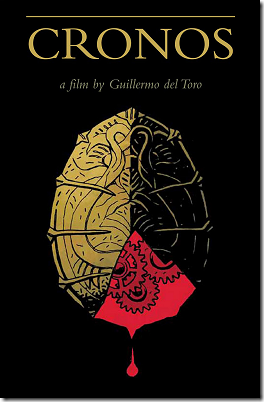
Cronos

This 1993 film from director Guillermo del Toro is a bit of a “vampire origin” story.  An old man stumbles upon a “Cronos” device, an immortal-insect powered machine made by a 16th century alchemist.  When someone uses the device by filtering his blood through it, he becomes immortal, and quite vampire-like (he wants to drink blood and stay out of sunlight, for example).  It’s classified as a “horror” movie for its definite horror elements and visuals, but at its heart, like del Toro’s Pan’s Labyrinth, it is really a fantastical drama; the horror elements are not there simply for their own sake.  Fun movie, even while some of the visuals were definitely quite repulsive.
bladerunner

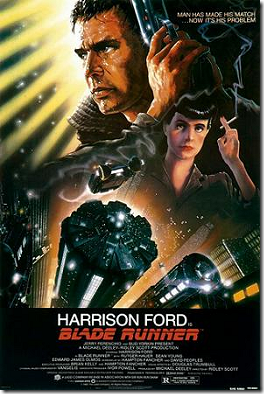
Blade Runner: The Final Cut

I had never seen this 1982 Ridley Scott sci-fi film all the way through before, and the pieces I’d seen on TV were from the theatrical “narrated” version which I couldn’t stand.  The narration was poorly written, poorly performed, unneeded drivel.  So I was happy they made a version without the narration.  It’s certainly a visually stunning film, a very engaging world of night with smoke and rain and neon signs.  The pre-CGI special effects are remarkable.  Unfortunately the story itself was too loose for me; Deckard, as performed by Harrison Ford, needed more personality and drive for his replicant-murder quest.  And the theme of wondering what it means to be human by pondering the nature of replicants is just not a very interesting philosophical question to me; I’ve already thought about it too much myself for such a film to engage me with such philosophical predicaments.  But I can understand why the film seems so iconic.

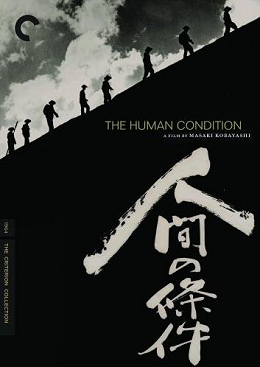
human

The Human Condition – No Greater Love

This 1959 Japanese film is the first installment of an epic trilogy (based on Japanese novels) directed by Masaki Kobayashi.  This first film tells the tale of Kaji who is sent to supervise a prison camp where prisoners are forced to work in mines.  Kaji works to overturn the injustice he finds there, but meets very few who agree with his moral positions.  The roller coaster of drama often makes the 3-hour film feel more like a TV miniseries than a self-contained story, but it is fantastic.  A great story with great acting and constantly gripping conflict.
ivan

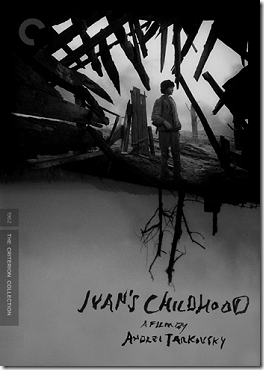
Ivan’s Childhood

This 1962 tragic Soviet film from director Andrei Tarkovsky tells the story of a child named Ivan (who woulda thunk?) who is orphaned by the tragedies of World War 2 and can no longer stand to merely wait on the sidelines.  So he joins Soviet army doing reconnaissance missions as they battle the Germans.  The film features great cinematographic composition, great use of sound (when the sounds and visuals don’t match, but you can tell what the film is “saying”), and great acting.  The story seemed rather sparse to me, which can sometimes be disconcerting for my American-ized tastes, but I think it was purposefully done in this case in the effort of making the film seem more like a bundle of distant childhood memories than a clear-cut this-then-that sequence of events, and from that point of view it is successful.
pirates

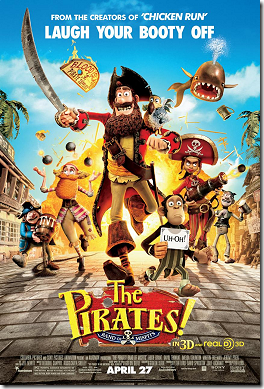
The Pirates: Band of Misfits

This 2012 animated feature from Aardman Animations provided some great light-hearted fare after watching those somewhat depressing black-and-white war films.  A glimpse at some non-CGI animation was also quite refreshing, as characters do not move and arc through their motions in the quite the same way.  I love the way stop-motion can feel so much more tangible than CGI, like toys come to life.  While the story itself was a bit too light-hearted for me (The Pirate Captain wants to win the “Pirate of the Year” award – don’t mind me if I can’t quite relate to the gripping conflict that implies), I loved the wild ridiculous humor of it all, and the storytellers did form a well-structured cohesive story out of it.  I had feared the humor would be too cheesy and childish for me.  Some of it was, but some of it was hilarious, and I found myself laughing out loud.  (Though the row of seven or eight children behind me did have some pre-show commentary, such as “The movie is starting!”, I became too engaged in the story of the Pirate Captain to notice whether or not they laughed at all.)  (And I had to laugh at how they changed the “leper-boat” joke to a “plague-boat” (with obvious lepers) joke.  Because you don’t want to offend lepers in a stop-motion film.  Heaven forbid children grow up to be anti-leper, having been encouraged by their youthful watchings of an otherwise harmless animated pirate movie!)  Overall, quite a fun movie.

spartacus

Spartacus

The classic 1960 film from Stanley Kubrick of course tells the tale of the slave Spartacus as he leads an unsuccessfully slave rebellion in the days of ancient Rome.  Despite some rather cheesy fight scenes, love scenes (characters might as well have just said: “You can tell how much I love you by the background music and the twinkle in my eye!”), and effects (bright red paint = blood), the story was great and I highly enjoyed it.  One of the ending scenes very much reminded me of an ending scene in the book The Hunger Games, but seemed much more authentic in how the characters ultimately responded.  Great film.

human

The Human Condition – Road to Eternity

Kaji’s adventures (if they can be called such) continue in this second film from the aforementioned trilogy.  In this film, Kaji is sent to join the army itself.  If he thought things were bad in the prison camp, the army isn’t much better.  This one reminded me a bit of Kubrick’s Full Metal Jacket, in how superiors sometimes treat soldiers so inhumanly and slave-like, it is a wonder any war was able to be fought at all.  I don’t know my history, so I don’t know how much these movies compare to their real-world counterparts, but in terms of questioning the moral obligations of a man in such situations in the context of a story, this film (not Kubrick’s film) does a great job.  Great film.

nausicaa

Nausicaa of the Valley of the Wind

Another animated film from Studio Ghibli and director Hayao Miyazaki, this one from 1984.  This film tells the story of Nausicaa (which looks too much like the English word “nauseous” to me), who is the happy and well-loved princess of a happy community living in the “Valley of the Wind.”  The princess and her happy people live in a world full of evil toxic chemicals that have made certain areas of the world toxic.  Invaders invade the valley, seeking to grow a biological weapon (a “giant warrior”) in their valley which they hope will destroy the toxicity with fire most powerful, but what if it does more harm than good?  Who will save the day?  A pretty princess!  Overall, this one left me scratching my head.  I didn’t understand characters’ motivations, the overall plot seemed too all-over-the-place, and I tend to be annoyed with unauthentic depictions of young royalty being so naturally well-loved by royal subjects.  The depiction of believable fantasy cultures, however, was quite fun.

road

Road to Perdition

This 2002 crime film from director Sam Mendes takes place in the 1930s.  It tells the story of Mike Sullivan (an Italian – just kidding) who works for a mob boss.  When his mobbish ways indirectly get his wife and son killed, he and his surviving son set out for justice/revenge.  (Not sure the line between the two is very easy to distinguish when both parties have already denied certain moral standards.)  A tragic but great film with a wonderful score by Thomas Newman and incredible cinematography by the late master Conrad Hall (who won an Oscar for it).  I had heard someone describe the film by saying “every scene is like a painting” and it’s true.  I especially love the scene in which Mike’s son (Mike Sullivan junior) is spying on his father through a hole near the floor and we watch the scene play out from his perspective.  And the scene in which Jude Law’s character is walking towards the camera and the camera moves closer and zooms out creating the effect of the world warping around him (opposite of the camera moving away and zooming in, popularly used in Goodfellas).  And the scene is which it’s dark and wet and rainy and we still see wonderfully defined silhouettes of mob men as they walk to a dark car before meeting their dark fates.  Worth watching for the cinematography alone.  Great film.

once

Once Upon a Time – Season 1

Not a movie, but I put TV seasons in here too.  Once Upon a Time tells the story of Disney-fied fairy tale characters who are somehow “cursed” into the modern world in an act of revenge, and the only one who can break the spell is Miss Swan.  (Not the MADtv character, which would’ve been more interesting.)  I’m not really a fan of “fairy tales in the modern world!” concept, as I don’t think retelling a story in a different setting is at all creative, but fortunately Once Upon a Time doesn’t quite do that; it simply remakes the fairy tale characters into modern counterparts.  I still found the writing to be a bit too simple, but it seems to be a much more family-oriented show than anything else on TV at that timeslot on a major network.  Disney versions of fairy tales always seem to have something annoyingly unauthentic about them, and the romances in Once Upon a Time are no different.  Still, I find it very interesting to see the storytellers playing with the fantastical elements they’d probably otherwise stay away from; like the cancelled fantasy show Legend of the Seeker, I find these shows inspiring from a storytelling point of view; for me, there are often little nuggets of ideas my story-plotting mind can play with, even if the stories I steal them from aren’t completely engaging.  You know what I mean?  So I’ll keep watching for Season 2.
fringe

Fringe – Season 4

This season of Fringe was not quite as strong as previous seasons have been, but I think it’s because the producers made the over-arching story too complicated and are now trying to answer questions before the series ends with Season 5.  I appreciate that they’re trying to answer questions before it’s too late, but I wish they wouldn’t have made the over-arching story so complicated to begin with.  Now they are paying the price.  It’ll be interesting to see how the series ends, but I think Season 3 was the overall strongest so far (though that animated episode from Season 3 was absolutely awful).
House

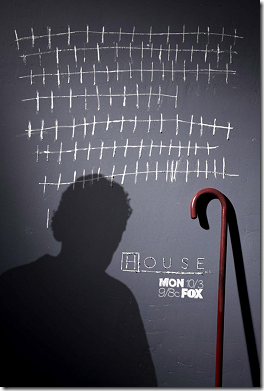
House – Season 8

I will miss House.  The last season managed to stay strong despite Cuddy disappearing.  I didn’t much care for the final episode.  It was nice to get the dead characters back, but in the end they raised the stakes so high that the final “joke” was just yawn-inducing.  Overall, though, great season, great series.

judgment

Judgment at Nuremberg

This 1961 film directed by Stanley Kramer tells the story of judge Dan Haywood (played by Spencer Tracy) who travels to Germany after the fall of the Nazi regime to act as a judge in the Nuremberg trials, meant to judge the German judges for crimes against humanity during the Nazi regime.  The film does not try to show how and why racism and the Holocaust were evil (we all know that).  Rather, the film lets us question the role of these German judges.  We know they weren’t saints, but they didn’t directly even know about the Holocaust themselves, so were they that bad?  How bad were they?  For a moment, I was half-afraid the judge was going to make the wrong decision.  Great film.  I especially loved the last lines.  Ernst Janning was one of the judges on trial.  He begs Haywood, the judge, to believe him when he says he didn’t realize so many millions of people would be killed:

Ernst Janning: Judge Haywood… the reason I asked you to come: Those people, those millions of people… I never knew it would come to that. You must believe it, you must believe it!
Judge Dan Haywood: Herr Janning, it came to that the first time you sentenced a man to death you knew to be innocent.

french

The French Connection

I’m tempted to say the real “French connection” was the influence of that handheld camera look that was popular with French filmmakers near that time, but it was based on a book, so probably not.  Anyway, this 1971 crime film tells the true (but fictionalized) story of two police men who uncover and stop a large drug smuggling.  Fun movie, especially with its famous car chase scene (the end of which is completely given away in the film’s iconic poster).

contraband

Contraband

This 2012 film starring Mark Wahlberg tells the story of a ex-drug-smuggler who’s forced back into the world of smuggling to get his family out of danger (which his brother-in-law’s crimes have put them in).  Fun movie.
double

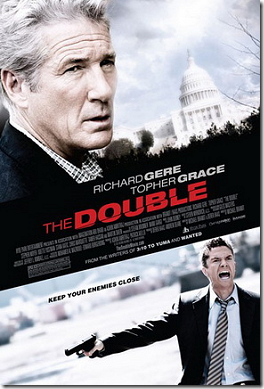
The Double

This 2011 film tells the story of an ex-killer who’s also a government agent investigating himself.  When a younger agent comes close to discovering his secret, he must return to his killing ways and try to find a way out of his deadly predicament.  Another fun movie.
pajamas

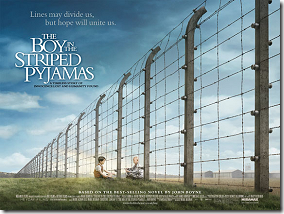
The Boy in the Striped Pajamas

The premise of this 2008 film was interesting.  During the Holocaust, a young boy, son of a Nazi official, befriends another boy in “striped pajamas” (or “pyjamas” for foreigners who favour spelling things wrong) – a prisoner in a prison camp who we know is doomed to die.  Some critics have complained that the film’s premise is simply too farfetched.  I can forgive the film that.  But I have three complaints.  Firstly, I don’t think the film explored nearly as many possibilities as it could have.  The film seems to draw (or try to draw) most of its emotional power from us, the audience, already understanding in retrospect how tragic the Holocaust and Nazi racism was.  “Remember how bad the Holocaust was?  Yeah.  Feel that.”  The movie did little to try to create that emotion itself in terms of character relationships; instead we, the audience, must provide it by reminding ourselves how evil those Nazis were.  The film could’ve done so much more with the character relationships.  A wife who doesn’t like what she sees, but turns the other way.  A sister who convinces herself that because her father is a Nazi, Nazis must be a force of good.  A kid in a prison camp who doesn’t understand why he’s being considered an enemy.  The film hardly touched on any of these inner-character conflicts.  Secondly, I’m not sure I agree with this currently popular notion that children are never racists themselves, but are taught to be racists through parental or societal indoctrination.  If that were true, when was racism invented?  I think racism is an unfortunate byproduct of the ways in which humans naturally think (by categorizing things, and labeling things as dangerous, however prejudiced that may be).  In some ways, it is a survival technique (if someone has these traits, don’t trust them) that has become farfetched, irrational, and immoral.  But it can develop in children just as easily as adults; it does not need to be taught.  Lastly, the film just seemed too inauthentic.  Perhaps this relates to my first critique.  Because so many character elements were left unexplored, the characters were left displaying the simplest and most cliché emotions they were capable of, as if the line between good and evil during something like the Holocaust should be as transparent as a battle between a princess and an evil stepmother in a Disney cartoon.  And it’s a very strange combo when you try to mix the weight of tragedy of the Holocaust with the simple and clear morality of Snow White.  Judgment at Nuremberg did a much better job in this regard.  We already know Nazis were evil and the Holocaust was tragic; give us something deeper!  One last critique (with a SPOILER alert): at the end of the film, Bruno sneaks into the prison camp to help his prison friend Schmuel look for his missing father.  How the heck does Bruno think he can help?  How does he know what Schmuel’s father looks like?  It’s such a forced way to get Bruno into the camp that what ends up happening to Bruno completely loses any dramatic power it may have had.  Ultimately this film failed to live up to its potential.
gandhi

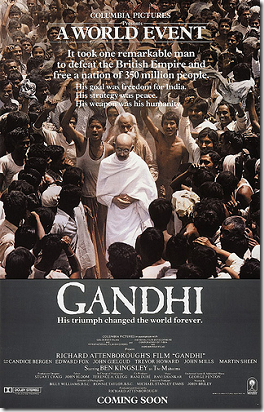
Gandhi

“They may torture my body, break my bones, even kill me.  Then they will have my dead body.  Not my obedience.”  This 1982 film from director Richard Attenborough truly spared no expense.  (I had to.)  It obviously tells the story of Gandhi.  While one film, even a three hour one, can only scratch the surface of Gandhi’s work, the film does a superb job of portraying “Gandhi’s best moments” while stringing together a coherent and engaging life-encompassing story.  While I thought Ben Kingsley looked rather odd in his Indian make-up throughout the film, his acting was (as it always is) pretty much perfect.  The cinematography, the writing, the music – everything came together wonderfully for this film.  While I don’t agree with all of the Gandhi’s philosophies (at least as they are portrayed in the film, or maybe I just misunderstand some of them), this was certainly a fantastic film (and it looks great on blu-ray).

Explorations in cinema shall continue, I hope.

Les Miserables teaser trailer

A teaser trailer for the upcoming film version of the popular musical Les Miserables came out recently:

My comments:

This is only a teaser, so it’s hard to know how representational these little glances will be of the finished product. I see some things I like, and some things leave me scratching my head.

We don’t get much in the way of music, which is too bad, since this will be a musical after all, but it’s only a teaser. I don’t like how I Dreamed a Dream begins with no instrumental accompaniment at all; it sounds empty. And even when the instruments do come in, the voice and the instruments just don’t mix right; the voice is too “small” as if she’s singing to herself in a small room. It sounds like it was amplified in post so that it would not be drowned out by the orchestra. (“But the tigers come at niiiii….” Pronounce your T’s, woman!) I hope this sort of recording is not representational the style of sound we’ll hear in the movie, or it will be truly awful.

As for camera work, some shots look fantastic and amazing, others look very bizarre. Wobbly documentary-style wide-angle close-ups look very odd to me if I don’t understand the shot’s context. (Is it a character’s POV? Is it part of a long shot?) I’m also not a big fan of the tilted camera, but, again, it depends on the context; the tilted shots featured in this trailer make me fear the camera tilt will be overused. However, the wide-angle shots panning the barricade, tracking people walking the streets, or looking straight down on the factory workers look brilliant. Regardless of whether or not all these shots will work in the context of the film, I think we’re in for a visual feast.

On ghosts

To believe in an objective difference between right and wrong (God and not God) implies the existence of immortal souls, spirits that exist non-physically, and continue existing even after the mortal physical body dies (naturally becomes unable to continue living in the physical sense). So, in this sense, ghosts do exist. We are, in fact, part-ghost right now, in the way that “ghost” means a non-physical spirit.

But, as humans, it is often tempting to “humanize” our understanding of the nature of immortal souls so that they are understood to exist as humanly as we do now, just without physical bodies, as if they’d float around the physical world and communicate with and/or frighten us physically living people.

This makes no sense. Think about the nature of truth; when something is true, its truth exists outside or beyond the physical constructs of space and time. Its existence is not dependent on a specific location or time the way that physical phenomena is. So it is with the difference between right and wrong, and so it is with God, and so it is with our immortal souls. When our souls separate from our physical bodies, they also separate from the physical constructs of space and time. We can understand this to be true even while it is currently impossible to understand what that sort of existence is like. But it does allow us to understand how the common notion of “ghosts as spirits wandering around the physical world” is at best a silly notion of spiritual ignorance, at worst a temptation away from God (truth).

So a lot of “ghostly phenomenon” does not pass the true-faith-in-God test. Ghost Hunters and such shows may be entertaining, but to truly believe them is to reject the true nature of God, whether it be for the corrupted desire for unnatural powers (that is, the desire to communicate with the dead; not because it can be done but is just dangerous (it can’t be done, but we can easily spiritually deceive ourselves into believing it can, like a spiritual placebo effect, through which we can credit perfectly natural mental abilities (such as talking to oneself) to ghostly activity), but because the desire for that sort of experience is not in union with a desire for God (love and truth)), or simply out of a spiritual misunderstanding of the nature of God and immortal souls (as opposed to the incomplete understanding of the nature of God we all naturally experience as part of our temporary physical existence).

That said, we know that God can interact with us in our physical existence through our non-physical spirits; otherwise we would be incapable of understanding that there exists an objective difference between right and wrong, and would be incapable of believing in Him. (I am considering our “sense” of God as a form of “interaction” — I do not mean to imply that God often physically moves things around in front of us to prove His existence to us — He obviously doesn’t — I do not think He would desire for our faith in Him to be based on tricks of changing the laws of physics, which would probably do more harm to us than good.) God must also, then, be capable of allowing, in proper conditions, the spirits of the physically departed to spiritually appear to or communicate with physically living beings for the sake of the spirit of the physically living (not for a ghost’s “unfinished business”). It is also important to note that, when this happens, it happens through and with God; it is not some departed spirit acting of its own volition, and it is never done in response to a living being requesting or desiring such contact, which, as I stated before, is a spiritually disordered request.

Guillermo del Toro on children in horror stories

cronos2

I recently saw the 1993 film Cronos directed by Guillermo del Toro (director of one of my favorite films, Pan’s Labyrinth).  Re-watching the film with the director’s commentary, I thought what he said about children in his horror movies was particularly interesting.

I also like what he says about the “innocence” of childhood.  I can’t remember if I’ve mentioned it on this blog yet or not, but I am not a fan of the phrase “the innocence of childhood” as if children can’t be guilty of something just because their worldview might be more inexperienced.  (Similarly, I don’t like the phrase “coming of age” – as if there exists a psychological transition from childhood to adulthood that’s as radical or as clearly defined as puberty, or some other cultural rite-of-passage.  But that’s a different subject.)

On an unrelated side note, I didn’t realize until re-watching Cronos that the child in the movie only has one word of dialog, and is completely silent throughout the rest of the film.  For some reason, I didn’t even notice this at all in my first viewing.  Weird.  I guess that’s a testament to how well her emotions and thought processes are captured without dialog, which I think is a sign of masterful filmmaking.  Or it might be a testament to how completely oblivious I can be.

Anyway, here are the words of Guillermo del Toro:

I love children in horror stories.  Why?  Because I think that the horror tale, or the horror genre, is a logical continuation of the fairy tale.  The fairy tale was, in its origin, a very moralistic tale that was usually done to teach children principles of behavior.  They would be told that if they wondered alone in the woods they would be punished by having a witch try to boil them and eat them, whatever… that if you were lazy and you didn’t build your house of bricks, in would come a wolf that would tear it down… and all these moralistic principles.

Out of which came a far more fantastic, for more anarchic type of fairy tale where, by product of these moralistic lessons, that children became main characters.  They were given their own subgenre.  And out of these fantastic creatures I believe came a branch where the witches and the ogres and the goblins became more and more central to the story and became actually horror tales.

And in these horror tales, if you are going to talk about the darkness, it is central that you talk about the purity.  I’m saying "purity" and not "innocence" because I don’t think children are innocent in the moralistic way they are viewed.  I think that children have a very complex emotional component.  I remember my incredibly troubled first seven or eight years as being an incredibly rich landscape of angst.  I jokingly say that I was seventy by the time I was seven, and now that I’m thirty-eight, I’m finally getting to be young because I suffered so much as I kid, my mind was an ever-boiling little inferno.  And I try to do kid characters that react and interact with the horror stuff in a different and more complex and more natural way than the adults.

I think that children have this powerful possibility in horror tales to be sort of a white center of purity in the middle of the tale.  They are not only the greatest witness, but also the greatest access for the human spirit.  They really root the tales in humanity.

Movies watched in April 2012

Continuing my explorations in cinema, here are the movies I watched in April 2012:

intime

In Time

Being a fan of Andrew Niccol’s previous work, The Truman Show and Gattaca, I was looking forward to seeing this movie from 2011.  In the future, humans have figured out how to stop aging.  But to prevent overpopulation, artificial limits are put on a person’s lifespan, and time left to live becomes a trading commodity, replacing money.  The poor die young while the rich can live forever.  Like Niccol’s previous work, the movie featured wonderful writing, good acting, and an engaging story.  Great film.

cinematographer

Cinematographer Style

Thought I might learn something about cinematography with this DVD from 2006, though it’s just a bunch of talking heads.  Absolutely no examples from actual films at all.  Still, some of the interviews were very interesting, especially the ones with Vittorio Storaro and Gordon Willis.

sundancekid

Butch Cassidy and the Sundance Kid

I had seen a bunch of bits and pieces of this film since it’s so iconic, but never saw the whole thing until this past Easter Sunday.  And it definitely lived up to its iconic status; I loved it.  Great mix of humor and tragedy.  And of course the “Raindrops Keep Fallin’ On My Head” song is insanely catchy.  Though I was familiar with the song previous to watching the film, the spirit of the film and the song match so well, watching the film makes the song even more catchy.  The blu-ray also featured some great commentary tracks and a deleted scene (with lost audio) in which Butch and Sundance watch themselves get killed on a newsreel in a theater.  I don’t know why they deleted it; I think it would have fit wonderfully in the film.

kundun

Kundun

This 1997 film by Martin Scorsese tells the tale of the Dalai Llama.  I guess it was educational.

titanic

Titanic 3D

I was curious to see how James Cameron’s insanely successful film from 1997 would look in 3D (I love 3D), and it was an extremely impressive conversion.  I can’t imagine all the insane amount of work that must’ve went into it, but it was hard for me to tell it was a conversion.  The only scenes that looked a bit odd were the ones in which a night sky full of stars was the backdrop.  It just looked too close to the foreground, as if the actors were acting in front of a poster-board with stars painted on it.  It did not look like the stars were far in the distance.  As for the story, I had never actually seen the first half of the film, didn’t know anything about how Jack got on the ship or what the story with the jewel was all about.  Geez, that romance was corny corny corny.  Is that really the sort of guy women want?  Bleh!  Oh, and of course every time I saw the captain I thought: Theoden King!

realsteel

Real Steel

This film from 2011 tells the story of an alienated father and son trying to find a way to relate to each other through the training and fighting of giant boxing robots.  The story is based on an old sci-fi short story, not the boxing head-popping robot toys.  The special effects were amazing, and it was refreshing to see a heartfelt story behind the action.  Fun popcorn movie.  But they certainly didn’t explore all the possibilities the premise of fighting robots could provide; it will be interesting to see if they create a sequel or not.

startrek

Star Trek

I hate Spock.

godfather2

The Godfather: Part 2

I very much enjoyed this famous 1974 sequel.  Again, I had seen many bits and pieces of the film before, but never the whole thing all the way through.  It was a great film; one of the few sequels better than its predecessor.

burnnotice

Burn Notice: Season 3

OK, it’s not a movie, but I have been watching Burn Notice DVD’s lately, and recently finished Season 3 from 2009.  Great show.  I’m too behind to watch it on TV, but I’ll keep watching the DVD’s when I can.

totoro

My Neighbor Totoro

I’m continuing to catch up on Studio Ghibli’s famous films, essential viewing for animation fans.  This film tells the story of two sisters who discover magical creatures in the woods behind their house who help them, in a way, cope with their mother’s illness.  Great film, full of a believability and spirit you don’t see in many of today’s animated films that are instead full of pop-culture reference gags.  (Though I still enjoy a good pop-culture reference gag.)

warhorse

War Horse

This Spielberg film from 2011 tells the tale of a horse who is “recruited” for war while the boy who raised him wonders whether or not he’ll ever see him again.  A great movie for people who think horses can feel human emotions.  I myself must admit that I am a blatant equusist; I am prejudiced against horses.  I don’t think they can have human emotions.  So it was very hard for me to relate to the horse’s war struggles.  I certainly don’t think there’s anything wrong with a human loving an animal (I know I quite loved my dear dead dog Patches), but I don’t like the idea of love for an animal being romanticized on the level of intra-human love in the context of a film’s story.  Does that make sense?  It’s a similar problem I had with Spielberg’s A.I.; I just couldn’t feel a relatable emotion with a little robot kid who doesn’t have real emotions in the first place.  And in War Horse the Germans, of course, spoke English with accents during the war, don’t you know?  Because Heaven forbid an American should have to read subtitles!

kagemusha

Kagemusha

This Kurosawa film from 1980 tells the story of an impersonator who replaces a dead emperor during dangerous times as old Japanese kingdoms battle each other.  After watching Kurosawa’s Ikiru a couple months ago, it was nice to see a film of his that was more epic in scope, and Kagemusha did not disappoint.  Great film.

visionsOfLight

Visions of Light

This documentary from 1993 about cinematography actually had examples from movies!  Woohoo!  Great stuff, but it still wasn’t as educational as it could’ve been.  It would be nice to see a documentary in which a cinematographer actual goes through the steps he takes to make his creative decisions instead of just looking at a bunch of final products and saying how good they are.  Still, this DVD was educational and even inspirational.

becket

Becket

This 1964 film tells the story of Thomas Becket (played by Richard Burton) who is friends with King Henry II (played by Peter O’Toole).  The King appoints Becket to be Archbishop of Canterbury in hopes that, because they’re friends, he’ll have a bit more control over that position.  But Becket ultimately has different religious beliefs than the King, and their friendship begins to rip apart.  Though some of the film feels a little dated and fakey by today’s standards (nice cardboard crown there, Henry), the story was engaging.  I didn’t think the writing was so great; the characters seemed too blatant about their emotions, and too long-winded when it came to expressing them, like some classical play.  But I guess that’s because it was adapted from a play.  But with a film, I think you can show an emotion much more effectively just by a look in a character’s eye, the way the shot is framed and colored, and what sounds accompany the picture.  No need to say anything sometimes.  But Becket won the Academy Award for Best Adapted Screenplay.  Heh.

towerheist

Tower Heist

This movie from 2011 tells the story of a guy who works in a tower.  A bit like in Fun With Dick and Jane, his boss is arrested for something scammy, and it seems the guy and his working pals who had all their savings in the boss’s company may now go bankrupt.  So they decide to break into the boss’s apartment, find where he’s hiding all his money, and steal it!  The humor was a bit hit or miss for me (some of it seemed too forced), but overall it was quite funny.

casablanca

Casablanca

I had never seen this classic film from 1942 before.  Still, I knew many of the famous lines.  And maybe that’s why they didn’t quite work for me.  I had heard the famous lines so many times before, it felt like they were just being recited.  Overall, it was a good well-written movie, but I don’t know why it became such a huge classic hit.  I didn’t think it was that incredible.

castle

Castle in the Sky

Another Miyazaki film from Studio Ghilbli, this one from 1986.  The movie tells the story of a boy and a girl with a strange magical necklace thing who set out in search of a legendary floating island called Laputa.  I think I would enjoy any adventure film with castles and airships; they really set off my imagination.  So far, of the ones I’ve seen, this is my favorite film from Studio Ghilbli.  Loved it.

moviesold

The Greatest Movie Ever Sold

This documentary from 2011 was weird.  It was supposed to be about the product placement in movies.  But the filmmaker, Morgan Spurlock, decided it would be neat if the documentary itself was funded entirely by companies in exchange for product placement.  The result was a rather empty film.  It was like an ad that just advertises itself.  What’s the content?  The content is the ad itself!  Er, OK, what?  The pitch meetings were interesting to watch, but the documentary as a whole didn’t make much sense to me.

raymond

Exporting Raymond

This documentary from 2010 follows Phil Rosenthal, the creator of Everybody Loves Raymond (one of my favorite sitcoms), as he travels to Russia to help them adapt his sitcom for their country.  Hilarious film, and very interesting to see how the TV business works in Russia.

So that’s, what, 19 this month?  Movies rewatched this month include: 13 Assassins, The Truman Show, and The Prestige.  Explorations in cinema continue this May, I hope.

Chatbots pass Turing Test!

While most of the world was watching TV and surfing the web, scientists achieved the unthinkable: a pair of chatbots that can pass the Turing Test.  A recorded conversation was posted to YouTube just a few days ago.  Forgiving the digital voices, the content of the conversation is remarkably human-like.  This feat is both exciting and scary.  What will come next?  When and how will this technology start changing the world?  These are truly exciting times we live in!

(OK, yes, it’s an older viral video I just now came across.  But it was way too funny not to post.)