And another upcoming animated film I’m looking forward to…
Movies
8 1/2 and Jean de Florette
Here the latest films my explorations in cinema have led me to:


Overall, I did not much care 8 1/2 from 1963. The story centers around a director who is directing a film, but doesn’t know quite what he wants. This premise, in and of itself, is perhaps only interesting to artists who pride themselves on being intellectual, but rather hate the thought of having to think much. The “modern art” mentality. But themelessness is not an actual theme. This film was not intellectual; it was stupid and lazy. What does a plotless film end up as? In this case, a collection of pointless dream sequences, often based on the director’s memories, but otherwise worth nothing to the audience unless such sequences can, in their pointlessness, remind an audience member of some element of his own imagination that he can inflate and find something to be interested in, and perhaps trick himself into thinking that the director’s unique vision had anything to do with the phenomena. The wise know better. Personally, I’d rather spend my time watching the work of a director who actually has something to say. Saying “I have nothing to say” is not worth the time spent saying it.


Jean de Florette and its sequel Manon of the Spring from 1986 were much more to my tastes. Taking place on a couple of farms in old France, a hunchback moves in and his evil neighbors secretly block his water source in an effort to get him to want to move away so they can have his land for themselves. Water is vital for farmers, you know, and they didn’t have indoor plumbing back then. Tragedy ensues, and the storyline remains interesting to the final scene. Great acting, great story, great use of music. Really enjoyed it.
Movies
Ikiru
I recently subscribed to Netflix so I could catch up on watching a bunch of movies (old and new, but mostly old) that I’ve been wanting to see. So I might have some random blog posts every now and then about random thoughts on random old movies. (There may be some spoilers in such posts as these, in case you care.)
The latest film I watched was Ikiru from 1952. The film tells the tale of an old civil service worker, Watanabe, who is quite bored by his job but bears it anyway. When he learns he has stomach cancer and has less than a year to live, his life suddenly seems incredibly wasted and he’s not sure how to cope. Overall, I thought it was quite good, though the pace was a bit slow for me at some parts. Also, the second half of the film was quite strange. Half way through the film we jump forward in time to after Watanabe’s death, and are given the rest of the important moments leading up to his death in flashbacks recounted at his wake by those who knew him. On the one hand, telling the second half of the story in flashbacks allows us to see how Watanabe affected others with his behavior, and allows us to easily skip around to the more interesting moments, without having to see resolutions to each and every scene. I guess the problem I have with it is that the style of storytelling is just too different from the first half. I think flashbacks would’ve worked if the director had actually told the entire story that way, instead of just the second half. Instead, we go from seeing the world through Watanabe for half the film, to viewing him from the outside. Perhaps that was the point, but I think the story would’ve been stronger if the director stuck with one method throughout. Or even overlapped them throughout.
One thing I loved about the movie was the cinematography. There was some awesome use of deep focus, which we seem to get hardly any of in movies today: shots in which almost everything is in focus; what’s close to the screen and what’s far away. Here are some shots I particular liked:

Watanabe’s head is taking up half the screen, but our focus is on the guys on the other half, as they look at him and are surprised and not very pleased to see him back at work.
A few similar shots, with only three people in each shot, each at varying distances and heights, making each pleasing:


A couple shots with more people, all arranged so we can see all their faces clearly, and know what they’re focusing on:


I love all the enormous stacks of paper in that office in the first shot; probably a bit tongue-in-cheek to show how wasteful such work is, with paper and energy and time. And I love the composition of that second shot, with the faces all arrayed so nicely and clearly. Who these days would take the time to create a shot like that?
Some nice frames-within-frames:

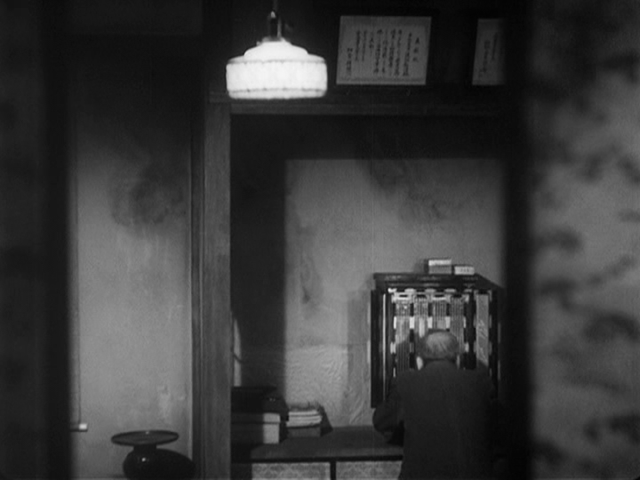


(OK, that last one’s a bit of a joke – because it’s literally a frame. Heh heh heh.) I especially love that playground shot. Symbolic?
Here was a great little sequence. In the first shot, we have our characters talking in the foreground, a man sitting behind them, and other people way in the back. As the conversation continues and intensifies, Watanabe moves and blocks out those people way in the back. As the conversation intensifies even more for Watanabe, he switches sides, coming closer to the camera and turning from the speaker.


Some nice “shots from behind”:


There were some nice two-way dialog shots in which, with the deep-focus, the background between the two characters was quite clear, almost to the point of distraction, yet the subject matter of the conversations kept the attention on the characters’ interactions:


Here’s a very nice silhouette shot. The focus (and subject matter of the characters’ dialog) is the sky. Too bad it’s not in color.

This was an interesting moment in the film. Watanabe is walking downstairs; he’s just had a flash of inspiration. He’s just come to terms with his death. It’s a pivotal moment in the film. It’s the “break into three” after the “all the lost” moment. So he rushes down the stairs and the people behind him are singing “Happy Birthday” in English to a character who’s off screen. But the song might as well be for him. It’s such obvious use of . . . some thematic device. I almost burst out laughing. (Actually, not almost, I did burst out laughing.) He finally comes to terms with his impending death, and this group of happy young people are singing “Happy Birthday.” It’s almost silly. I certainly would never have thought of something like that.

In the shot afterwards, we see the girl he was just talking to. She’s not sure what just happened. But, with the deep focus, it looks as if she’s watching that group of happy people across the room, looking down on them. A group of privileged young people around her age that she’ll never be a part of. It’s almost rather sad. Someday, when mortality is knocking on her door, she may suffer the same inner-trials as Watanabe. We don’t really leave her character on a happy note. Or maybe she’s just sad that Watanabe took her toy bunny.

Here’s an excellent mirror shot. How else can you have two characters facing each other, yet not facing each other? Gotta love shots like these.

Then we zoom in on the mirror so we have this great line-up of talking heads with shiny glassware lined up underneath. Nice.

And, finally, my favorite shot. Watanabe is dead, and this character has vowed to be more like him, or at least how he was after he changed in the months before his death. Here, this character just had an opportunity to hold true to his vow. He stands up and looks at his coworkers as if to say: “C’mon! Did Watanabe teach us nothing?” But then he cowardly changes his mind and sits back down, slowly disappearing behind the enormous stacks of paper, letting himself sink back into the drudgery of life. Sadly, nothing will change for this man anytime soon.

Movies
Hanna review
Before the ball dropped in New York City to give light to this year of 2012, I watched the film Hanna on DVD. My comments contain spoilers, so read no further if you plan to watch Hanna and hate spoilers.

On the filmmaking side, I thought it was great. (Of course, after sitting through the disaster that was The Adventures of Tintin, almost any movie feels like a relief to watch.) The cinematography and editing were continuously engaging, helping us understand Hanna’s state of mind throughout. It even had an excellent long shot of a man being surrounded by attackers and then fighting them off. I love long shots. The pacing was fantastic; we go from moments of exciting fights, whether they’re with fists, knives, or guns, to calm quiet meditative moments. The use of music was quite fun.
On the story side, I thought it was a bit weaker. Strands of the story were drawn out so much that they became thin and boring; the progression was just too slow. Even so, it wasn’t so bad that didn’t work at all. But it made one really fatal flaw.
The fatal flaw of the movie was, I think (and here’s the spoiler), when Eric, who we thought was Hanna’s father, reveals that Hanna was born in a research facility. Hanna is actually the result of genetic manipulation, genetically engineered to be a skilled and ruthless killer. Woah! Suddenly this is a sci-fi movie? Suddenly we must accept the possibility of such successful biotech? It’s just too unexpected to have any emotional value. And since the revelation was made at the climax of the movie, our acceptance of anything at that moment is pretty vital for the rest of the movie to work. The revelation ruins it.
How would I fix it? (It’s a question any wannabe storyteller should ask themselves when critiquing other works of fiction.) I would start the film with Hanna already knowing everything revealed in Eric’s revelation. That way, we (the audience) would have to accept the farfetched sci-fi genetic engineering right from the get go; we’d know that this is the sort of story where that kind of science is possible. The rest of the story, then, would be about Hanna coming to terms with the nature of outside world with what she knows about her own nature. Can she mix in? Can she be “normal”? What is “normal” anyway? Would she really want it? Is Hanna’s assassination plan worth the trouble? Was the genetic engineering morally OK? You’d have to pick a certain theme about the conflict of her nature and a normal person’s nature and stick with it, but I think it would’ve made for a much more engaging story from start to finish. Leaving the genetic engineering to be a “surprise” just doesn’t work.
Movies
Tintin was awful
Here’s my terribly negative review of the recent film The Adventures of Tintin.

I’ve never read the comics. And, to be honest, from the previews, I didn’t expect it to be that great. But it was worse than I could’ve possibly imagined.
I didn’t much like the character design. On the technical side, they were amazing. But on the design side, they were a bit disgusting. Realistic enough to make their cartoon-ness quite creepy.
The acting all seemed a bit overdone; everyone was gesturing and moving their arms about and turning their heads curiously too much like awful high school actors in a school play.
The camera kept doing this constant wobble. I guess the director was trying to make it seem more natural, more realistic, but it was just annoying. Yes, you can make a computer camera seem natural, you’re very smart, stop it.
The worst part, though, was the dialog. The main character, Tintin, feels the need to say all his thoughts out loud because we’re too dumb to figure anything out for ourselves. “Now where did I put that magnifying glass?” I don’t know, Dora, where could it be? This goes on and on. Shut up already! Let me enjoy the atmosphere of this CGI world. No, you just have to keep on telling me how curious everything is to you.
Maybe one has to be familiar with the comics for this movie, because I just didn’t care about Tintin at all. I guess it was because Tintin himself didn’t really care about anything. He just wanted to solve the mystery and find the hidden treasure because… oh, just because! Character motivation? Pfft! Who needs that? He was just born to go after the treasure, save for the all-is-lost moment near the end, when he gives up for the simple reason that he’s supposed to at that part of the story. What will get him to break into act 3? Some of the worst scriptwriting ever, of course! “Don’t let failure stop you!” Wow, thanks! How encouraging and inspiring!
The humor was atrocious. We’re meant to laugh at people getting hit on the back of the head with a plank of wood and passing out. Hahahaha! How innovative! Bumbling police men. Hahaha! Being drunk! Hahaha! I never thought I’d see humor so worse than Disney Channel’s dismal laugh-tracked offerings.
The elements that I did appreciate (for the bad elements were so bad that the most I can do for the good elements is “appreciate” them) were the over-the-top action sequences, especially that magnificent one near the end when the characters are racing through the city chasing slivers of paper, all shown in one long glorious long shot like an epic level from a video game. I can’t help but imagine how awesome the scene might have been if the story surrounding it wasn’t complete drivel.
I also appreciated the clever scene transitions, possible only with CGI. Again, though, not enough for the quality to be considered redeeming.
Overall, it was a horrible movie. One of the worst movies I’ve ever seen. Just depressing.
It’ll be interesting to see whether or not they make a sequel as planned. If Peter Jackson directs the sequel, I may give it a chance.
Movies
On Gollum sinking into lava
Wired had this interesting article which states:
Gollum, if you remember, dove into the lava of Mount Doom after his precious ring was thrown in — he proceeds to sink into the lava (see below) and leaves the ring floating on the lava until it melts away. Guess what? Sinking into lava just will not happen if you’re a human (or remotely human). You’d need to be a Terminator to sink into molten rock/metal …
On a discussion of the article on some other site, author John Scalzi wrote:
In a film with spiders of physically impossible size, talking trees, ugly warriors birthed out of mud and a disembodied malevolence causing a ring to corrupt the mind of anyone who wears it (and also turn them invisible), we’re going to complain that the lava is not viscous enough?
I can understand Scalzi’s point, but I disagree with his argument that one shouldn’t complain about the physics of Middle Earth lava just because one has accepted the existence of fantastical Middle Earth creatures.
I agree with Scalzi when he writes:
… you should consider the work in its totality and ask whether in the context of the work, this specific thing is inconsistent with the worldbuilding.
I’d also add (though it should be obvious) that this will be a subjective issue. Some people can more easily suspend their disbelief about certain things than others. If your area of expertise includes lava, lava falsehoods will stand out to you more than talking trees (and Ents are not trees, by the way).
Personally, the lava issue doesn’t bother me, but I’ve never seen a living creature fall into lava before. And it’s not something I ever really want to see. But if I did see such a thing, aside from being scarred and depressed for the rest of my sad sorry life, I can understand why Gollum’s death goop might stop working for me, even while I accept all the other magic of Middle Earth. There’s nothing in the story that signifies that the lava should behave in any other way than it does here on earth. Similarly, gravity behaves the same way, temperature behaves the same way, elf and hobbit and wizard emotions behave the same way. So it’s not like we assume that everything is so different that we have to just accept everything that comes our way.
Imagine if Gollum had bounced on the lava as if it were a trampoline. Who would accept that? Would me saying “hey, you accepted talking trees!” make you change your mind? I doubt it. You expect the lava to behave a certain way in the context of the story.
I would say that most audiences accept the physics of Gollum’s death because that is exactly how most of us imagine falling into lava should look, because most of us haven’t witnessed creatures falling into lava before. When we watch videos of rivers of lava pouring down the side of a volcano, it looks as viscous as it does in Gollum’s death scene. So our acceptance of the physics of Gollum’s death is based on our own lava-physics ignorance, not on our consideration of our own acceptance of the wizards and talking trees and giant spiders that preceded it. This lava-physics ignorance is also what makes the Wired article interesting at all in the first place (at least to me). It’s fun and educational!
Also, I think we could argue that as the lava liquefies Gollum’s innards, because the ring of power has turned him into the ugly gross unnatural goblin-like creature he is, his unnatural innards would liquefy in such a way that they mix in the lava in such a way that what we see in the movie makes perfect sense. That is, the Wired article may be right about the physics of the lava, but it hath no knowledge about the physics of melting Gollum guts, which might become extremely dense at high temperatures. (Sure, why not?) Or perhaps his skin vaporizes easily at lava temperatures, and lava pours into muscles and bones. He’s not really sinking; he’s being pulled down by the flow of the lava. Why didn’t Tolkien specify these sorts of things? He could’ve had an entire section of the appendix for this!
Movies
Neverland

I just finished watching the miniseries Neverland that came on the Syfy channel here in the USA. The miniseries provided an interesting explanation for the nature of Neverland involving an 400 year old alchemist from Queen Elizabeth I’s era (how do you write possessives with roman numerals?) and some galactic space-time continuum jargon. I enjoyed the friends-to-enemies back story of Peter and Hook, and the explanation of how both pirates and Indians wound up in Neverland.
What I felt was most lacking were the main characters’ motivations. In fact, I’m not even sure what Peter wanted, besides to oppose Hook. Meanwhile, Hook wanted superpowers (in the form of a special mineral dust; I’m glad they didn’t call anything “pixie” or “fairy”), but seemingly for no deeper reason than any typical villain wants superpowers—because they’re superpowers. I would’ve tried to give them deeper issues. For example, perhaps Peter is seeking parental guidance and approval. Perhaps he knows what kind of loving relationship he’s missing out on by being an orphan, and this is torture for him. It would be pretty cliché (orphans in books are always struggling with this issue), but Peter might get away with it, since it would help explain the whole “Wendy is our mother” element of the traditional Peter Pan tale. An issue for Hook: perhaps he sees in Peter everything he could’ve been were he a bit more clever and popular. Perhaps he’s just plain jealous of Peter and the relationships he’s able to forge in Neverland. He hates Peter because he craves everything he has. Wanting the superpowers is his way of getting even, or at least that’s his hope. “Once the power is mine, I’ll have nothing to envy.” These are just examples; the point is, I think the characters would’ve been more sympathetic with these deeper issues plaguing their minds.
The special effects were fantastic for a TV film, though the flying looked rather awful. But I can’t blame them too much for that; I think humans always look pretty horrible flying. The flying looked much better in Disney’s animated version, I reckon because animators could have so much more control over the characters’ feeling of weight, and how the center of gravity swings back and forth during a flying move so that it looks like the body is moving of its own accord and not attached to some invisible string.
Lastly, the ending made no sense at all, but this is another thing I can’t blame them too much for. Neverland is trying to set the stage for the tradition Peter Pan story, and the beginning of the traditional Peter Pan story makes no sense. But J. M. Barrie could get away with that in his day, because back then people didn’t have very high standards. (OK, different standards at least.)
Over all, it was some good food for my writerly imagination.
This review says:
When this Peter Pan origins tale isn’t gutting small children with giant swords, it’s pumping Native Americans full of bullets and pushing Pirates off cliffs. Oh and there’s sex in it too, and fairy genocide — so yeah, "gritty" is one way to describe it. Or you could say: a bunch of adults ham-fistededly stuff somewhat salacious origin tropes into a poor, unsuspecting fairy tale.
Apparently someone grew up watching too much Disney and not actually reading many fantasy stories. Neverland was hardly what I’d call “gritty” at all.
Movies
Hugo 3D

I saw Hugo in 3D tonight. I am now going to praise it a bit:
The film’s use of 3D was the best I’ve ever seen. Yes, it is the best 3D film yet made. All those people who complain: “eh, it doesn’t really add anything.” In this case, it does. But even with one eye, the cinematography, use of color, composition, etc. is just beautiful. The movie posters and trailers don’t at all capture the spirit of the film itself. The adaptation from the book is wonderful. It’s not the same as the book—there are additions, deletions, and changes—but that should be expected from any adaptation. And in this case, I think they all worked superbly. The movie’s use of history’s earliest films makes the story seem like it is much better suited as a movie in the first place. I really loved the story’s celebration of the human imagination, from books to magic tricks to mechanics to movies. And the theme about how the world is like a clock.
So, if you get the chance to see it, I highly recommend it. And in 3D.
Movies
Ender’s Game film to start shooting in 2012… ?
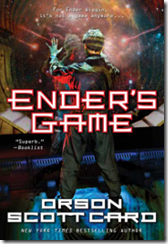
After years, nay, decades of being stuck in development hell heck, it seems a film version of one of my favorite books of all time, Ender’s Game
Summit Entertainment, the production company behind "The Twilight Saga" films, has acquired the rights to the youth-oriented "Ender’s Game" franchise. … The shoot is scheduled to run from February 24, 2012 through June 8, 2012.
To be honest, I’m not holding my breath for the film to be amazing. It certainly has potential, but I think it will be a very tough adaptation. Although it’s sci-fi, and there’s certainly some sci-fi battle action involved, it is not an action adventure story. It is, I think, a drama more than anything else. And if they overdo the action and underplay the social issues, I don’t think it’ll work story-wise. But if they overdo the social issues and underplay the action, it will be a marketing nightmare. The story deals with a "battle school" filled with children, yet it is certainly not a happy Disney-ish or Nickelodeon-ish kids’ adventure, and I hope they don’t try turning it into one, even though that would make it much more marketable.
All that said, I’m excited that it’s finally gotten to this point of development, and I look forward to watching what happens.