Defiance S1E2: Down In the Ground Where the Dead Men Go (2013)

defiance

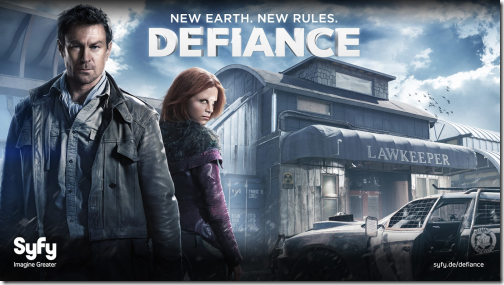
Summary: Nolan chases Ben as he flees down an old mine, where an entire ghost city is buried.  Ben is up to evil, and must be stopped!  Meanwhile, Irisa confronts Datak Tarr as he leads a torture ritual in the streets.

Thoughts: What a boring episode.  Nothing interesting in this one at all.  The plans of the villains are far too vague to be interesting, and the main characters have no goals except to confront whatever obvious moral wrongness they see.  If the next episode is this shallow, I’m calling it quits.  I want real conflict, moral dilemmas, witty sarcasm.

Defiance S1E1: Pilot (2013)

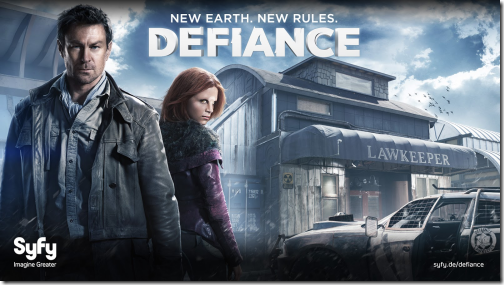
Summary: In a future in which several alien races have invaded earth, a man and his adopted alien daughter look for a safe haven amid the chaos, because apparently a lot of aliens are evil and there are wars all over the place.  They stumble upon a town called Defiance.  The town has its own share of problems, but at least it’s better than the cruelty outside.

Thoughts: Overall, I thought the pilot was decent.  They avoided the common pilot mistakes of trying to do to much backstory and/or trying to overcrowd the subplots.  They deftly kept the story simple and jumped right in.  It seemed they knew the fun of the show would be in the setting and introducing the various alien races and cultures, so they got right to it.  The visual effects were also very good for a TV show, especially after witnessing the horrible effects of shows like Terra Nova.

My main complaint is that the writing was horrible.  There was way too much exposition in dialog, people saying things for the obvious sake of telling the audience something.  Some of this may have been to compensate for skipping over the backstory, but I think they could’ve gotten away with much less exposition.  True sci-fi fans can figure things out.  Anyway, I thought the writing could still have done with some more humor.  I want some witty banter, sarcasm, along with the occasional astute philosophical observation.  The overall plot was also rather uninspired, but I can forgive that in a pilot.  Making the main character become the new sheriff was a rather forced way to get him to stay in Defiance and involved in future conflicts, especially since the same thing happened in Once Upon a Time.  Lastly, the character of Doc Yewell really bothered me.  She came across as arrogant and moody, yet she’s portrayed as a good character we’re supposed to root for.  I hope she’ll either lighten up or get more sarcastic in future episodes.

I’ll check out the next episode, but I’m not yet impressed enough to become a dedicated viewer.  We’ll see.

Life of Pi (2012)

Link: Life of Pi

Summary: A young man survives a shipwreck with a tiger.

Thoughts: What a boring movie.  Long stretches of nothing interesting happening.  Might’ve been interesting to see in 3D in theaters for the special effects, but the story was thin and meaningless, save for the meaning you can make up for yourself with the character’s occasional mention of something vaguely religious.  Aside from the long stretches of no story, the role of religion really bothered me.  The  main character is interested in religion, but doesn’t show an understanding of it (“I am Christian and Muslim and Hindu!”), nor does religion play any interesting role in his decision making, save for a few prayers.  Though when he says something like, “God, I give myself to you!” and then continues to act completely the same, one has to wonder whether his prayer meant anything.  The attempt at making this film have a religious undertone completely fails, as it plays no role in the actual story or in the characters’ decision making; it is merely something mentioned in dialog every now and then, as if that’s all religion really is, something to argue about.  His father’s words about the role of religion versus science is about as deep as a ten year old reflecting on the subject for the first time.  “Science explains things, religion doesn’t!”  Oh, wow, there’s a deep philosophical thought I never considered before, thanks!  Similarly, the main character’s decision to take on a mathematical name played no role in the story, apparently chosen only for an interesting title of the original book.  I mean, there could’ve at least been a circle metaphor somewhere.  As it is, the title could just’ve easily been Life of Logarithm.  Finally, the ending of the film hints that the entire story may be a complete lie, leaving it up for the viewer to decide what to believe, because that’s really poetic and artistic.  Yes, there’s nothing like a boring adventure that ends with the narrator hinting that maybe it’s not even true.

Horrible stupid boring movie.

Dragon (2011)

Link: Dragon

Summary: After a man fights and kills a notorious convict, an investigator believes he’s a notorious criminal himself.

Thoughts: I really enjoyed this film.  The action sequences were a lot of fun.  The fights played with their settings and were well shot, without all the annoying rapid editing you get in American action films these days.  (As Donnie Yen says in the bonus features, “Shooting the action is a lot more important than choreographing the action.”)  I enjoyed how the investigator would stroll around slow-motion replays of the action or how we’d get to see diagrams of what he’s thinking about; it was very visually imaginative.  The overall plot was a bit cliché; it’s a classic sort of story with no surprises.  But I think they did manage to breathe a unique life into it.  Fun movie.

Sleuth (1972)

Link: There is no link.  Unfortunately this film does not seem to be currently available on DVD; I caught it on Turner Classic Movies.

Summary: Based on a play.  A mystery writer invites his wife’s lover to his house in hopes of getting him to help with a ridiculous insurance fraud scheme.  But that itself turns out to be a scheme, as ulterior motives surface.  The story itself is not a mystery, but it’s about mysteries, about the creation and solving of mysteries (hence the title).

Thoughts: I loved this film, thought it was fantastic.  The writing was hilarious, the editing to creepy-faced automatons was hilarious, and the twists and turns of the plot were exciting.  I enjoyed the mysterious Clue-ish feel to the whole thing; it all takes place in one mansion.  The cast is very conservative; there are only two characters in the entire film.  Being based on a play, it does kind of have stage feel to it, how most of the story is in the dialog between the two characters.  But it’s fantastic dialog, clever and engaging, with each character believably transitioning to various emotions in turn, from happy to devastated to enraged to calm.  I loved the idea of mysteries being games, and the exploration of how far is too far when it comes to game playing.  Really wish this was on DVD or Blu-ray.

The film stars Laurence Olivier and Michael Caine.  Interestingly, the film was remade (or re-imagined, I should say) in 2007, with Caine switching to Olivier’s role.  I haven’t seen it yet, but it’s in my queue.

The Man with the Iron Fists (2012)

Link: The Man with the Iron Fists

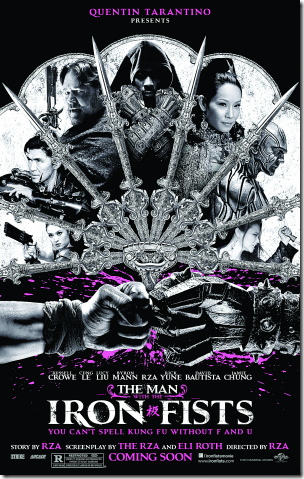
Summary: In this martial arts film written, directed, and starring rapper RZA, a blacksmiff makes himself arms of iron to face villains who are fighting over gold or something.

Thoughts: I honestly enjoyed some elements of the film, mostly the over-the-top fantastical wildness of its setting, its characters, and the unique style of weaponry.  Many fun elements to play with.  Unfortunately, there didn’t seem to be a story.  Too many characters seemed to be fighting for no reason, and the dialog was as inane as it gets.  It’s all the more annoying because the fantastical elements could’ve easily inspired a much more interesting story in the hands of better writers.  Very disappointing film.

Zero Dark Thirty (2012)

zdt

Link: Zero Dark Thirty

Summary: The story behind the search for and killing of Osama bin Laden.

Thoughts: A boring film.  The lead actress overacted a bit much, but I blame the director for that.  I didn’t understand why her character should be so obsessed with killing bin Laden, but I guess it’s one of those artifacts of trying to turn actual events into a dramatic film, finding the right balance between facts and dramatization.  Overall, I wasn’t impressed.

Hitchcock (2012)

hitchcock

Link: Hitchcock

Summary: Hitchcock sets out to make Psycho, but is burdened with a suffering marriage.

Thoughts: I’m not sure what was up with the makeup in this film; everyone had yellow faces, and Hitchcock’s ears kept moving strangely.  Anyway, even if Anthony Hopkins didn’t look very much like Hitchcock, he did a great job of capturing his speech pattern and the way he seemed to carry himself.  And the guy who played Anthony Perkins also did a great job.

I don’t know anything about Hitchcock’s personal life, or what sort of things he and his wife might have struggled with, or whether or not this story is based on people’s hearsay.  (If they never confessed anything themselves, I would take it all with a grain of salt.)  Of course, my favorite film being Amadeus, I am more than willing to accept wildly fictional portrayals of historic artists, granted the story is compelling.  This story, unfortunately, was not compelling.  It was extremely shallow.  It is basically a shallow romantic drama between Hitchcock and his wife as they try to rediscover their love for each other as the production of Psycho stresses them.  Hitchcock wants to make Psycho to revitalize his career and reputation, but there’s really nothing at stake for him, so what the heck do we care?  If the production of Psycho related more to his marital problems, it might have been more interesting.  (See the interplay between the theatrical production of Peter Pan and Barrie’s relationship problems in the fantastic film Finding Neverland.)  Overall, I wasn’t impressed with this film.

A few points for Danny Elfman’s compelling musical score.

A Man Escaped (1956)

Link: A Man Escaped

Summary: A man escapes from a prison.  It’s as simple as it gets.

Thoughts: This is the second film by French director Robert Bresson that I’ve watched, and I enjoyed it more than Pickpocket.  Bresson’s otherwise annoying directing style serves the focused nature of this particular story very well.  The film title itself establishes the character’s goal, and the story remains focused entirely on the main character achieving his goal.  We don’t even care why he’s in prison (it’s Nazi occupied France, so I suppose we assume the reason is unjust).  No backstory, no big subplot.  We are given every detail of how he escapes; nothing is left conveniently unexplained.  Though the pace may be slow at times, I found myself captivated watching as the main character scraped the end of a spoon into the crevices of his door to loosen its boards.  Given the title and the past-tense narration, we know the character is going to escape at the end, it’s just a matter of discovering what exactly he will do to escape.  I also enjoyed the use of Mozart.  Fun movie.

Bates Motel S1E4: Trust Me (2013)

Summary: After Norman discovers a girl being held captive in the deputy’s house, he tells Norma.  But Norma knows Norman has hallucinations, and does not believe him.  Dylan does, and agrees to help Norman.  The deputy tries to get to know Norman better, apparently hoping for a long term relationship with his mother.  Norman and Dylan see him as evil, of course.  At the end of the episode, Dylan confronts Norma about how she treats Norman, who he must now realize is mentally disturbed, but Norma refuses to change her ways, fearing Norman will be taken away from her if she seeks professional help or tells anyone.  A severed hand is found in the lake where Norma and Norman dumped the body of the man they murdered in the first episode, and Norma is arrested for his murder.  Bum bum bum!!!

Thoughts: I don’t quite understand Dylan’s character.  He seems to change his mind too often and doesn’t seem to want anything concrete.  It makes it hard to understand his actions because I’m not sure what he’s trying to achieve.  It’s also getting annoying to see so many morally depraved characters in this show.  Norman at least now has the excuse of being mentally disturbed.  The only other character who actually seems to understand right and wrong is the sick girl, who hasn’t had much screen time and wasn’t even in this episode.  It will be interesting to see what role she will end up playing in the rest of this season.  Perhaps she will become a stakes character.  Anyway, it was interesting to see Norma arrested and to see the deputy as a more evil and manipulative character.

Bates Motel S1E3: What’s Wrong With Norman (2013)

Summary: Norman has visions and passes out in school, putting him in the hospital.  Meanwhile, the police get a search warrant and search Norma’s house for clues in regards to the man they murdered in the first episode.  After the search, Norman discovers the belt he had kept from the murdered man has been taken.  Norma whines to the deputy, who admits that he took the belt and is keeping it safe in order to protect Norma.  And, of course, Norma plays along, hoping to keep herself out of jail.

Thoughts: Overall, this was a fun episode.  Norman passing out in school seemed a rather forced and unrealistic way to get him stuck in the hospital for a while.  Why would they want to monitor him overnight if all he did was pass out but now he’s fine?  It would’ve been more interesting if they were given some clue that would foreshadow the twist at the end of the episode.  The twist at the end of the episode was the best part, as it puts an interesting twist on Norman and Norma’s strange relationship.  Now it seems that Norman’s father may have been murdered by Norman, and not Norma, while Norma’s otherwise creepy smothering affection for Norman comes from her trying to keep her son out of a mental institution.  Finally, the twist that the deputy may be even more manipulative and evil than anyone creates a strong and interesting villain.

Jurassic Park 3D (2013)

Link: Jurassic Park 3D

Summary: 3D rerelease of the 1993 blockbuster.  A theme park featuring resurrected dinosaurs as the main attraction breaks down, and the dinosaurs eat the tourists.

Thoughts: Jurassic Park has been one of my favorite films since I first saw it when I was a young kid and couldn’t understand most of the subplot.  I just loved the dinosaurs.  I watched the VHS quite a few times over the summer at my grandmother’s house, so before we journeyed home, we went to a used bookstore and bought a used copy, which I continued to watch many times.  As far as disaster action thriller movies go, Jurassic Park gets the tone and pacing absolutely perfect, enough to forgive the many continuity errors and moments of cheesy dialog.  (“Woman inherits the earth!”  Lame.)

Anyway, the 3D was fantastic.  I thought it was amazing how well the photography lent itself to the addition of a third dimension, and I’m surprised they had the technology to convert the film so well.  There were a few little things here and there that looked a bit wonky, mostly the flat eyes of actor close-ups, but overall I was extremely impressed.  Most of the 3D is beautiful.

This will definitely be a 3D film I’ll see in theaters more than once.

John Dies at the End (2012)

Link: John Dies At The End

Summary: After getting injected with a creepy mysterious drug that seems to be sentient, a man struggles to deal with strange and disturbing paranormal powers.

Thoughts: This was a weird film.  While I found some parts to be hilarious, the story was overall just too random for me.  The magic system, if one can call it that in this sort of context, had no clear rules, allowing the storyteller to introduce whatever sort of crazy monsters and random-hallucination-like nonsense he could come up with.  I prefer a stronger story with clearer character goals and conflicts, rather than such an emphasis on the pure craziness of random weirdness.  Still, this did seem like a very unique brand of crazy that I won’t soon forget.  Especially interesting when you philosophize on the nature of thought.  Do thoughts move through us, or do we move through thoughts?  “When you hear a song on the radio, where’s the song?”

The Way of Kings by Brandon Sanderson

wok

Link: The Way of Kings (The Stormlight Archive)

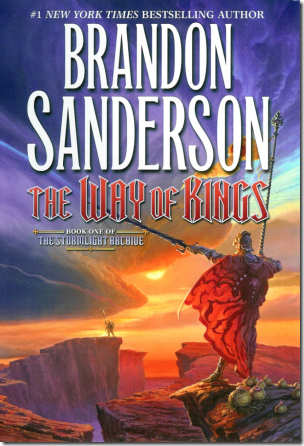
Summary: An enslaved soldier fights for freedom for himself and his friends.  An assassinated king’s brother works to unite his kingdom while trying to understand mysterious visions.  An artist sets out to steal a powerful magical object from a secretive but powerful scholar.  All the while, a dark evil is looming and growing in this popular 1200-page high fantasy, just the first installment of a series called The Stormlight Archives.

Thoughts: Whew.  Long book.  And I am slow reader, so that took me a good amount of time.  But I very much enjoyed it.  Sanderson’s writing is very clear and concise, so it’s an easy read, even if a long one.  It was always clear what was going on.  The pacing was rather slow for me; characters spent a great deal of time in their heads, and there were quite a few conversations that, while they helped to establish characters and their world, didn’t really seem to move the story along, at least not as quickly as they could have.  There were also some storylines and side-POVs that didn’t seem to contribute much at all.

A few critiques: In the story, our hero, Kaladin, is enslaved and decides to try to give hope to his enslaved comrades.  Most of them have resigned themselves to not caring about life, awaiting their inevitable meaningless deaths.  But by the end of the book, Kaladin has inspired them all!  Yay!  Not only that, but they all look to him as their faithful leader!  Yay!  Something always kind of feels false and manufactured to me when a large group of people are not only converted, but so willingly treat someone else like a commander to be obeyed, respected, and still treated as an equal.  It just seems too easy, too convenient.

Most of the humor didn’t work for me.  One of my particular pet peeves is when a character says something witty and “all the other characters laughed.”  Groan.  I prefer the sort of straight man comedy, where one character jokes and the other character fails to see the humor.  It’s not really what the character says that’s funny, it’s the contrast in attitude between the characters.  For example, look at the humor in Star Wars.  Look at the contrasting attitudes of the droids; one is a  worry-wort, while the other is confident.  Look at the contrasting attitudes of Han Solo and Luke; one is cynical, the other is not.  Look at just about every comedy duo.

In The Way of Kings, there’s a character named Shallan who prides herself on being witty.  From page 65 (Mass market paperback edition):

That had established in her what  her nurses had referred to as an “insolent streak.”  And the sailors were even more appreciative of a witty comment than her brothers had been.

“Well,” Shallan said … “I was just thinking this: You say that my beauty coaxed the winds to deliver us to Kharbranth with haste.  But wouldn’t that imply that on other trips, my lack of beauty was to blame for us arriving late?”

“Well . . . er . . .”

“So in reality,” Shallan said, “you’re telling me I’m beautiful precisely one-sixth of the time.”

“Nonsense!  Young miss, you’re like a morning sunrise you are!”

“Like a sunrise?  By that you mean entirely too crimson”—she pulled at her long red hair—“and prone to making men grouchy when they see me?”

He laughed, and several of the sailors nearby joined in.

I’m not sure exactly what Sanderson was going for, but, to me, this certainly isn’t witty.  Still, the scene could be funny if, instead of laughing, the sailors don’t get it or don’t think she’s funny.  That way, even if I don’t think her words are all that clever, I’d still be laughing at the situation.  And I wouldn’t say anything about Shallan thinking of herself as witty; I would let her dialog speak for itself.

One final critique: In the world of The Way of the Kings, women read and write, while men don’t.  While this may be an interesting worldbuilding twist, it makes no sense to me.  Reading and writing are very powerful communication tools; I have trouble relating to any male character who cannot recognize that and wouldn’t want that power for himself.  If anything, it would be the other way around, with men reading and writing and women being forbidden from the task.  Or with higher nobles and royalty learning how to read and write while forbidding the lower classes from doing so.  Not that that would be good, but it would certainly be more realistic.  Men want power, knowledge is power, therefore men will want access to knowledge.

Some praise: What I enjoyed most about the novel was the spiritual theme.  As a character says on page 1037:

“Life before death,” Teft said, wagging a finger at Kaladin.  “The Radiant seeks to defend life, always.  He never kills unnecessarily, and never risks his own life for frivolous reasons.  Living is harder than dying.  The Radiant’s duty is to live.

“Strength before weakness.  All men are weak at some time in their lives.  The Radiant protects those who are weak, and uses his strength for others.  Strength does not make one capable of rule; it makes one capable of service.”

Teft picked up spheres, putting them in his pouch.  He held the last one for a second, then tucked it away too.  “Journey before destination.  There are always several ways to achieve a goal.  Failure is preferable to winning through unjust means.  Protecting ten innocents is not worth killing one.  In the end, all men die.  How you lived will be far more important to the Almighty than what you accomplished.”

Very religious, and certainly Christian.  The book never gets preachy and never tries to knock you over the head with these themes.  I think the above quote is as direct as it gets in terms of dialog.  The danger in being too direct with such themes is that they can easily come across as fake, like a beautifully-wrapped Christmas present with nothing inside.  They are better communicated through story itself.  And Sanderson masterfully fits these themes into the characters’ decisions and the overall plot of the book.  So when characters make big decisions at the end of the novel, they feel dramatically powerful.

Overall, I very much enjoyed this book, and I’m definitely looking forward to the sequel.

Mon Oncle (1958)

mononcle

Link: Mon Oncle (The Criterion Collection)

Summary: A man does not quite fit in with his sister or nephew’s modern way of living.

Thoughts: Like Tati’s Playtime (which I enjoyed more), this film has no real plot.  Rather, it’s a set of comedy sketches, a bit like Mr. Bean, though with a much different character to it.  In Mon Oncle, the humor does not come from the main character’s inability to do things right; rather, it comes from the eccentric characters that surround him who try too hard to be modern and stylish.  Overall, I enjoyed the film.  But Tati has a way of developing gags on top of one another so that they’re easy to lose track of, and sometimes they’re so subtle or drawn out that they’re just boring.