Broken City (2013)

Link: Broken City

Summary: A retired cop is hired by a powerful city mayor to spy on his wife.  But what begins as standard catch-my-wife-cheating-on-me job turns into the uncovering of a much larger and darker political scandal.

Thoughts: I thought this was pretty standard fare for the crime thriller genre; nothing special.  I didn’t quite understand the weird dirty undertones though.  The ending was awful.  Spoiler ahead.  The hero martyring himself by “taking the fall” for a crime doesn’t quite work when he’s actually guilty of the crime he’s taking the fall for.  So basically the ending reveals that this whole time, the hero was just as guilty of cold-blooded murder as the film’s villains.  And we’re supposed to feel that him finally going to jail for it many years later is somehow honorable and courageous?  No.  Basic story principles.  You cannot have a hero be clearly guilty of cold-blooded murder, escape justice for it, and expect us to root for him when we all know perfectly well that escaping justice for it is morally wrong.  That’s not some artistic “moral ambiguity”.  That’s just stupid.  And don’t know, maybe I missed something?

The Wages of Fear (1953)

Link: The Wages Of Fear

Summary: Four men accept the deadly job of driving two trucks of explosive nitroglycerin over dangerous roads.

Thoughts: While the first half of this film was a bit slow, when they actually start driving the trucks, things get as tense as things can get in a film.  It was surprisingly suspenseful for a movie about driving trucks, and I was on the edge of my seat as they worked through some very close calls.  And, oh yes, not all of them make it, so the threat of death is real.  It was like watching those TV shows about truckers driving up dangerous mountainsides.  This sort of stuff terrifies me.  The editing and use of sound during the suspense scenes was masterful, better than Hitchcock (though Hitchcock’s brand of suspense was more character-driven, whereas this suspense is more situation-driven).  Great film.  My biggest critique would be that the end was ridiculous.  I’m not sure what they were going for with that ending, but after being on edge throughout much of the film, that sort of ending comes off as a ridiculous joke.  Maybe that’s what they were going for.

The Night of the Hunter (1955)

Link: The Night of the Hunter

Summary: A serial killer pretends to fall in love with a woman in an effort to get her children to tell him where their late father hid a large stash of stolen money.

Thoughts: This was supposed to be a classic crime thriller.  Unfortunately, it does not stand the test of time, if it was ever thrilling at all.  The serial killer, rather than being creepy and manipulative, is far too unsubtle; he basically confronts the kids directly, “Where’s the money?” and then plays nice when other adults around.  That’s neither thrilling nor realistic.  The acting was terrible with everyone over-exaggerating their expressions, and the writing comes off as very scripted, complete with people looking off into the distance and talking to themselves.  I hate when people talk to themselves.  Overall, not impressed with this one.  Not sure why it became a classic.  One thing did work for me, though: the use of character singing as background music, especially when the youngest child sings as she and her brother float down the river, was very creepy.  It didn’t really go with the atmosphere of the rest of the film, and it was obvious her voice was dubbed, but there was something very creepy about it.

The Impossible (2012)

Link: The Impossible

Summary: After being torn apart by the 2004 Indian Ocean tsunami, a family struggles to survive and find each other.  Based on a true story.

Thoughts: I thought this film did a very graceful and touching job with some very difficult and sensitive material.  The tragedy of the real-life tsunami provides a heavy foundation for much of the film’s emotional weight, allowing the story of the film to be approached in a very natural manner, without trying to force exaggerated conflict or cheesy dialog into it.  Great acting from all the actors with some tough material.  Director Juan Antonio Bayona and writer Sergio G. Sánchez also worked on the 2007 thriller The Orphanage, which I also very much enjoyed.  I will definitely be on the look out for their future work.  Good film.

The Brothers Bloom (2008)

bloom

Link: Brothers Bloom

Summary: Two con-artist brothers hatch a scheme to swindle a wealthy heiress.  But their plans get a bit out of hand when one of the brothers finds himself falling in love with the mark.

Thoughts: While a con-artist falling in love with his mark sets the stage for a classic sort of male-protagonist romantic comedy that any Hollywood hack could put together, writer/director Rian Johnson brings a very unique and welcoming voice and spirit to the story.  The first half of this film was great.  I was fascinated by the various larger-than-life characters, the hilarious gags, and the engaging dialog.  And then came along the second half, when the story tries to do way too much.  It’s as if Johnson couldn’t decide whether or not he wanted this to be a romantic comedy, a buddy movie, a heist movie, or a comedic thriller, and tried to make it all of them at once.  It just didn’t work; too many conflicts were begging for attention to the point where none of the resolutions felt very strong.  There’s the con-man’s love story, the con-man’s relationship with his brother, the heist itself, plus some convoluted plot involving a villain from the past who shows up half-way through to complicate things.  It was just a mess.  By the time the film ended, I had disengaged with most of the story.  If he had stuck with the light-hearted simplicity of the first half, keeping the story focused on just one over-arching conflict, this would’ve been a fantastic film.  But it didn’t.

Ender’s Game trailer

endersgame

The official trailer for Ender’s Game has finally arrived.  The film is set to be released November 1st, 2013.  I think the special effects look nice, but the overall tone and spirit of it look too, dare I say, cheesy and YA-ish.  We’ll see.  Can’t judge a film until you’ve actually seen the whole thing.  Check it out:

Ender’s World: Fresh Perspectives on the SF Classic Ender’s Game edited by Orson Scott Card

endersworld

Link: Ender’s World: Fresh Perspectives on the SF Classic Ender’s Game

Summary: A collection of fourteen diverse essays by a diverse group of contributors on Orson Scott Card’s famous book Ender’s Game.  Contributors include writer Eric James Stone, writer Mary Robinette Kowal, Burn Notice creator Matt Nix, among many others.  The essay topics are also quite varied, including philosophical observations, storytelling observations, and even military application observations.  Between each chapter, Card answers various questions about the making of Ender’s Game.  This isn’t a book of literary criticism, the sort of essays college dweebs might write for some boring class.  These are personal essays, the writers responding casually yet honestly about how the book affected them, about how some attribute of the book influenced their lives.

Thoughts: I very much enjoyed this book; I wish it were longer!  My favorite essays included “How it Should Have Ended” by Eric James Stone, “The Monster’s Heart” by John Brown, “The Cost of Breaking the Rules” by Mary Robinette Kowal, “A Teenless World” by Mette Ivie Harrison, “Ender on Leadership” by Colonel Tom Ruby, “Ender Wiggin, USMC” by John F. Schmitt, and “Ender’s Game: A Guide to Life” by Matt Nix.

A few short random comments on them:

The first three essays by Stone, Brown, and Kowal are, I think, great for writers.

In “How it Should Have Ended”, Stone writes on page 8:

One of the best pieces of advice I have received about writing characters is that you should figure out what a character desires most—and what the character fears most.  With that knowledge, you can craft a climax to a story that puts the desire and the fear into conflict.  By making the stakes as high as possible on a personal level, the climax of the story is more powerful.

Stone goes on to show how Card does this in Ender’s Game.  Very insightful for the aspiring writer.

In “The Monster’s Heart”, Brown writes on page 23:

For fiction to provide an experience then, all it needs to do is present the situational cues to us that will automatically trigger our appraisals and physiological responses. … despite the often-repeated eleventh writing commandment, “Show, don’t tell,” the truth of the matter is that a text never shows a reader anything except marks on a page … Movies and plays can show.  They can also provide raw auditory input.  But a book never *shows* us anything.  It’s *all* tell, tell, tell.  The trick is to tell in a way that allows the reader to imagine the situation with enough clarity and realism that the imagined situation triggers the response.

And of course he goes on to show how Card does this in Ender’s Game.  This is also very insightful for the aspiring writer.

You may have already heard some of Kowal’s writing observations in “The Cost of Breaking the Rules” from the podcast she co-hosts, Writing Excuses.  But there’s more here.  She makes some very interesting observations, ones I did not notice when I first read Ender’s Game.  Granted, it was before I became interested in polishing my writing craft and started paying attention to how authors do what they do.  Still, it’s fascinating to see how somebody’s writing can affect you in ways you don’t even notice.  Which must be why we can recognize when a story moves us, yet be incapable of recreating the experience with our own work, things like point-of-view, how it’s written and how it shifts, etc.  Anyway, yet another very insightful essay for the aspiring writer.

In a Q&A section between chapters, Card offers another great writing advice gem on pages 61-62:

Too many people think characterization is about finding an interesting backstory for the character, or inventing quirks and eccentricities and mannerisms.  Those are actually cheap tricks; it’s what you do to make characters without actually having to create them with any depth.

Instead, real characterization is figuring out who they are, what attitude and manner they present, in *each* of their significant relationships.  This is hard work!

What interested me in Harrison essay, “A Teenless World”, was the notion that teenagerhood is a modern concept.  While I’m not sure I agree with her theory that technology has caused this artificial extension of childhood (though there is certainly a correlation), her essay certainly resonated with me.  If you’ve read my other blog, you may know that I believe that “there’s no such thing as a teenager.”

“Ender on Leadership” and “Ender Wiggin, USMC” had some very interesting insights into how Ender’s Game affected military personnel.

One of them mentioned the idea that a good leader does not seek to maintain his status as leader.  He hires people who can get the job done, even if that means his own weaknesses will be pointed out.  A good leader recognizes his own weaknesses, fully admits to them, and seeks help to overcome them.  He does not try to hide them, thereby hiring only people who would not notice them or would pretend not to care about them and thereby not challenge the leader’s power.  Maintaining a leadership position for it’s own sake, for the sake of mere power over others, is useless.

The other essay talks about how war games (“TDGs”) were designed to help commanders make tough strategic choices on the battlefield.  Rather than designing games constricted by artificial rules (because in real combat, the “rules” are unknown), commanders come up with solutions to problem scenarios and their solutions are discussed and compared and critiqued.  The point is to help commanders learn how to think instead of trying to teach them specifically what to think.  (“In this situation, do this.  In that situation, do that.”)  These sorts of “games” are similar to games Ender is forced to play in Ender’s Game; open ended game meant to encourage strategic thinking.

Matt Nix’s article, “Ender’s Game: A Guide to Life”, most closely matched my own way of thinking after I first read Ender’s Game, and how my thinking evolved in the years after I continued to dwell on the issues brought up in Ender’s Game.  Issues such as how I relate to Ender personally and what his decisions and outlook affect my own.

For example, consider the role suffering plays in any story, particularly in Ender’s Game.  It’s something I’ve wondered about for a long while.  Why do we like to imagine being characters who suffer?  On page 276, Nix writes:

Suffering, by itself, is just suffering.  A guy throwing a script at you because the fax machine is broken isn’t *really* a lesson, any more than Ender’s torment at Bonzo’s hands was.  Lessons are only lessons if you choose to see them that way.  In some ways, wasn’t that really Ender’s greatest skill—his ability to learn from his torment?

Another lesson Nix writes about involves figuring out what matters.  If you want to “make it”, you’ll have to understand that what matters to other people is the bottom line, not how you feel about it.  But that doesn’t mean you shouldn’t care about your own feelings.  On page 278-279, Nix writes:

At the end of the day, you have to deliver the goods, and people don’t much care how you feel about it.

The ends *don’t* justify the means.  Nothing justifies anything.  There’s just what you do, and whether you can live with it.  It may be true that the only thing anyone *else* cares about is whether you won, but that doesn’t mean it’s the only thing that matters.

Overall, great collection of essays here.  I very much enjoyed this book and will probably be returning to read some of these essays again.  Great stuff.

The Very Best of Tad Williams cover

I’m excited about this upcoming story collection from fantasy writer Tad Williams, The Very Best of Tad Williams to be released next year, March 2014.  Not only do I highly enjoy his writing, but this is some of the most beautiful cover art I’ve ever seen.  I’d love to get a print of it, and maybe I will at some point as it looks like the artist behind the masterpiece, Kerem Beyit, sells prints on his DeviantART account.  Beautiful work.

Ender’s Game trailer announcement video

endersgame

This short video recently appeared on YouTube, announcing that the trailer for Ender’s Game will be released in less than a week on May 7th.  The video then gives just a few shots of some special effects, characters saying their lines, and battle school students standing there looking at something.  The special effects look good, but it’s too early to judge much else.  Obviously the film will not be like the book, so book fans (myself included) should get that out of their heads right away.  A lot of the book’s power depends on being able to see inside Ender’s head over the course of years.  There’s obviously no way to film that sort of thing, so the power of the film (if it will have any) will have to come from somewhere else.

The Croods (2013)

Link: The Croods

Summary: When random natural disasters begin happening, a family of cavemen are forced to venture out of their caves to seek a safer place to leave.

Thoughts: I must admit, my eyes got a bit misty watching this film.  Because I was yawning so much.  It was awful.  I just couldn’t relate to any of the characters.  The father is constantly plagued with worry; he’s seen many other families die on his dangerous planet, and prefers his family to stay in a cave and stay there.  But his daughter refuses to heed his warning, wanting to experience the wonders of nature.  When the cave is destroyed, the family is forced to face nature in all its beauty and danger.  The father feels like he’s losing his family as they all seek wisdom in Guy, a hip cool guy who doesn’t shy away from danger but looks for ways to conquer it.

A couple problems.  Firstly, the story switched main characters.  At first, it seems the teenage girl is the main character, as she struggles to explore the world while her father wants her to stay safe in the cave.  But when the family is forced out of their home, the father becomes the main character, as he struggles to face danger that he’d rather shy away from.

Secondly, the father’s dislike for Guy makes no sense.  If anything, he’d cling to Guy for guidance, which could’ve inspired some good comedy.  Meanwhile, the daughter’s dislike of her father’s worrying makes no sense, since he’s not carrying out any discipline or actually harming her in any way.  I just don’t understand these characters’ motivations for their attitudes.

So, when we reach the end, what exactly was the story about?  I think the theme they were going for was not being afraid of experiencing new things, even though they might be dangerous.  But the actual events of the story and the decisions the characters make do not illustrate this theme, so characters are forced to say it out loud so bluntly that it’s supposed to double as a joke.  Experiencing new things is never a consequence of a decision any of them make on their own; nature continually forces it upon them.  It’s like trying to elucidate the joy of skydiving when the plane is on fire.  It’s not an interesting decision to jump from a plane when the only other option is getting consumed by flames.  That’s not conflict.  Evading one disaster after another is not a story about trying new things.

Can Chris Sanders make a good film without Dean DeBlois?  Nope.  Not yet, anyway.  But my negative opinion is in the minority.  The film has made a boat load of money, and a sequel has already been announced.  I think I might miss it.

The Sorcerer and the White Snake (2011)

Link: The Sorcerer and The White Snake

Summary: Based on an ancient Chinese legend.  A man’s love is doomed when he falls in love with and marries a demon (who, in her true form, appears as a giant white snake).  Meanwhile, a demon hunter tries to save the man by capturing the demon.

Thoughts: The premise was interesting (explaining why it survived as a legend for hundreds of years).  There’s a lot a good writer can do with a man who unknowingly falls in love with a demon.  You know the relationship will not work out, but you know neither party will give it up willingly.  So the foundational story is a strong and timeless one.  Unfortunately this particular interpretation of the story was rather boring.  Everybody overacted as if they were in a cartoon, and the dialog was far too straightforward; hardly ever any subtext or style.  I can forgive cheap CGI when the story is compelling enough, but the story was not compelling here, so the effects just made me feel a bit sad.  The fighting scenes were choppy and bland, and the cartoony film score just made everything worse.  Felt like I was watching something made for five-year-olds.  Maybe I was?

West Side Story (1961)

Link: West Side Story

Summary: The classic forbidden love story of Romeo and Juliette retold as a dance and song musical on the 1950’s New York streets.

Thoughts: Though I’d already heard pretty much all the songs and music from this popular musical, I’d never actually seen the movie.  And, eh, it was OK.  A bit too wannabe-hip for my tastes, and the dancing was blegh, except for when they did flips, because flips are always cool.  But it’s like, “Hey, we’re hip, ‘cause we’re snappin’ our fingers to the groove, and now watch us gracefully kick our legs really high!”  What?  Stop it.  What do you think you’re doing?  If you’re going to dance, then you should dance like they did in Singin’ in the Rain.  And I’ve never found Romeo and Juliette to be a very compelling story; it’s such baseless shallow love.  “I see you, and now I love you!”  “Me too!”  “Why do we love each other?  Just because!”  Blegh, I say!  Bah humbug!

Anyway, it’s hard not to love Leonard Bernstein’s beautiful music.  Sondheim’s lyrics are OK, but not nearly as intricate or interesting or witty as they’d become in his later work.

Alphas S1 (2011)

alphas

Link: Alphas: Season One

Summary: A team of people with superpowers (“alphas”) work for the government, helping them to solve crimes committed by other people with superpowers.  Superpowers usually have some pseudo-science explanation for how they are possible.

Thoughts: A day or two after I started watching the first episodes of this series, it was cancelled after its second season, its storyline left unfinished.  Grrr!  Anyway, the first season does have its share of problems.  It can’t seem to decide what sort of show it wants to be.  Is it a sci-fi thriller?  Is it crime drama?  Is it superhero action?  Since it tries to be all three, it comes off as none, but rather a muddled mix.

Still, it had some strong points.  The characters were interesting.  They were each unique and believable, and the dialog between them was fun and natural.  You get to know them and their personalities pretty fast, which I don’t think is a very easy feat in any sort of storytelling.

It’s the overarching conflicts that made no sense to me.  Sometimes they’re tracking down a single alpha who’s misusing his or her powers for evil, sometimes they’re battling this vague underground criminal organization made up of alphas.  Meanwhile, they work for the government, so they don’t even necessarily get to make their own decisions about who and what and where and how to fight.

It would’ve been much more interesting (even if cliché) if they had been part of a secret organization themselves, away from the government, with their own set of morally questionable goals and a much more concrete set of enemies.

I’ll try to watch the second season if/when Netflix gets them on DVD, even though I’m sure the unresolved cliffhanger will annoy me.

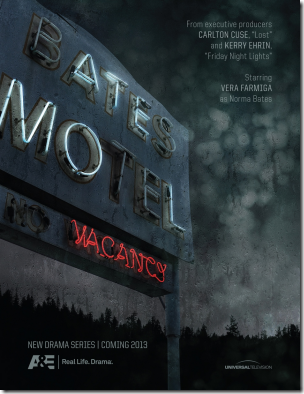
Bates Motel S1E6: The Truth (2013)

batesmotel

Summary: Norma seems to finally accept that Deputy Shelby is evil, yet she doesn’t want to go to the police as Shelby is still blackmailing her for the murder she’s guilty of (since he still as the victim’s belt that he found under Norman’s bed).  When Shelby happens upon the girl hiding out in Norma’s motel, he’s understandably upset.  And deadly.

Thoughts: We finally get to see how Norman’s father died, if we are to believe Norma’s story to Dylan (which I guess we are since we know Norman hallucinates).  It will be interesting to see how this affects Dylan, who already knows Norman has something wrong with him.  It was also a relief to have Shelby’s evil character come to an end, though we don’t know what happened to that girl.  Definitely ends on quite a cliffhanger.

Bates Motel S1E5: Ocean View (2013)

batesmotel

Summary: Norman helps Norma get out of jail.  Norma then seeks help from Deputy Shelby to get her murder charge dropped, but she realizes how dangerous Shelby is when Norman finds the girl he saw in Shelby’s house, the girl Shelby has been holding captive.  Meanwhile, Dylan’s crime partner is murdered in cold blood, and Dylan seeks revenge.

Thoughts: I was afraid the girl Norman saw had been one of his hallucinations, but it turns out she’s real, and Shelby is indeed quite evil.  It was interesting to see Norman and Norma’s relationship get a bit twisted as Norma blames Norman for his not being there when she was arrested.  While Norman has his obvious moments of crazy, Norma clearly has some psycho issues herself.  Not sure what Dylan’s subplot contributed to the story, but perhaps it’s setup for something.