Jobs (2013)

jobs

Link: Jobs

Summary: The story of how Steve Jobs founded the computer company Apple.

Thoughts: This film suffered from two main problems.  Firstly, there was no over-arching theme, at least none that I could find, so it feels more like a dramatized documentary than a self-contained film.  Secondly, it seems Steve Jobs was too much of an arrogant jerk to be the inspiring figure he’s simultaneously attempted to be portrayed as.  His character in this film was almost completely unlikeable.  He treats his friends like dirt, and puts so much pressure on them to succeed it’s a miraculous wonder anyone continued to offer their services.  Meanwhile, what work did Jobs do?  In the film, mainly badger potential business partners, making it again seem miraculous his company was ever successful.  So when the sentimental music swells up in the background and Ashton Kutcher as Steve Jobs starts speaking in vague general abstractions about being nobly creative and changing the world, it feels like the forced empty sort of speech it is.  I have no idea how well the film reflects the true story of the man and the company, but as a film, this just doesn’t work.

About: Interestingly, part of the film was shot at Jobs’s actual childhood home in California, where his stepmother still lives.

Jobsmovie Los Altos

Apple Cofounder Steve Wozniak was approached by the filmmakers, but he turned down the opportunity to consult on the film after finding the script “was crap.”  Instead, he’s consulting on another Steve Jobs biopic, one being written by Aaron Sorkin, the writer behind The Social Network, based on Walter Isaacson’s Steve Jobs biography.  So we’ll probably get a much more decent Steve Jobs biopic sometime in the next few years.  It would be interesting, though I suppose quite unlikely, to have Ashton Kutcher reprise his role as Jobs; he does look like Steve Jobs, in a way.

Pelle the Conqueror (1987)

Summary: A father and son from Sweden immigrate to Denmark where they struggle to start a new life for themselves on a farm where immigrants are not made to feel very welcome.

Thoughts: For some reason, I have a particular interest in father-son relationship stories, and the relationship between this older widower father and his young son is considerably tested through the course of the film by their new surroundings.  Pelle’s father, played by Max von Sydow, wants to get remarried for practical purposes; he’s older and he wants someone to look after him.  But his search in an already prejudiced anti-immigrant environment does nothing to help Pelle, whose peers consistently bully him and his poor pathetic father.  Pelle’s only friends, if they can even be called that, are other outcasts.  When the father promises to beat up those who bullied his son, Pelle looks forward to it, but when confronted, his father does not in fact have the backbone for it.  Later, when a lead for a new wife comes to a dead end, the father searches for relief from his grief in drink, leaving his son to come home to find his father drunk and stumbling about.  Still, the father resolves to carry on for the sake of his son, to whom he promises that the world can be conquered.  Max von Sydow gives a great performance in this film.  Unfortunately, though, the story just seems to fizzle out at the end, leaving us in a rather dramatically ambiguous place, probably feeling emotionally empty.  In retrospect, it didn’t seem the overall story was about anything in particular, just a series of related episodic conflicts.  That is, I’m having trouble understanding what, if anything, Pelle learned through the course of the film, or if the whole things was just about torturing the poor characters.

About: The film is based on the first part of the novel Pelle Erobreren by Danish writer Martin Andersen Nexø (1869-1954), which was published in four parts from 1906 to 1910.  (An English translation is available from Project Gutenberg.)  Perhaps that is why the story feels so incomplete; it is based on just the first part of a much larger story.  Interestingly, the actor who played young Pelle was himself named Pelle (Pelle Hvenegaard), named after the character from the original book.

The film won the Golden Palm at the Cannes Film Festival.  The film also won the Academy Award for Best Foreign Language Film; the year before, another Danish film had won the award—Babette’s Feast.

Yikes, what bad TV graphics they had in the late 80’s.  Looks like Pelle had some interesting contenders.  A psychic Nazi film?

Once Upon a Time in America (1984)

Summary: An old man recalls the friendships of his mobster past as he searches for some final answers.

Thoughts: I’m not really sure what to say about this film.  It’s one of the best films I’ve ever seen.  It was three hours and forty-some minutes, but it pulled me in and the time flew by, like being pulled into a wonderful symphony; the pacing was just perfect.  This is definitely Sergio Leone’s masterpiece.  My only complaint is that I didn’t think it had to be so dirty; I guess Leone was going for the “gritty” dirtiness that tries to make you feel dirty as a viewer.  It’s all unnecessary and doesn’t add anything to the story.  That complaint aside, the overall film is just brilliant.  It starts out a bit confusing, because you get these seemingly random scenes and you’re not sure how they relate to each other.  But as the film continues, it all becomes clear, and in a way that makes the chronological shuffling somehow work wonderfully.  At its heart, the film is about the relationship between two guys played by Robert De Niro and James Woods.  We see their friendship begin as teenagers, continue into adulthood, take some wild twists, and end in an unexpected powerful tragic poetic awesome way.  Gah!  It was so good!  I can’t write anything very intelligent-sounding about it, because the emotion of it was just so perfect.  Tragic, but . . . I don’t know how to describe it.  It’s not like a “someone dies” sort of tragedy, it’s like the whole story, the whole arc of the main characters’ relationship just somehow comes together . . . I really don’t know what it is.  It just left me overwhelmed with emotion.  The film also features one of Ennio Morricone’s most beautiful musical scores, and some beautiful use of the song Yesterday.

It seems the blu-ray is currently out of print, but it seems there’s an extended cut in the works that will add an additional twenty minutes (I think) of footage to the film, bringing the film’s running time over the four hour mark.  Whew!  But I’ll definitely be on the look out for it.  Brilliant, epic, wonderful film.

The Way Way Back (2013)

Link: The Way, Way Back

Summary: A teenager tries to survive a summer vacation with his divorced mother’s new evil jerk boyfriend.

Thoughts: I’m not sure I really understand these awkward comedies; it’s like they want you to laugh at the main character’s dorky awkwardness and feel sorry for him at the same time, like you’re supposed to identify with him and then laugh at yourself.  And while I think dealing with an annoying jerk is universally relatable (as played to perfection by Steve Carell in his most loathsome role yet as the divorced mother’s new evil Candy Land Nazi boyfriend), relating to an overly self-conscious brooding teenager is not the most interesting or enjoyable mental exercise, at least not for me.  The film centers around the main character’s search for self-confidence, but he seems to mostly miraculously gain it externally, mostly by hanging around with the bizarre outgoing-funny-charming-immature adult character played by Sam Rockwell, who’s ready and eager to push a random awkward teenager out of his comfort zone and into the zone of self-confidence-building socially awkward situations, just like the friend I’m sure every awkward teenager daydreams of meeting.  I didn’t understand this film at all.

Sanjuro (1962)

Link: Yojimbo & Sanjuro

Summary: The nameless ronin from Kurosawa’s Yojimbo (1961) helps nine samurai defend against some kind of plot by scheming officials.

Thoughts: As you might guess based on my summary, I found this film I bit confusing.  I wasn’t quite sure what exactly the villains were plotting, so I wasn’t quite sure what the entire conflict was all about.  Still, even without understanding the intricacies of the overall plot, the main character’s clever counter-schemes were engaging, at times hilarious, while the nine samurai’s torment over whether or not to trust this nameless samurai kept things interesting.  The swordfights were well choreographed, but the comedy of the overall plot drained them of some of their dramatic power.  The film features some more of Kurosawa’s great cinematographic style, and it was nice to hear the musical themes from Yojimbo revisited.  Overall, though, the film is no match for Yojimbo, which remains my favorite Kurosawa film (of the ones I’ve seen).  Perhaps the overall conflict, being of a more political-scheming nature, just feels too light-hearted or abstract for me.  Still, I found it to be an enjoyable film.

The Wolverine (2013)

Link: The Wolverine

Summary: Taking place after the events of X-Men: The Last Stand (2006), the Wolverine is pulled into a conflict in Japan, where he must protect an old acquaintance’s granddaughter while trying to figure out why his self-healing powers have mysteriously vanished.

Thoughts: While I thought Wolverine’s constantly brooding moodiness got tiring very quickly, I actually enjoyed this film more than any other X-Men film so far.  Of course, I’m not sure that’s really saying much; I’m not much of a comics-based superhero movie fan in general.  Anyway, the Japanese setting was refreshing, the action was fun, and I thought the villains were intriguing enough, but overall the film seemed to be a rather standard action flick.

Black Sunday (1977)

Link: Black Sunday

Summary: A terrorist plans to attack the US by blowing up a Goodyear blimp at the Super Bowl.  Why, of all the crazy schemes!  Can they be stopped in time?

Thoughts: This was awful.  The writing was just silly, with characters talking to each other as if they had to make sure third graders could understand their dialog, yet trying to sound really cool.  The plot was completely bloated; the film is two hours and twenty minutes, yet only has maybe an hour and a half of real story.  The rest is just bad bland writing that takes too long to move the story forward.  The special effects were just disastrous.  Not even charmingly cheesy, just sad, especially the fake explosions that leave you laughing rather than caring about any of the characters you just watched perish.  Ridiculous film.  Not the worst film ever; it leaves you more with a good laugh than feeling sad for humanity and overly self-conscious about your own art, but still, pretty ridiculous.

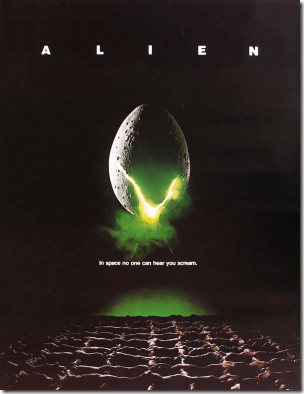
Alien (1979)

Link: Alien Anthology

Summary: After exploring a strange planet where another spaceship crashed, a crew returns to space with an extra passenger onboard, and not a friendly one.

Thoughts: Here’s another classic sci-fi film that I finally watched for the first time.  However, this one is so classic that I basically knew almost all the storyline before watching the film.  (Especially as a fan of Blake Snyder’s Save the Cat! books, the titles of which refer to a plot device used in this film, in which the main character saves a cat to help make her character likeable.)  The special effects are terribly outdated (charmingly cheesy, perhaps I should say), but otherwise the look and feel of the film is awesome, and it looks fantastic on blu-ray.  I love the design of the spaceship, how things look used and the spaces looked lived in.  The plot itself was classic a “monster in the house” plot, and, along with Jaws and Jurassic Park, is one of the best films of this sort, in my opinion.  (They don’t seem nearly as popular these days, do they?  I don’t recall seeing a very modern one lately.)  The plot and pacing were tight.

I didn’t notice it until listening to some of the commentary, but none of the characters have backstories.  Yet they all have very unique easy-to-recognize personalities.  I wouldn’t have even noticed if someone had mentioned this on the commentary, but it’s rather brilliant, isn’t it?  We never see one of those cheesy moments when someone looks a picture or watches a recording of some loved one they’ve left behind.  We never get hints that characters had romantic flings before the film began.  I can easily imagine a novice writer (myself included) wanting to put such things in naturally, taking them for granted.  Yet this films cleverly avoids all that, magnifying the jeopardy of the situation.

Really fun film.  Very easy to see why it’s such a classic.

Close Encounters of the Third Kind (1977)

Link: Close Encounters of the Third Kind

Summary: After a man sees a small group of UFOs, he become obsessed with trying to understand a mysterious vision of a mountain.

Thoughts: I had never seen this classic Spielberg film before.  Although the effects are quite obviously dated, the film looked great on blu-ray.  I especially loved the look of the mothership UFO at the end, along with John Williams’s classic well-known score for this film.  The filmmaking was masterful; it’s very easy to get drawn into the mysteriousness of what the UFOs are doing as different characters take different approaches to trying to figure it out, our poor main character driven to the edges of his sanity in the process.

Overall, though, I’m not quite sure I understand what it’s all about.  Why exactly did these aliens come?  What are they doing?  What is the government trying to do with them?  What are the main character’s intentions as he walks onto the spaceship at the end?  I didn’t understand the film’s ending at all.

Still, it’s a fun film.  It was easy to get drawn into, and there’s something very engaging about the pacing and tempo of the whole thing, it just sucks you in like a catchy piece of music.  Which only makes the bizarre answer-less ending all the more annoying.

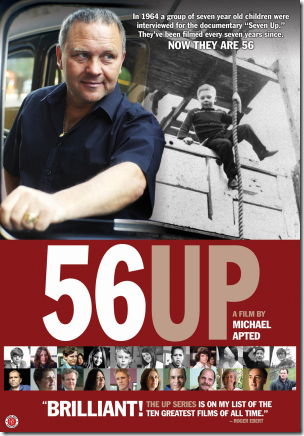
56 Up (2012)

56up

Link: The Complete Up Series

Summary: This film catches up on the ordinary lives of some random British citizens.  Their lives have been chronicled every seven years since they were seven years old; they are now 56 years old.

Thoughts: I started watching this series with the last installment, 49 Up.  I love these films.  Even though we only see very brief glimpses into these people’s lives, as many of the subjects themselves are quick to remind us, it is fascinating to see both how they change every seven years, how they adapt to the changes that are forced upon them, and yet how they, in some ways, remain the same.  Though I’m sure different fans of these films find them fascinating for different reasons, with this latest installment I was mostly reminded that the important things in a person’s life are not his potential for fame and fortune, but his relationships both with other people and with himself, and that there is always hope; all struggles are temporary.  Yeah, that might sound like a cheesy theme to find, but that’s what I thought about as I watched how these various people progressed through their various stages of life in the span of minutes or seconds.  The worldly stuff gets left behind and forgotten; meanwhile, the self changes what it needs to, and perseveres.

I hope they will continue with another installment.  If something happens to director Michael Apted before then, I hope someone else will take it over.  It would also be fascinating to see something like this in the USA.  I know there have been attempts, but I’ve not come across them; I guess they are not nearly as popular.  In any case, this is perhaps the most fascinating documentary series of all time.

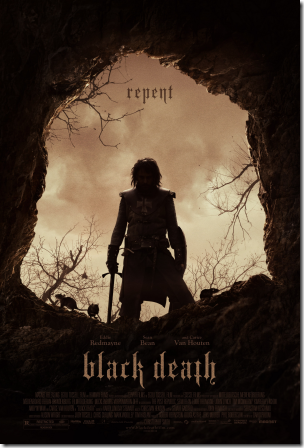
Black Death (2010)

blackdeath

Link: Black Death

Summary: Amid the dangerous outbreak of the bubonic plague, a young monk joins a group of fighters out to investigate a mysterious village, where people claim the dead are being brought back to life.

Thoughts: A rather bleak film.  I enjoyed the look and feel of it, though there was far too much employment of the infamous shaky cam.  The premise itself wasn’t bad, but the overall film was little more than a direct dramatization of the premise.  That is, the film feels like a short film that’s been artificially bloated to a full film.  Most of the conflicts are episodic and don’t seem to relate much to each other, save for the fact that the same characters are engaged in them.  I could not grasp any sort of theme or emotional subtext that could’ve held the film together.  What is the hero’s main emotional conflict?  I couldn’t detect one; all his conflicts were outward and physical in some manner.  By the film’s end, the whole thing just feels bland and empty.

Princess Mononoke (1997)

mononoke

Link: Princess Mononoke

Summary: After getting attacked by a giant pig-demon, a young man goes off in search of a cure for his demon-related injury, and winds up centering himself in a deadly conflict between a village of industrial workers and the spirits of the nearby forest that they are gradually destroying with their industry.

Thoughts: While I enjoyed the eccentric fantasy elements of this famous film from Studio Ghibli and legendary director Hayao Miyazaki, the overall story confused me a bit too much for me to get emotionally invested in it.  I may just have a bias against forest spirits, as they remind me of the preachy environmentalist animated films of my youth, Once Upon a Forest, FernGully: The Last Rainforest, and the original traditionally animated short The Lorax from the 70’s, each dramatized as if every child will one day face the question of whether to chop down some trees or live peacefully with them, encouraged to do the latter with the memories of the charming animated characters of their youth.  Sorry, forest spirits, I don’t believe in you and I don’t care about you at all.  I am not an enemy of environmentalism in general, but environmentalism should be directed at preserving a balance for our sake, so that we can continue to use the resources the environment offers us.  Not for the sake of made up spirits and talking animals.  So a film that ends with the hero proclaiming: “Forest spirit, we give you back your head!  Take it and be in peace!” just doesn’t work for me.

Perhaps the real problem I had with this film is that I couldn’t understand the main conflict in the first place; the main character needs to find a cure for his demon-arm injury, but the conflict he gets sucked into seems only incidental.  It didn’t seem personal enough for him, leaving our emotional investment to depend mostly on how much we can relate to and care about the supporting characters and their problems.  Granted, it is more than possible that the manner of story exposition just didn’t work for me, leaving me confused more than anything.

This film does feature Studio Ghibli’s typical beautiful visuals and one of composer Joe Hisaishi’s most beautiful scores.

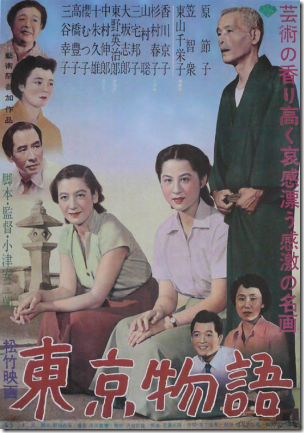
Tokyo Story (1953)

tokyostory2

Link: Tokyo Story

Summary: Aging parents visit their adult children in Tokyo, but the changes to Japanese culture in the early 50’s have created quite a generational gap.  The parents are disappointed that their children are not as successful as they hoped they would become.  Meanwhile, the children seem only to be burdened by having their parents as guests.

Thoughts: This is the first film from famous director Yasujirô Ozu that I’ve seen.  Unfortunately, I couldn’t quite get into it.  Ozu’s slow natural pace of storytelling mostly just made me tired, and I loathe his camera work.  Straight-on close-ups, weird confusing 360 degree cuts, almost everything shot at a low angle.  I found it distracting, and it only worked to make the slow-paced story that much more boring.

The over story itself was interesting; I think the emotions the characters go through are universally relatable.  And I like how the characters behaved naturally and believably.  Save for the moments when characters let their emotions affect their behavior directly, many of their emotions are evident only through subtext, keeping (or at least attempting to keep) the viewer engaged.  That said, the slow pacing and boring camera work only seem to work against the story.  That is, if the attention required to understand the characters is too much, the mental effort to stay engaged is only further strained by the pacing, camera work, and mechanical line-delivery, as if the director is just daring your mind to wander off into a confused slumber.

While I may check out some more of Ozu’s work at some point, I must confess that I didn’t find this feature particularly engaging.

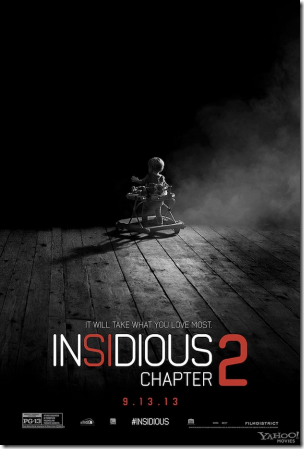
Insidious Chapter 2 (2013)

insidious2

Link: Insidious: Chapter 2

Summary: Starting where the first Insidious film left off, a family deals with setting things right after a father becomes possessed by an evil ghost intent on killing the family.

Thoughts: I enjoyed this sequel more than its predecessor.  While the premise is still rather ridiculous, this chapter seems to take itself less seriously and just has horror-film fun with a collection of creepy situations and jump scares.  Best watched at night in complete darkness.  Director James Wan really knows how to edit and pace a good jump.  Like The Conjuring, seasoned horror film fans probably won’t find anything special here, and may even be disappointed with how un-seriously this film takes itself, but it’s the self-conscious humor of this sequel that I really enjoyed.  And while the overall premise is kind of silly for a horror film, I still like the idea of ghosts threatening to take over your body during sleep.  Fun movie.