Random thoughts on Gödel

Last year I blogged about fiction books I wanted to read that year. I only ended up reading three of them. I finished reading War and Peace, which was very long but very good, Stands a Shadow by Col Buchanan, and The Vindication of Man by John C. Wright. Point is, I ultimately didn’t read that much fiction, but read more non-fiction instead.

I’ll probably continue reading more non-fiction than fiction this year as well; there just seem to be more non-fiction books capturing my interest.

I recently finished reading Journey to the Edge of Reason : The Life of Kurt Gödel by Stephen Budiansky. It’s short, less than 300 pages, but provides a very good overview of his life and important mathematical contributions. I wouldn’t have minded if it went deeper into the math, but that’s something I can keep exploring on my own.

A good explanation of Gödel’s most famous contribution, his Incompleteness Theorem, can be found at the 15:16 mark of this YouTube video, though while the video makes the main idea understandable, it still glosses over the finer details of the proof that make it definitive.

To quote page 241 of the book:

Both of Incompleteness Theorems proved that no finite process of inference from axioms within a well-defined system can capture of all mathematics. But that, Gödel pointed out, leads to an interesting either-or choice: either the human mind can perceive evident axioms of mathematics that can never be reduced to a finite rule — which means the human mind “infinitely surpasses the powers of any finite machine” — or there exist problems that are not merely undecidable within a specific formal system, but that are “absolutely” undecidable.

Both choices point to a conclusion “decidedly opposed to materialistic philosophy,” Gödel observed. If the mind is not a machine, then the human spirit cannot be reduced to the mechanistic operation of the brain, with its finite collection of working parts consisting of neurons and their interconnections. If, however, the mind is nothing but a calculating machine, then it is subject to the limitations of the Incompleteness Theorem, which leads to the thorny fact that numbers possess at least some properties that are beyond the power of the human mind to establish: “So this alternative seems to imply that mathematical objects and facts (or at least something in them) exist objectively and independently of our mental acts and decisions, that is to say some form or other of Platonism or ‘realism’ as to the mathematical objects.”

Of course, none of this should be mind-blowing to anyone who already believes in God and has already rejected the notion of materialism, but I still find it thought-provoking. As to whether or not the human brain is nothing but a calculating machine, I don’t know. But even if it were, it would not be inconsistent with religious belief, as it would still point to metaphysical truths beyond itself. (This also states nothing about consciousness or the nature of Free Will. Is Free Will born from a necessary limitation of the Incompleteness Theorem?)

While Gödel was not open about whatever he believed regarding God (especially in the more atheistic-leaning circles in which he worked), he did write a letter revealing he certainly believed in an afterlife (from page 267-268):

You pose in your last letter the momentous question, whether I believe we shall meet in the hereafter. About that I can only say the following: If the world is constructed rationally and has a meaning, then that must be so. For what kind of a sense would there be in bringing forth a creature (man), who has such a broad field of possibilities of his own development and of relationships, and then not allow him to achieve 1/1000 of it. That would be approximately as if someone laid the foundations for a house with much effort and expenditure of money, then let everything go to ruin again. Does one have a reason to assume that the world is set up rationally? I believe so. For it is certainly not chaotic and arbitrary, but rather, as science shows, the greatest regularity and order reign in everything. . . . So, it follows directly that our earthly existence, since it in and of itself has at most a very dubious meaning, can only be a means to an end for another existence.

This of course to me echoes C.S. Lewis’s famous quote: “If I find in myself desires which nothing in this world can satisfy, the only logical explanation is that I was made for another world.”

That said, Gödel seems to not have been fond of organized religion. He also says, “… according to Catholic dogma omnibenevolent God created most human beings exclusively for the purpose of sending them to Hell for all eternity.” This is, of course, completely wrong; he obviously spent no time looking for an honest understanding of Catholic dogma.

Gödel was also plagued with mental disorders. He suffered from hypochondria, obsessive-compulsiveness, and harsh periods of maniacal fear and paranoia. While it may be tempting to regard these mental instabilities as an unfortunately side effect of his brilliant mathetical logician’s mind, as the contrast seems starkly ironic, I believe they are more likely unrelated. It would seem more likely to me that his mental disorders arose from emotional overreactions in his assessment of various perceptions. That is, assessing the meaning of a troubled stomach, for instance, has nothing to do with logic, so being a genius logician is perfectly compatible with overreacting to such a thing. He probably would have been able to received better psychological treatment had he been born decades later. Also, if he had been more open to the implications of the teachings of religion, he may have been less inclined to obsess over his social status and whether or not he “achieved” anything, another source of excessive worry and doubt for him.

Overall, it was a very interesting biography, and I would definitely like to explore more of his work and better understand his theorems, especially in how they apply to computer science and AI. Recommended to anyone with similar interests!

Trailer for Jurassic World: Dominion released!

The trailer for the final installment of the Jurassic World trilogy was recently released!

The film at long last reunites the characters Alan Grant, Ellie Sattler, and Ian Malcolm for the first time since the original Jurassic Park film as they join Owen Grady, Claire Dearing, and Maisie Lockwood in a game of seeing how close they can get to dinosaurs without being eaten. (The trick is to always have children by your side, because dinosaurs never eat children.)

Hopefully evil mad scientist Dr. Henry Wu will get his comeuppance and suffer a grisly dino death.

The film is set to be released on June 10, 2022; audiences are advised to watch it in 3D for the best experience. I hope they will also release it on Blu-ray 3D as well, as I already have Jurassic Park, Jurassic World, and Jurassic World: Fallen Kingdom on Blu-ray 3D, and I would like my collection to be complete. (Studios are sadly reluctant to release films on Blu-ray 3D in the USA anymore, it’s really awful. Woe, is me!)

New album “Moonwish” released!

I recently released my third album, Moonwish!

The album is now available on Bandcamp, Amazon, Spotify, and YouTube!1

9 tracks about 50 minutes long. The cover features an image of the 2017 solar eclipse, though I tried spicing it up with some color and texture. I think it came out OK, if still a bit amateurish.

I’m distributing it digitally with DistroKid, which charges about $20 a year, but does not charge fees for royalties earned. Still, in the five years I’ve paid them, I’ve only made about $35 in return, so still a net loss (and that’s before taxes). But that’s with only two albums (A Dream Half Lost and Storybook Overture). As DistroKid does not charge more for each new release, I really need to release more stuff so that it will at least pay for itself.

I still hope to produce some music animation videos for YouTube for some of the album’s tracks, particularly Second Star to the Right, Somewhere Far Away, and Star of Wonder. I’d also like to create a video that features the entire album.

Patreon

On a side note, I also haven’t updated my stagnant Patreon for a long while. All of my patrons dumped me for not delivering, save one single patron who must be a saint. But I was composing about two new tracks a month, so now I owe around 80-something tracks for all the months I collected tips and did not deliver anything. So I still plan to deliver all those tracks! But it will likely take a while. Other than delivering those tracks, I doubt I’ll keep using Patreon; I just don’t seem to be able to stick to a monthly schedule. (Actually, I think there’s a newer option now where you can just deliver stuff when you can, which I guess I could try, but it’s probably still not really worth the effort for my niche audience. Better to focus on TuneSage.)

My grandmother passed away

Sadly, my last surviving grandparent died on Monday. She had been suffering with dementia.

Her brother, my Great-uncle Charles, also passed away the same day, only 20-some minutes before, also from complications of dementia. His death actually made the New York Times in an article1 that also mentions my grandmother:

A sister, Marianne Donovan, also died on Monday.

So my grandmother made the New York Times!

I only saw Charles now and then at family events, but I do remember him encouraging me to continue writing when I was a child prodigy… or a child interested in writing stories at least.

My grandmother was very fond of Charles, so I can easily imagine them reunited, with their minds made whole again, entering the eternal kingdom together. Requiescat in pace.

Ow! I broke my finger…

Hope everyone had a happy Thanksgiving! The holiday fell on my birthday this year, so happy birthday to myself!

I also broke the ring finger on my left hand.

Last night, while unfolding a stepladder, I somehow managed to smash a finger tip between one the steps and the metal bar it snaps onto underneath. It actually latched on completely, so the stepladder was fully open, with my finger wedged inside. It hurt. It was even more painful when I managed to unlatch it and pull my finger out. It was a bit misshapen and the bottom of the fingernail actually popped out of the skin. It looked disgusting. (It still does, but I put a band-aid over that part so I don’t have to see it anymore.) I actually almost fainted, got all sweaty and weak.

So we went to the ER and they took an x-ray and confirmed a small fracture. Also got an extensor tendon disruption, so I can’t straighten out the end of the finger, so I’ve got a minor case of “mallet finger”. Hopefully the tendon is not completely torn and it will heal with no need for surgery. (Fingers crossed, but not that one.)

I’ve got a splint on the finger now. The pain has subsided with some pain meds, but still hasn’t gone away. I have to hold the hand up a bit, otherwise the finger throbs with pain. Fortunately I’m right-handed, so the loss of dexterity is not too extreme. I can also still use the index finger and thumb of my left hand, I just can’t bend the middle finger or pinky very much with the ring finger in a splint.

The doctor said not to do any work whatsoever for at least a year. I can only stay in bed and watch movies. Really wish I could do some work, but… *sigh*… oh well!

Fun with AI generated art

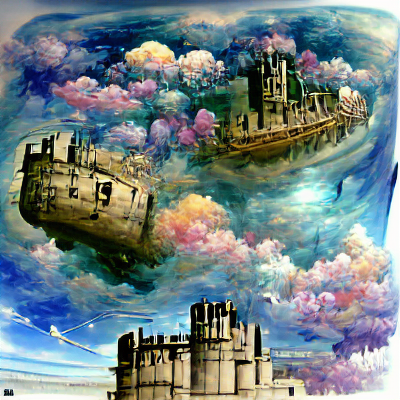
Over the past week I’ve been having some fun generating bizarre digital art with AI via a couple of websites. You generate the art by simply giving the AI a text prompt, such as “castles in the sky” and, after a couple of minutes, out pops the AI’s somewhat abstract but interesting interpretation:

Castles in the Sky

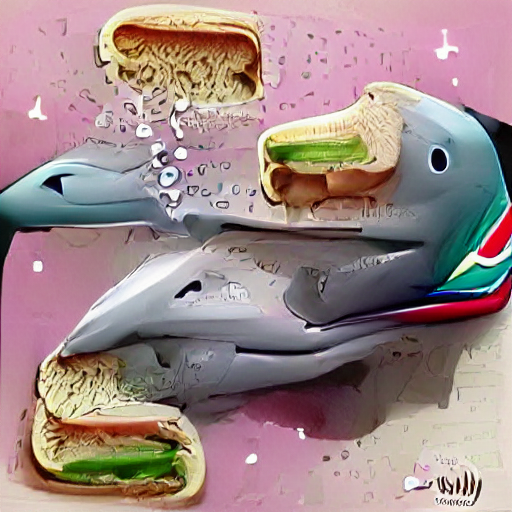
Since the results are rather abstract, it helps to use words that lack specific forms, such as clouds and landscapes. If you ask for an animal or human, you’re probably not going to get anything that actually resembles their shape, but rather only some abstract colors and textures that resemble them. For instance, here is “dolphins eating sandwiches”:

Dolphins Eating Sandwiches

It also helps to give the AI some hints as to what the result should look like. For instance, the exact prompt for “castles in the sky” above was actually: “An enormous castle floats in the sky beautiful artwork”. Adding the tags “beautiful artwork” help give it a more painterly look.

The art is also limited in resolution; the AI just takes too much memory for larger pics, so the smaller resolutions are the norm.

I’ve been using two websites to create such art:

  1. NightCafe Studio’s AI Art Generator. The site features a very nice user interface, lets you set some optional settings, and allows you to save and share your work while exploring the works of others. It does make you create an account and limits how much you can create with it using a credit system. You can buy credits or earn some. You can check out my profile here: https://creator.nightcafe.studio/u/Seanthebest
  2. NeuralBlender has no user interface or options, but does not seem to limit use. You do have to wait for the AI to finish its current image before starting a new one if you want to see it in your browser.

I have not yet tried it, but if you do a bit of Googling, you can find resources on how to set up your own AI art generator without having to use one of the websites above; the tech is called VQGAN+CLIP and is available to all. A “GAN” is a generative adversial network … and I have no idea what the other acronyms stand for (obviously you can Google that too). So I’m not sure how long the above websites will stay in service considering the tech is not proprietary, nor do I think the AI produces artwork of enough controllable quality to be of widespread use beyond offering an amusing spectacle.

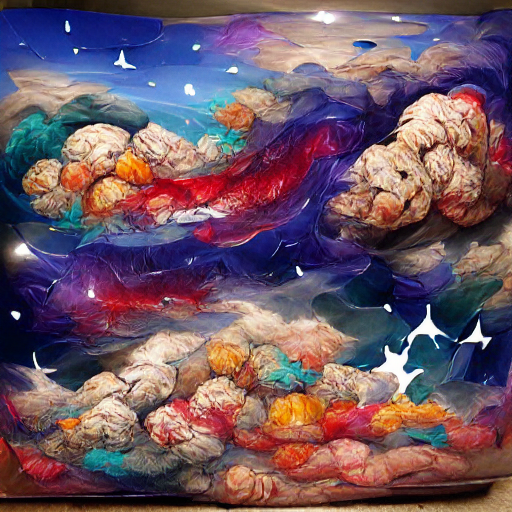
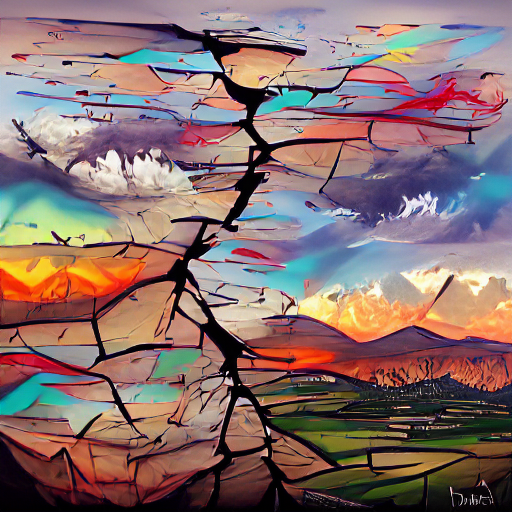
Still, it’s fun to play with. Here are some of my favorites that I’ve generated so far:

Colorful Clouds

Airship

The Sky Is Cracked

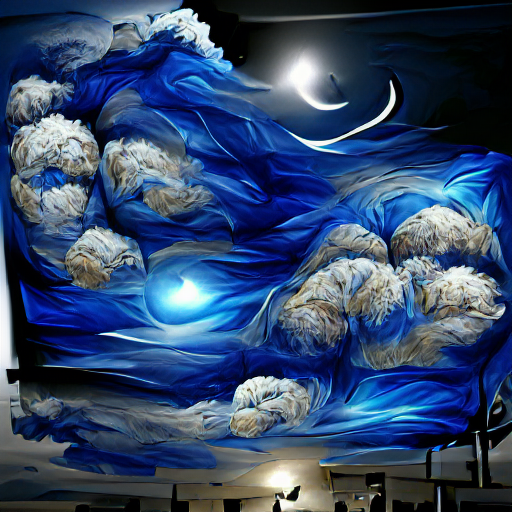
Blue Sky at Night

Stone Palace

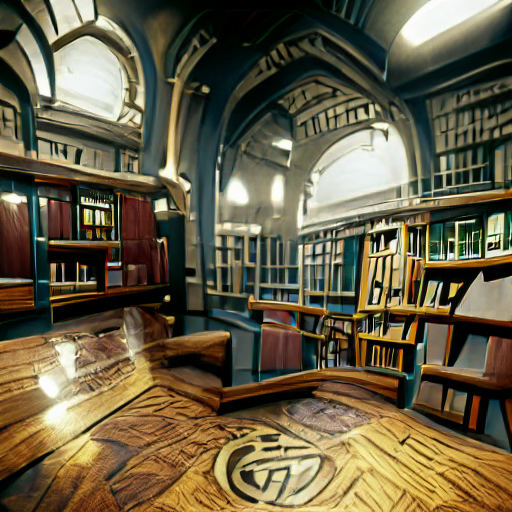
Library

Library 2

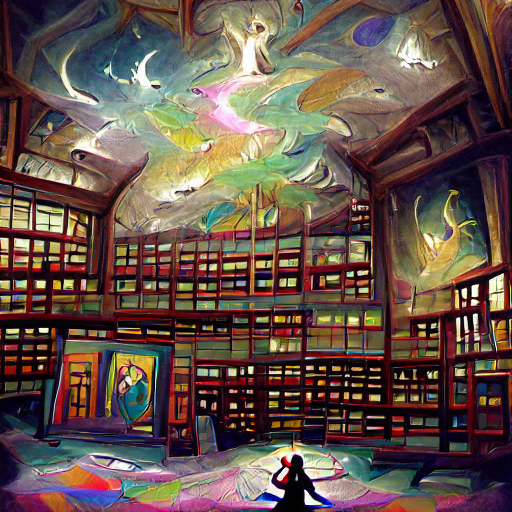
Library 3

Movies watched in May 2021

I’m a month behind already, so here are the movies I watched this May.

Wish I Was Here

In this 2014 film written and directed by Zach Braff, an actor struggling to find work decides to home school his kids after his dying father (Mandy Patinkin) can no longer afford to pay for their private schooling.

These indie comic tragedies are hit or miss for me, usually miss, and this one was definitely a miss. A lot of the humor was just not my style, such as kids cursing and being crass. Most of the more “serious” dialog didn’t work for me either, felt too obviously scripted. “I know you don’t believe in God, but maybe you can believe in family…” What is that supposed to mean? The main character getting all Walter Mitty daydreamy also made little sense to me. I couldn’t figure out Many Patinkin’s character, why did he seem overly judgmental at random times? His dialog just didn’t feel natural.

Overall, the film was just too thematically all over the place, I have no idea what it was really supposed to be about. Is it about death, unfulfilled dreams, responsibility, fatherhood? All those issues can play a part, of course, but thematically you gotta pick one so the overall story has some focus.

Things Heard & Seen

I honestly already forgot what this 2021 film was about. I think it was some kind of ghost story? Whatever it was, it was boring and forgettable. It did feature (and take its title from) a book from a 1758 called Heaven and its Wonders and Hell From Things Heard and Seen by Emanuel Swedenborg, an account of his spiritual visions, which I thought sounded interesting (though perhaps heretical from a Catholic point of view).

Third Person

This 2013 film from writer / director Paul Haggis was similar to his 2004 film Crash in that it features a small collection of characters with interrelated stories. They all share a similar theme, as they seem to involve a parent coping with losing a child to a pool drowning. As the film goes on, you start to understand what stories are only in a writer’s head and what is real. Overall, though, the story left me rather unsatisfied.

Come Play

In this 2020 horror film, a non-verbal autistic child is haunted by some kind of strange monster from an ebook on his tablet who apparently wants to take him to his creepy monster ghost world. If that sounds like a weird premise, it is. Somehow a phone recognizing a face just behind you that you can’t see isn’t really all that creepy. The film is ultimately more silly and stupid than it is creepy. The child does enjoy SpongeBob though, so it features some great SpongeBob moments.

The Suicide Song

In this 2007 Japanese horror movie, a popular song with mysterious origins seems to be involved in a series of suicides, a creepy premise that unfortunately doesn’t deliver. The story is too convoluted and confusing, jumping between too many characters and side stories, and the ending feels so random and out-of-nowhere that it doesn’t satisfy. Perhaps something was lost in translation; Japanese horror films do tend to have their own style and tropes. But I think this one was just too ambitious for its own good.

Objectified

This 2009 documentary is supposed to be about the design of everyday things, the ubiquitous items we use everyday whose designs we just take for granted. Unfortunately rather than actually explore the creative decisions designers make, the documentary makes the same sort of mistake as last month’s Steinway documentary; it turns into a bunch of talking heads sitting on stupid-looking chairs talking about their random opinions about their work. It’s such a lazy way to make a documentary. The viewer doesn’t learn much.

In Their Skin

In this 2012 horror / thriller, a family arrives at their vacation house and meets some new neighbors who are a little too friendly and won’t go away. It soon becomes apparent that these new neighbors want to kill them and take on their identities. Why? Because… whatever! The plot is nonsense and the dialog is bland. Another forgettable movie.

A Little Princess

I saw this as a kid, but hadn’t seen it in decades. Based on my 4x great aunt’s classic children’s novel, this 1995 film tells the story of Sara Crewe who is dropped off at a decadent but stiffling boarding school while her father (played by a younger Liam Cunningham of Game of Thrones fame) goes off to war. When news of her father’s death reaches the school, Sara finds herself in complete poverty, and must strive to keep her spirit alive after having her belongings and social status pulled out from under her. Although the film’s music and cinematography are fantastic (cinematographer Emmanuel Lubezki would go on to work on films like Gravity, The Tree of Life, and The Revenant), the screenwriting leaves something to be desired. Still, the overall story still works well enough.


Let Him Go

In this 2020 drama, a pair of grandparents set out to rescue their grandson and daughter-in-law after their son dies and his wife remarries an abusive guy from an abusive family. While the overall story was a bit bland with some stretches that just moved too slowly for me, it had some good suspenseful moments.

The Sleepover

In this 2020 family film, a standard sleepover turns upside-down when children realize their mother is a former master thief living in witness protection. Her former criminal colleagues try to force her to pull another job, leaving the overly clever and resourceful children to set out to find her. It’s a family adventure comedy, so of course everything is ridiculous and over-the-top, but it’s a fun little movie as long as you don’t try to take it too seriously.

Kingsglaive: Final Fantasy XV

This 2016 animated film is a tie-in (I think a prequel) to the Final Fantasy XV video game. I haven’t played the video game, and perhaps that’s the reason I understood nothing at all in this film. A lot of action, but I didn’t know who anyone was or why anyone was doing anything.

Minari

This 2020 drama takes place in the 1980’s when a small Korean family moves to rural Arkansas to try and start a farm. With little money and a lot at risk, family tensions run high. A sort of slice-of-life drama, it was a little too slow-paced and meandering for me. It didn’t feel like it ever really went anywhere, I think it needed more emotional focus. It got great reviews though, so it obviously worked for a lot of people, but wasn’t quite my cup of tea. It was funny how they thought Mountain Dew was a healthy drink though.

The Woman in the Window

In this 2021 psychological thriller, a woman with agoraphobia (Amy Adams) meets a friendly neighbor from across the street who then disappears. Fearing she’s been murdered by her abusive husband, she discovers the neighbor apparently never existed. Maybe her extreme anxiety is making her delusional? Or are her neighbors hiding some dark secrets? While it’s not a brilliant genre-shattering mystery, it’s a decent movie, perhaps reminding one of Hitchcock (though not quite a masterful). It’s perhaps a bit slow at times, but it comes to a satisfying (if predictable) conclusion.

Cantor’s infinities are meaningless and stupid

Overall, this video provides a good intro to some important math ideas:

Here are some random thoughts on the video:

I don’t think principles like undecidability necessarily imply a “hole” or “flaw” in mathematics. It only appears to be a “hole” if you’re assuming something should be there, like decidability. But that’s based on your assumption that it should exist in the first place.

The video soon turns to Cantor, giving me the perfect opportunity to finally rant about how foolish he was! (I’ve been intending to do so for some time.)

Cantor’s infinities are a bit of a pet peeve of mine. His foolishness, and the foolishness of those who nod in bedazzled wonder and agreement with his nonsense, stem from a lack of understanding the implications of infinity. Infinite size means no size. That can be confusing, because in this instance “no size” does not mean a size of 0. So how can something have no size without the size being 0? By being infinity. One must stop thinking about infinity as a number, but as a concept parallel to that of number.

So when Cantor asks (at 4:30 in the video): “Are there more natural numbers or more real numbers between 0 and 1?”

Woah, back it up, back it up, beep, beep, beep!

That is a nonsense question. It’s like asking: “What is five divided by green?” By definition, there cannot be “more” or “less” of something that has no amount to begin with. There are infinite natural numbers. There is not an amount of natural numbers, because there are an infinite amount, which means there is no amount. So there cannot be more, or less, or the same. There can be no comparison whatsoever because what you’re trying to compare is the amount, which does not exist.

Does infinity equal infinity? If you’re intending to compare amounts, the question is again meaningless nonsense. Infinity cannot, in this sense, equal or not equal infinity because you cannot compare them like finite amounts.

As the video shows, Cantor goes on to (rather stupidly) compare two lists. His methods are meaningless because his premise (that infinities can be compared) is already flawed. He then finds with his “diagonalization proof” that you can’t logically define a pairing between every natural number and every real number between 0 and 1, and in the depths of his infinite stupidity thinks that this somehow proves that there are “more” real numbers than natural numbers.

Uh, no it doesn’t, Mr Georg without an “e”. All you’ve shown is that you didn’t actually succeed in defining a pairing. You haven’t proven anything about sizes because infinite sets do not have sizes. Whether or not you can rigorously define a pairing (a one-to-one corresponce) implies nothing at all about sizes. It only proves your definition of the pairing to be paradoxical nonsense. You can’t say “let’s assume we’ve paired all natural numbers to real numbers between 0 and 1” and then say “here’s a real number that can’t be in the list!” That just means we didn’t actually pair the sets to begin with!

The crux of the paradox doesn’t lie in the “sizes” of the sets anyway (which don’t exist). It lies in the inability to express all real numbers with finite decimal places in the decimal system. If we take for granted that we could instead express some otherwise undefined real number with an arbitrary symbol (like, gee I don’t know, a natural number), the paradox is completely resolved. There is nothing to “diagonalize” and the one-to-one corresponse is complete. Logic 1, Cantor 0.

At 6:45: “Cantor’s work was just the latest blow to mathematics…” Perhaps more of a blow to mathematical philosophies than to math itself. Aside from being complete nonsense, it had no implications aside from morons thinking “oh wow, different size infinities sure is amazing, derp!” which is about as meaningful as thinking, “oh wow, five sure is colorful, derp!”

At 7:27: “On the one side were the intuitionists who thought that Cantor’s work was nonsense. They were convinced that math was a pure creation of the human mind and that infinities like Cantor’s weren’t real.”

Perhaps, but whether or not an infinity can be “real” is really not the issue with Cantor’s illogic. Also, his lack of logic in this particular area does not necessarily imply inherent weakness with set theory in general.

The video goes on to speak of set theory’s self-reference paradox. It is indeed a paradox, but is by itself really no weakness of set theory anymore than the existence of paradox itself is somehow a weakness of the human mind that conceives of them. In fact, one could say the ability of a system to define a paradox is actually a strength.  It’s like trying to make a programming language that doesn’t allow for infinite loops by taking out the ability to have any loops at all.

I really like the video’s explanation of Gödel’s work with using; actually, perhaps because it’s visual and tangible, I think it may be the best explanation I’ve seen!

At 31:34: Haha, what is this artsy-fartsy shot? “Look at my back as I gaze at the sky and ponder the deep thoughts of the world…”

The video ends by circling back to the “hole” in math, which is now defined as not being able to know everything with certainty, which seems a rather imprecise way of summing up undecidability and incompleteness as it takes for granted the meaning of “certainty”. I guess we could say: “Hey, Gödel, if math is incomplete, then your proof is incomplete and therefore not a proof! Hyuck hyuck!”

UFOs: Are they projections?

I was just randomly thinking about the strange ways in which UFOs seem to defy the laws of physics:

  • Anti-gravity
  • No visual propulsion system
  • Maintain insane speeds
  • Accelerate with insane force
  • Observed in air and water

But what if we’re taking it for granted that the UFO is a unit unto itself?

This isn’t a perfect analogy, but think about shining a laser pointer on the wall. With the rotation of the wrist, we can give the dot of light similar physics weirdness, albeit limited to two dimensions. The point of light doesn’t propel itself, so it doesn’t need a propulsion system. Likewise, insane speeds and accelerations are actually derived from magnified wrist rotations, and so are not nearly as insane as they seem.

Granted, this doesn’t quite explain the anti-gravity. Gravity’s effect on light is negligible from our typical standpoint; it’s generally not until we’re studying blackholes or light across galactic distances through telescopes that gravity’s effect on light becomes measurable. Assuming UFOs are not just light, it seems they’d still have to contend with gravity. Still, maybe whatever is “projecting” them provides the force needed to hold them aloft.

The analogy also breaks down dimensionally. The dot of light from a laser pointer projects onto a wall and bounces to our eyes. Without the wall, the light would just keep travelling and disappating into space. If UFOs are projections, what are they projecting onto? (This is also the obvious challenge of developing the sort of 3D hologram systems often seen in movies like Star Wars. How can we seemingly get light to reflect at a specific point in empty space?) And, for that matter, how can one project actual physical matter rather than just light?

I have no clue, I just thought it was an interesting idea.

Regardless, I’d love to know what their weird UFO things are and what exactly they’re doing out there.