Winter in Wartime
This 2008 war film from the Netherlands tells the story of a Dutch teenager growing up during the German occupation of the Netherlands. He finds a British pilot (who had previously just barely escaped being made into a meat pie) who had become stranded in the woods with an injury, and takes it upon himself to help the pilot escape the country without being captured by the Germans. With German uniforms and secretive spies all over the place, the task is not easy. Still, to me the film came off more as a light-hearted thriller than the edge-of-the-seat suspense thriller the premise seems to promise. But I suppose the film is meant to be more about the inner emotional struggles of the situation rather than the suspense it implies. But without any intense suspense, internal or external, the sentimental moments don’t have as much impact. In the end, it’s merely a fun film.

Pulp Fiction
I had never before seen this classic 1994 film from director Quentin Tarantino. It’s really a collection of three inner-mingling short stories that sound rather mundane when only their premises are stated: A hitman takes a mobster’s wife out to dinner, a boxer flees hitmen after not keeping his end of a deal involving an arranged match, and a hitman says: “aw, man, I shot Marvin in the face.” Bummer. Problems ensue. While the stories themselves weren’t very epic in any high-stakes sort of way (and were actually ridiculously over-the-top), Tarantino manages (as he does with all the other films of his I’ve seen, which right now only include Death Proof and Inglorious Basterds) to make each scene captivating, namely through dialog; what the characters say makes you want to hear what else they’re going to say. They are good storytellers. My theory, which I may expand on later, is that Tarantino interests listeners by getting them to wonder: “What?” Even if it’s something not important to the story. “Guess what they eat with french fries in other countries?” Who cares? But, because it’s framed as a “what?” question, the audience listens, because we have to find out what. It might be important. I’m not saying a character always has to ask something like “Guess what?” I’m saying that a character has to get the audience to ask “what?” Not “why?” or “how?” or “when?” The most important storytelling question an audience has to wonder is “what?” and if you can make them do that, the answer itself doesn’t matter merely as much. I’ve noticed this in some parts of Christopher Nolan’s movies as well. Anyway, fun movie.

My Life as a Dog
This 1985 film from Sweden tells the story of a 12-year-old who is sent to live with his uncle in small town after his mother falls terminally ill and can no longer manage her children. In the town, the boy gets to know some eccentric characters and does his best to fit in, while having to deal with the tragedy of his mother’s eventual death. Overall, it feels more like a dramatized memoir with a bunch of random but related vignettes; there isn’t much of a over-arching story, just shifts in mood. I didn’t really get much out of it, except learning about the somewhat disturbing story of Laika the dog, whom the main character compares his situation to, thankful that his isn’t that hopeless. But there wasn’t enough story for me, or enough conciseness in the narration. The hills of the roller-coaster of emotion all seemed a bit vague and unrelated.
A Bridge Too Far
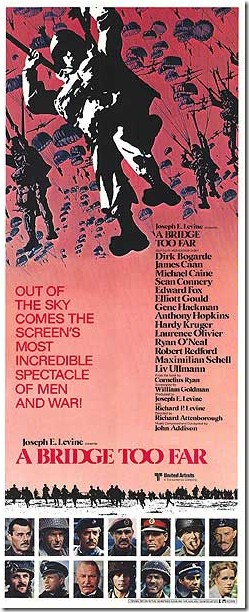
This 1977 war film was definitely directed by Richard Attenborough because, like all his films, it . . . spared no expense. The film tells the true story of Operation Market Garden, a failed attempt to capture strategic bridges in order to break through German lines in World War II, one key bridge being the John Frost Bridge in the Netherlands (which I think I saw in climax of Winter in Wartime). Near the end of the film, a British officer says the plan failed perhaps because they went “a bridge too far.” Gene Hackman tries out one of the fakest accents I’ve ever heard. I couldn’t tell if he was trying to be Scottish or Irish, but he comes across as an American trying to make fun of someone. In trying to keep the film true to history, the film follows all sorts of characters all over the place. We never really get a chance to relate to any one character, so it comes across as an elaborate documentary dramatization. The end result is epic in scope, but also boring. I guess they went a character too far.

The Pink Panther
This 1964 comedy starring Peter Sellers and featuring that famous Henry Mancini theme tells the story of a criminal, a bumbling detective, and a big pink diamond. The plot is rather simple: the criminal tries to steal the diamond, while Inspector Clouseau constantly fails to catch him. The slapstick comedy is sometimes quite funny and sometimes feels like someone trying to make a three year old laugh. Usually the latter. As in: way too forced to be funny. I think the cleverest part, however, was when Clouseau’s wife, who has two affairs going, finds them all in her room hiding from each other. Clouseau doesn’t know anyone else is there but his wife, the other two think they’re only hiding from Clouseau. And Clouseau’s wife manages to keep all her secrets. Quite a funny scene which I think they could’ve done more with. But, overall, it’s a super-cheesy film.
Das Boot
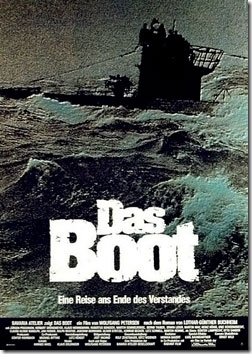
This 1981 war drama tells the fictional story of a German U-boat as it blasts enemies before being blasted itself and getting stuck on the bottom of the ocean. It was interesting to watch the characters go from optimistic crew members ready for some war action to tired bearded men fearing ugly impending death. And at 3 hours and 20 minutes, the Director’s Cut certainly gives the audience plenty of time to feel that change organically and believably. I couldn’t watch it in one sitting. Part of that is because Netflix sent me a blu-ray that became unplayable half-way through. But even if they didn’t, that’s a lot of movie to sit through, and it’s certainly not filled with action or drama like a long LOTR film. It’s very natural in its pacing, and keeps the audience feeling that dark claustrophobic U-boat feel. So you have to be in the right mood to take its slow pacing. But if you are, it’s actually quite engaging; nothing like the forced drama you get in The Hunt for Red October (though I enjoyed that movie too). Fun movie, if you’re in the mood to for something that length.

Seven Samurai
At three hours, here’s another long movie, but this had plenty of action, so it doesn’t feel like so long. This 1954 Japanese film from the famous Akira Kurosawa tells the story of common village farmers trying to defend against bandits by hiring seven ronin (masterless) samurai. Each samurai has his own personality and method of and reason for battle, so they come across as a “misfit crew.” The pacing works wonderfully; I don’t think trying to get so many characters introduced and recognizable and relatable through a character arc is a very easy task in three hours or less. It’s something I’ll have to study if I ever try to revisit my abandoned Harbringer trilogy, which features nine characters coming together to defeat evil. Anyway, very fun movie.
In a Better World
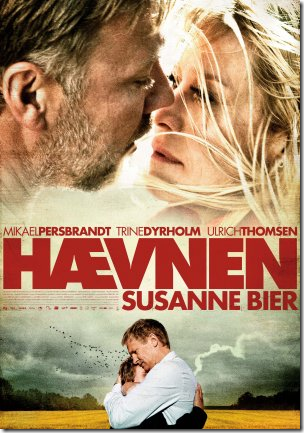
This 2010 Danish film tells three entwining stories all dealing with how different characters deal with revenge. Overall, the film seems to ask the question: what is the difference between justice and revenge? Where does one draw the line? Isn’t revenge a sense of justice? How, then, are they different? It’s a good question, and I don’t know the answer. The film follows the story of 12-year-old Christian who tries to cope with his mother’s death, and the injustice he perceives in it, by seeking justice at whatever the cost, even if it means breaking the law and doing very dangerous things. 12-year-old Elias, on the other hand, has to deal with bullies, but does not have the spirit to battle them; how will the new student Christian influence him? Meanwhile, Anton, Elias’s father, has to deal with some very unjust conditions as he works as a doctor in a refugee camp in Sudan. How can he teach his son the difference between right and wrong, revenge and justice, when he struggles with the question himself? Overall, though it risks running off with some subplots every now and then (I think the subplot of Anton trying to mend his troubled relationship with his wife only worked to muddle the already complicated story), it remains cohesive and engaging. Good movie; I can see why it won the Academy Award for best foreign film.

Anonymous
This 2011 film asks the question: did Shakespeare truly write his plays? Are you an Oxfordian or a Stratfordian? But rather than dramatize the question in any scholarly way, the film becomes an over-the-top ridiculous period political thriller. If the Oxfordian theory has any merit, it certainly isn’t given credence here, at least not nearly as much as it could have. I prefer the play The Bard of Avon. Anonymous was just silly.

The Thomas Crown Affair
This 1968 film starring Steve McQueen tells the story of an undercover agent trying to bring a mastermind bank robber to justice by attempting to seduce him, but ends up being seduced herself. The film features the dirtiest, most scandalous game of chess ever filmed. Save for the bank robbing scenes, the extremely catchy opening song (Windmill’s of Your Mind, sung by Noel Harrison, not Sting), and the film’s climax, the rest was rather boring.

Doctor Zhivago
This 1965 epic drama from epic director David Lean tells the story of a doctor, and his name is Zhivago. (That flag pole on the movie poster always makes me think of a syringe.) The film tells the story of Zhivago and the women he loves as they struggle through the changes of the Russian Revolution and the Russian Civil War. Very beautiful photography, cinematography, and musical score, and an engaging story. However, I’m not sure why we’re supposed to understand how perfectly OK it is for the doctor to completely cheat on his wife. The characters don’t question the morality of the doctor’s affair at all; it’s as if all the characters say “well, of course this is going to happen, so who cares?” I don’t get it. Maybe it’s more clear in the book. Also, as Kyle Smith writes in this article:
Zhivago … is essentially apolitical but he is also an idealist and when he returns home from the war to Moscow to discover that the People have taken over his home and moved 15 families into it, he pauses to process this infomation [sic] and then says “It’s much better this way. More just.”
Whether Zhivago is being sarcastic or not, it’s a funny reminder that even today people think of personal property comparisons as a measure of what is just. Finally, the entire story is being told Alec Guiness’s narration, so he doesn’t speak in his own story. It’s extremely annoying; very silly dramatization decision. Overall, though, fun movie.
Total Recall
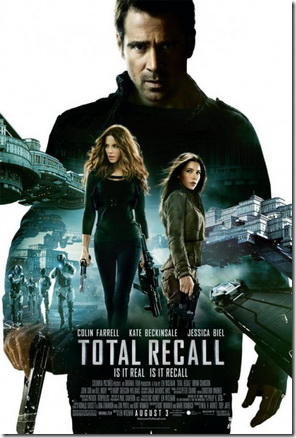
This 2012 remake of the classic 1990 sci-film got pretty bad reviews, so I wasn’t expecting much when I went to see it. I was pleasantly surprised to find that I enjoyed it immensely. Rather than thinking of it as a “remake” I think it’s more like a “variation on a theme.” One has to be familiar with the original film to understand some references. The pacing of the remake is also ridiculously fast, so it helps to have seen the original so that you know what’s going on. Anyway, it tells the story of Douglas Quaid as he visits a company called Rekall which implants exciting memories into people’s brains to help them temporarily escape from the dreariness of the real world. Something goes wrong with Quaid’s memory implant, however, leaving him believing that he’s actually some sort of undercover agent who’s forgotten his memories. So there are two possibilities: either he’s in Rekall, trapped in a fake implanted memory, or he’s really an undercover agent who has some conspiracy to uncover. There seems to be evidence for both takes, so which is it? Like some other films based on Philip K. Dick stories that got bad reviews, such as Paycheck and Next, I loved it. This is my sort of movie. The film also featured beautiful special effects. I especially love any sci-fi film with some vertical lens flares. Great film. And I think this is so far the only remake in which I really enjoy both the original and the remake.
Following
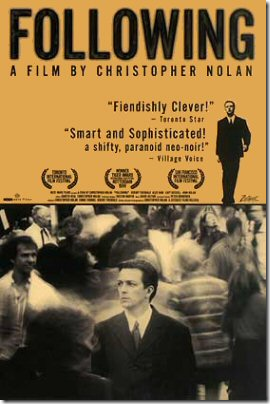
In my quest to watch all of Christopher Nolan’s films, I watched his first effort from 1998. This film tells the story of a creepy guy who likes to follow people. He finds himself following a petty burglar and the two decide to help each other out on some small-time burglary. But our main character soon realizes that this small-time burglar isn’t quite who he says he is, and that he’s inadvertently gotten himself involved in something a bit more sinister than he thought. Like Momento and The Prestige, Nolan tells this story out of order, jumping back and forth between past and present, following different plot lines, yet manages to keep it interesting and not confusing. It’s rather fun to piece it all together in your mind as Nolan guides you through making the necessary connections. While the story was fun, the writing wasn’t as refined as Nolan’s later films, from Batman Begins and beyond. Still, very enjoyable film, and very Nolanian.
The Thing
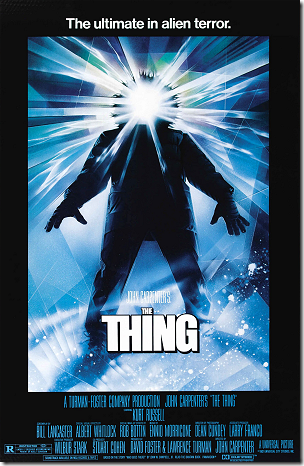
This 1982 horror film tells the story of a strange alien life form that infiltrates a small group of researchers in the Arctic. The alien has the ability to morph into human form, so it’s a constant mystery who is actually human and who is really “the thing.” This leads to a lot of fun mind games, and some ridiculously grotesque pre-CGI special effects. I wish I had caught glimpses of it when I was younger, because they would’ve scared me to death. Now that they’re dated, they come off as a bit cheesy. Overall, though, fun movie.

The Neverending Story
I first saw this 1984 film as a child, so I had vague memories of an epic fantasy journey involving a giant rock man, a giant turtle, a talking wolf, a furry dragon, a burnt face, a mean old bookseller who I didn’t realize was using reverse psychology, and a horse disappearing into mud. The story has all those things, but I didn’t realize how short and not-really-that-epic the story really is. I finally understand some of the thematic messages of the film about the role of imagination, but it doesn’t seem that mysterious and special anymore. Still, I enjoy the artistry of the puppetry, which looks much real and welcoming than the intangible CGI directors would use today. Fun movie, if only for nostalgic reasons.

ParaNorman
Already reviewed.
After the Fox
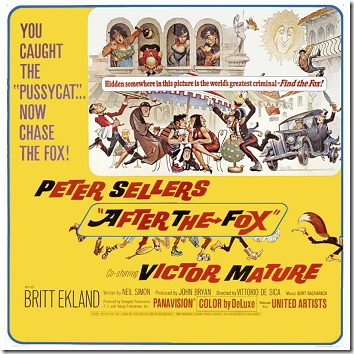
This 1966 comedy starring Peter Sellers and directed by Vittorio De Sica tells the story of a criminal who escapes from prison to help some friends steal some gold. How to pull off the heist when there are police all around? Pretend to be a movie director filming a movie, of course. The film hilariously parodies and lambasts popular directors of the time, including De Sica himself, who appears as himself in the film in a small scene. Quite hilarious film, though it pays to be at least a little familiar with the directors and styles they parody. But even without that, modern audiences should be able to find something to laugh at.
Fanny and Alexander
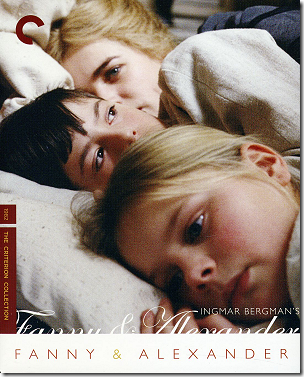
This looooooong 1985 film (5 hours, 12 minutes) from director Ingmar Bergman tells the story of two children who are sent to live with an evil stepfather after their real father dies. Like Tarantino, Bergman can somehow make long dialog scenes quite engaging (though I think Tarantino is better at it, perhaps because I speak English). The story also branches off to a number of subplots involving the children’s mother, uncles, and grandmother. The film features Bergman’s usual search for metaphysical truth. Does God exist? If so, why is the world like it is? Do ghosts exist? And while the characters may answer yes or no, an audience member definitely recognizes some spiritual things going on, and is left to draw his own conclusions about what the director meant by them. Bergman is very good at creating that strange sense of metaphysical mystery. Fun movie, even though some scenes dragged on far longer than necessary.

We Bought a Zoo
Dying parents certainly give characters in films some great problems to work through, don’t they? This 2011 film tells the true (but fictionalized) story of a man who buys a zoo after his wife dies to help his family cope with the tragedy. He knows nothing about zoos, of course, so problems ensue. I didn’t really understand this film; the entire story seemed a bit forced. And Matt Damon being a family man and having kids seems a bit too Mark Wahlberg-ish for him. And the ending was ridiculous.

The Grey
This 2011 film tells the story of a group of men trying to survive after their plane crashes in the Alaskan wilderness. If the unforgiving cold wasn’t bad enough, there are wolves who want to kill all humans. Liam Neeson’s character knows how to survive better than anyone, but who made him the boss of anything? And so Neeson and those he can convince to work with him set out to survive and escape the threat of the wolves. Fun movie.
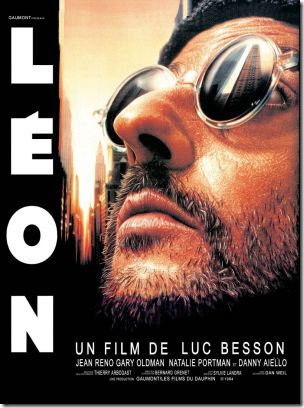
Leon: The Professional
In this 1994 film, a hitman, Leon, looks after a 12-year-old after her family is killed by corrupt police officers. Leon is street smart and is the best hitman there is, but lacks a lot of practical worldly knowledge, apparently having been a recluse most his life. In this way, the 12-year-old compliments his abilities, even while the two are as dysfunctional as a hitman and child from a dead dysfunctional family could be. The film features some amazing acting by a young Natalie Portman, and Gary Oldman comes off as a genuinely creepy and hate-able (if unrealistic) evil DEA officer. Fun movie.

Insomnia
And I complete my watching of all Christopher Nolan’s films with the only one he didn’t have a hand in writing (as far as I know) with this 2002 crime thriller. A man, played by Al Pacino, travels to Alaska to investigate a murder in a small town. When he finds the murderer, played by Robin Williams, he is blackmailed; Williams’ character has some dirt on Pacino. Fun movie, but, I suppose because Nolan didn’t write it, it doesn’t really feel like a Nolan film.

The Birdman of Alcatraz
This boring 1962 film tells the true story of Robert Stroud, a prisoner in Alcatraz who kept birds and did a lot of research on the treatment of bird diseases. After all, what better place for scientific research than a prison cell, where no one can bother you? His nickname as the “Birdman of Alcatraz” is a bit of a misnomer, as he kept no birds after his transfer to Alcatraz; he only kept birds in whatever prison he was in before. Alcatraz wouldn’t allow such a thing. The film does its best to show Stroud, played by Burt Lancaster, as a sympathetic character despite his murderous deeds that landed him in prison. The birds become a way for him to cope with the world he can’t seem to find his place in. But it doesn’t take any effort to love things that can’t hate you, so what is the reward in that? For me, the real failure of the film was that the subject was boring, always a threat when trying to make a film inspired by true events.

Micmacs
This 2009 French film from stylistic director Jean-Pierre Jeunet (director of The City of Lost Children and Amelie) tells the story of a man whose father is killed by land mine. Later, as an adult, he his shot in the head by a stray bullet from street crime. The injury puts him out of work and out of a place to live. He finds a home with a strange set of misfits who live underground, like something out of a strange children’s cartoon. With the help of his new friends, he decides to seek some vigilante justice on the evil weapon manufacturers that killed his father and put a bullet in his brain. The results are some over-the-top inventive unrealistic but funny plans. Overall, though, I just couldn’t feel at home with the misfits. I think I just didn’t like the color scheme.

The Eagle
This 2011 film tells the story of some Roman soldiers venturing northward to retrieve a lost Roman eagle standard from the evil northern British territories. (I guess that’s why the Romans have American accents here?) Fights ensue, but nothing exciting ever really happens. The end.

Pickpocket
This 1959 French film from director Robert Bresson tells the story of a man learning to pickpocket and then trying to evade the authorities as he can’t seem to stop himself from the thrill of pickpocketing. The film is interesting for the actors’ almost non-acting. They look down most of the time and recite their lines, not even trying to put emotion into their words. This eliminates cheesy overacting, but what’s left? A strangeness. Not unrealistic, but not realistic either. Stylistic, I suppose. While the main character is not someone the film even tries to make the audience sympathetic with, it does well to make his situation intriguing enough for us to wonder when and how he’ll be caught, and even fear the moment, as inevitable as it seems. Fun movie.

A Shot in the Dark
The bumbling Inspector Clouseau returns in this 1964 comedy. A shot is fired, in the dark! A man is killed. Who shot him? Was it the pretty damsel? Or someone else? In a country home in which just about everyone seems to be having or is the victim of an affair, everyone seems to have some twisted motive. While the overall mystery was fun, Sellers’s slapstick humor again goes from being funny to being three-year-old cheesy. “Oops, I almost tripped on these steps! That sure is funny, huh?” No, it’s not.

Brewster’s Millions
This 1985 comedy starring Richard Pryor and John Candy tells the story of a man who inherits 300 million dollars, but can only have it if he spends 30 million dollars in thirty days without having anything to show for it. The premise really makes no sense at all, but provides the setup for some hilarity to ensue, and ensue it does. Pryor’s actions make no sense to anybody. As he tries to spend his money on frivolity, his friends are left trying to help him keep some of his fortune, or thinking him a selfish ignorant stupid jerk. Fun movie.

Game of Thrones, Season 1
Some parts of some episodes were interesting, but overall the story was just too all over the place. It never felt like there was a clear overarching conflict; it felt like a child making up a story as he went along. I guess wondering where the characters will end up next is intriguing enough, though, as I constantly wanted to know what would happen next. It’s also ridiculously annoying how HBO felt they had to work nudity somehow into every episode to appeal to man’s most carnal desires, because Hollywood knows humans are slaves to their animal temptations. There also seemed to be plenty of “filler” scenes, scenes in which one character would be sitting or standing there, and another character would walk up and start some argumentative conversation, but at the end of the scene the story had hardly progressed. It was just some verbal conflict for the sake of itself. Anyway, overall, engaging show in which you never know what’s going to happen next (probably because neither did the author when he was writing it).
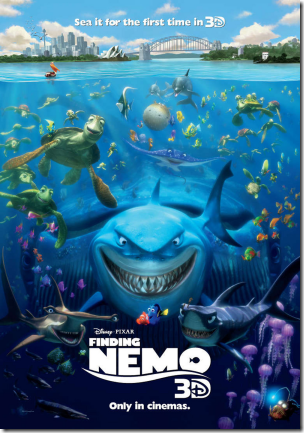
Finding Nemo 3D
Finding Nemo remains my favorite film from Pixar, so I couldn’t miss the chance to see its 3D rerelease. I enjoyed it very much. Unfortunately so did a row of obnoxious children a few rows behind me. They enjoyed it a little too much, and quoted everything.

X-Men Origins: Wolverine
I wanted to some more work from Gavin Hood before Ender’s Game in 2013, which I remain cautiously optimistic about, I guess. Anyway, the X-Men origins movie wasn’t as bad as I thought it’d be based on what I’d heard; it was at least as good as the least good X-Men movie, and better the X-Men: First Class. Still, the character struggled with boring issues, and I don’t know the comic world well enough to be impressed by any comic character representations. Merely a fun movie.
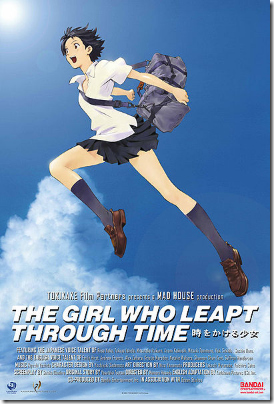
The Girl Who Leapt Through Time
This 2006 anime movie tells the story of a teenage girl who discovers she has the mysterious ability to leap through time by somehow leaping . . . through time. It reminded me of Groundhog’s Day at first, in that the girl first uses her powers to her own advantage to have her “perfect day.” If anything goes wrong, a leap through time gives her another chance. But she soon learns that all her decisions have consequences. If she uses a time jump to leap out of the way of a flying fire extinguisher, for example, it will hit someone else. If she turns down an opportunity for a date, the guy will ask someone else. Realizing that makes every decision extremely intriguing. I would’ve liked to have seen the girl use her time-leaping powers for more than relationship struggles (she really needs to sort out her emotions and stop trying to change subjects), but overall I highly enjoyed it. Good film; I’ll try to catch some of the director’s other work.
Alcatraz, Season 1
I finally finished watching the first and final season of this ridiculous sci-fi crime drama. The show ends with plenty of questions left unanswered, because how could writers write for just one season these days? Not a very good show. I’m not sure why I kept watching. It’s cancellation comes as no surprise.

Solaris
This 1972 Russian sci-fi film from director Andrei Tarkovsky tells the story of a scientist, Kris, who travels to a space station orbiting the mysterious planet of Solaris to investigate what’s going on with the station’s scientists. As he finds out, the planet Solaris seems to create things from the scientists’ minds, including Kris’s dead wife. Despite some cheesy 70’s special effects and some ridiculously long takes that put even Stanley Kubrick’s 2001: A Space Odyssey to shame, the film asks some intriguing (if not confusing) questions about the nature of human consciousness and knowledge and love and emotion. Can you have a world inside yourself? Would that world be enough to sustain you emotionally? How much of your own conscious experience comes from yourself? I’m not sure if the film meant to ask these questions directly, but those are the questions that intrigued me while watching. Good film.
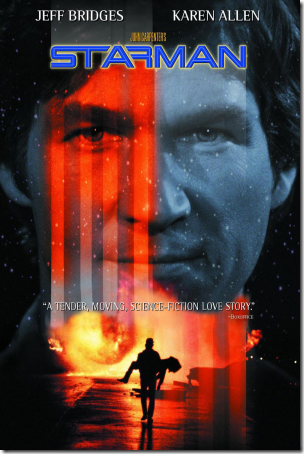
Starman
And on the other spectrum of sci-fi flicks involving the resurrection of dead spouses is this 1984 film about an alien who comes to earth for no good reason. He (or it?) finds some dead man DNA in a lock of hair kept by his wife and morphs into his shape. He then asks the wife to drive him to where he needs to meet up with a spaceship that will take him back home. The women is terrified at first, but grows to love the alien-in-her-dead-husband’s-body. The alien is very kind, even going so far as to impregnate her with dead-husband’s-baby, because he is just so kind. Unfortunately, scientists have detected that an alien has come and, in typical scientist fashion, want to capture him and do experiments on him! Oh no! Will the dead-husband-alien and the woman get away? Really awful cheesy movie.