I recently finished a novelette of around 11,400 words. (I’m using the SFWA‘s definition of a novelette: a story between 7,500 and 17,500 words.) I think that’s the longest work I’ve ever written and actually finished. The story is called Dreamgiver, and you might be able to guess what it’s about: a man has the power to give people dreams. I’m sure it’s been done in fiction somewhere before, but hopefully my story still has some newnesss to it. I could probably write many more stories from that same idea; I think it leads to a lot of possibilities. I could probably write a series of novels based on that premise, if I could actually finish writing novels. I’m not sure the name Dreamgiver is the best, but it’s straight-forward and to-the-point. It sort of instantly tells you what the story is about. That said, it does seem just a wee bit cheesy to me. But then, my writing probably seems cheesy to some people, so I guess it will match.
Anyway, I’m going to send this story through Critters some time to get it critiqued, though I realize I won’t get many (if any) because of it’s length. Right now my previous short story, No One Was Abendsen, is in line waiting to get critiqued. I’ll be very interested to see how people react to that story as it was somewhat experimental for me.
I’ve got some other ideas for short stories floating around in my mind, so I’ll probably try my hand at another one before I get back to composing music.
Favorite books on writing
First, I’ll just tell you what the books are:
The Art of Fiction: A Guide for Writers and Readers and The Art of Nonfiction: A Guide for Writers and Readers
 by Ayn Rand
Characters & Viewpoint and How to Write Science Fiction & Fantasy
 by Orson Scott Card
And now I’ll blather about my reasoning:
I think reading books on writing is much easier than actually writing, so I think it can be dangerous for wannabe writers to constantly seek out books on the subject. They can only be helpful if you actually spend some time writing. No amount of reading can replace that. That goes for the other arts as well. You can’t learn how to compose music by reading music theory books. You just have to do it. I think sometimes there’s a fear of failing, so the wannabe artist spends more time reading about the subject than actually practicing it.
Similarly, beware of writing about writing. I think writing about writing is also easier than actually writing. There seem to be a lot more people wanting to talk about writing tips and hints and how-to’s and strategies than there are successful authors. I don’t think that’s necessarily bad in and of itself, people can talk about whatever they want, and even unsuccessful authors can have some very helpful tips. Just make sure you don’t forget what it’s all for: actually writing. (On a side note, sometimes it seems like some writers who write about writing just sort of regurgitate advice they’ve heard before and don’t really understand why it exists. For instance: “show, don’t tell!” Make sure you filter any writing advice you hear through your own opinionated mind; you are allowed to disagree. Never blindly follow advice, otherwise you can’t really follow it.)
That said, there are very few books on writing I’ve read all the way through. Usually I find books on writing to be empty or boring or pointless or simply a collection of regurgitated advice. I find advice like “make your main character interesting!” completely unhelpful. Duh, I wanna make my character interesting. If a writer doesn’t know that intuitively, full time consideration of another endeavor might be in order. (On a boring a tangent, I hate when people suggest you need to know every tiny little thing about your character, like their eye color and height and shoe size and favorite ice-cream, as if you’re playing The Sims. That’s great if it helps you, but to me it’s a complete waste of time.)
In my opinion, the best writing books are not actually books on “How To Write”, they are books on “What This Author Thinks About Writing”, and I think that’s the way it should be. Writing is an art, not physics. It is guided by people’s tastes and opinions, though some academic writing books might want you to believe otherwise. Therefore, I think the best writing books for you are the ones written by the authors you already know you enjoy. For some reason, I think that kind of helps you know where they’re coming from. Because you already like their fiction, you’ll probably agree with most of the advice the writer gives and the opinions he or she has.
If the only writers you like are ones that have nothing to say about the process of writing, then you’re out of luck. Too bad; I guess you can never be a writer.
Fortunately for me, that’s not the case. Two of my favorite authors are Ayn Rand and Orson Scott Card, and they both have books on writing, so those are pretty much my favorite books on writing.
Ayn Rand’s Books on Writing
 I can’t say I agree with all of Ayn Rand’s philosophies, but I’ve found her writing to be quite immersive. In my opinion, she’s fantastic at describing characters’ motivations and attitudes. Her stories also have very strong themes, which I think is lacking in some of the fiction I read. So much fiction these days is purely about the action and has nothing to say beyond that. It’s like the author saw an action movie and just wanted to regurgitate it with different characters. Anyway, Ayn Rand talks all about themes and how they relate to plotting.
Rand also talks about creating believable characters and dialogue. Usually I think some beginning writers (I’m obviously a beginning writer too) think those are the easiest things: creating believable characters and dialogue. Personally I’ve found it difficult. When you have two characters who have completely different world-views, you really have to get inside their heads for each line of dialogue. Back and forth and back and forth you have to go between trying to trick yourself into believing things you don’t. Tricky, in my opinion. Well, some scenes aren’t, some scenes are pretty fun, especially if you’re writing humor. Other times, it’s just plain hard.
Finally, Rand talks about style and writing descriptions. If you’ve read her fiction, you might know she can be very verbose in her descriptions, and in my opinion, it works. For her. I think if you try to mimic her, you’ll just come off as being far too wordy. So, in my opinion, what she has to say about style is very helpful.
Although The Art of Nonfiction is about writing nonfiction, I think a lot she says in that book still applies to writing fiction, so it’s a great companion to the other one. I won’t blather much about this book, though, because I have a headache. If you like The Art of Fiction, then The Art of Nonfiction is also worth a read.
Orson Scott Card’s Books on Writing
 As I stated above, I find that characters can be quite tricky. Fortunately, Orson Scott Card wrote an entire book on the subject: Characters and Viewpoint. However, don’t let the title trick you into thinking this book is about a small subject in fiction. Characters without stories and stories without characters are extremely hard to find; they’re very strongly linked. Thus, in my opinion, learning about creating characters is learning how to create a compelling story. So it’s not like you’d get this book and then say “Oh, now I need a book on plot!” . . . though Card doesn’t talk about it by itself, you’ll still find that it relates strongly to characters (character development, duh!). That said, this book is part of a series called Elements of Fiction Writing, the other books by other authors. I found this addition to the series to be the only one worth buying.
Card’s How to Write Science Fiction and Fantasy lets him deal with the entire subject. There is just a wee bit of overlap, and Characters and Viewpoint I thought was overall more helpful (for me), but this is still a very worthy mention.
The End
These books aren’t long; they’re all under 200 pages. I’ve found them so useful that they are among some of the only books I reread every now and then. They’re the most worth buying, in my opinion, or at least checking out from a library.
To restate what I said above, I think the best books on writing for you will be the ones by writers you enjoy. I’ve taken a look at many books on writing, and they can certainly get empty and useless. Above all, don’t blindly agree with what you read in books on writing. Just because it’s published doesn’t mean you have to like it; you’re allowed to disagree. There are no “rules” in art, only observations and opinions. Think for yourself. Then when you come across a book on writing you do agree with, it will be far more helpful. Ayn Rand and Orson Scott Card do not agree on all subjects when it comes to writing, as is evident by these books. So I get to determine who’s right and who’s wrong. Neener neener.
So write! Now!
 There are a couple reasons I felt compelled to write such a post. Firstly, I’m reading quite an interesting psychology book called Human: The Science Behind What Makes Us Unique
 I wasn’t sure what to make of Gaiman’s post… I hadn’t really considered the idea that non-humans might have religious feelings. It just seems rather… absurd. But then again, I guess it depends on how you define religion. We humans tend to believe in a difference between right and wrong. Why wouldn’t animals? It’s needed for the survival of the individual and of the species. I would think it would be part of their psychology. I guess my puzzle is… where is and what is the nature of the link between believing in a difference between right and wrong and religion? I’ve met many an atheist who think religion is not just stupid, it’s evil. But that seems like a religious statement in and of itself; the word “evil” presupposes the existence of an objective right and wrong. How can anyone truly be atheist while believing in an objective difference between right and wrong? Wouldn’t true atheism just lead to moral relativism? Or should psychology by itself lead to moral relativism? But if atheists who believe in an objective difference between right and wrong are really religious, then wouldn’t animals also be religious, in a very fundemental way?
 , which sort of reminded me I wanted to blather about these thoughts. It’s a good book, though it’s really not as much about the craft of writing as the other books I mentioned in my last post are. In many ways it’s more about life philosophies and how they relate to writing. It’s extremely funny at times, and has some very poignant moments. I’m not sure I agree with all of Lamott’s thoughts, but it might just have to do with my interpretation of her words. She almost seems to encourage people to delve into their sufferings for material; to bathe in the unpleasantness they’ve experienced in their life for their writing. While I do agree with a lot of the other things she says (and really enjoy how poetically and humorously she says them), the suffering issue somewhat inspired this post.
 These thoughts are somewhat random… I’m not sure I’m trying to make any overall point, I’m just making observations and suggestions to myself for the most part. Hopefully it won’t sound too corny. But let’s face it: deep down in our hearts we’re all corny and sentimental. (Get it? Cuz that’s, like, sentimental right there?) Anwyay, here I go:
 I know there are plenty of artists who use art as a way to “release their emotions” … I guess it’s kind of a self-therapy. I guess whether or not such an act is useful depends on how it’s done. I think sometimes it can help the artist find answers to his problems. I like to think that writing literature is, in a way, searching for answers within oneself. That might sound corny, but I think it’s really true. Where else are you going to find any moral answers you can believe in? (That’s not an argument for moral relativism, by the way!) But I think “letting it out” can also help an artist to continue to hurt himself if the artist becomes dependent on such feelings to produce art, if that makes any sense, or if it just encourages the artist to dwell on terrible feelings.
 I don’t know how it emerged, but at some point having a “dream” became a very romantic thing. Children are raised being encouraged to “follow their dreams” and even adults are encouraged to continue to pursue them. Woah!! Doesn’t it matter at all what the dreams are? I think it does. I’ve talked to artists who long dreamed of becoming rich and famous, of having their work influence thousands or millions. And then their dream doesn’t come true and they become bitter and think about giving up. I guess the real problem is that it became more of an expectation than a dream. It became something they expected to achieve, and something they were depending on to find happiness. That’s just stupid!! I can understand the natural desire to want fame and fortune, but if you’re secretly expecting such things and depending on them for happiness, you’re an idiot. Just stop wanting them! Stop! Now!
 , and I have a few quotes from it to put up on my
  I also finished reading a fantasy book by Kage Baker called
  . It was a short book that came out in 2004, and I think it’s out of print now. I wanted to read a book by Kage Baker because I had read a few of her short stories and enjoyed her style. It was pretty light reading; the plot never got extremely thick or dark and the world never seemed very complex, but it was still engaging and believable and very humorous. Not a bad read at all.
 , a nice all-in-one volume I got for Christmas, but now I’m also reading T. H. White’s
  , the book of the legend of King Arthur, which has definitely been enjoyable so far, especially since I already know how parts of the story go, and this book kind of fleshes things out.
 First, I mention that my short story Oberon’s Paradise has once again been rejected because it’s such a terrible story.
 – I orchestrated a tune called The Cornish Wassail for the free album
  In my 23rd year of life, I didn’t get much music written. Last year I somehow managed to write over ten pieces, but this year I think I only finished four more, Opuses 42 through 45. I haven’t uploaded all of them to my MP3s page yet, but I think they’re all on YouTube. Only four, that’s pretty dismal. Oh, I also did a Christmas tune orchestration, I orchestrated the Cornish Wassail tune. I’ll be releasing that soon; it’ll be part of a free Christmas album released by Garritan this holiday season.
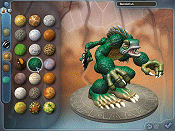 Also earlier this week, I found a very interesting video on YouTube with game designer Will Wright and some musician that I’ve never heard of. They were talking about generative systems, which Wikipedia calls “systems that use a few basic rules to yield extremely varied and unpredictable patterns.” So, they are basically systems which are good at producing emergent properties. The video from YouTube is just a clip from a much longer talk they gave (available to see