Ikiru

I recently subscribed to Netflix so I could catch up on watching a bunch of movies (old and new, but mostly old) that I’ve been wanting to see.  So I might have some random blog posts every now and then about random thoughts on random old movies.  (There may be some spoilers in such posts as these, in case you care.)

The latest film I watched was Ikiru from 1952.  The film tells the tale of an old civil service worker, Watanabe, who is quite bored by his job but bears it anyway.  When he learns he has stomach cancer and has less than a year to live, his life suddenly seems incredibly wasted and he’s not sure how to cope.  Overall, I thought it was quite good, though the pace was a bit slow for me at some parts.  Also, the second half of the film was quite strange.  Half way through the film we jump forward in time to after Watanabe’s death, and are given the rest of the important moments leading up to his death in flashbacks recounted at his wake by those who knew him.  On the one hand, telling the second half of the story in flashbacks allows us to see how Watanabe affected others with his behavior, and allows us to easily skip around to the more interesting moments, without having to see resolutions to each and every scene.  I guess the problem I have with it is that the style of storytelling is just too different from the first half.  I think flashbacks would’ve worked if the director had actually told the entire story that way, instead of just the second half.  Instead, we go from seeing the world through Watanabe for half the film, to viewing him from the outside.  Perhaps that was the point, but I think the story would’ve been stronger if the director stuck with one method throughout.  Or even overlapped them throughout.

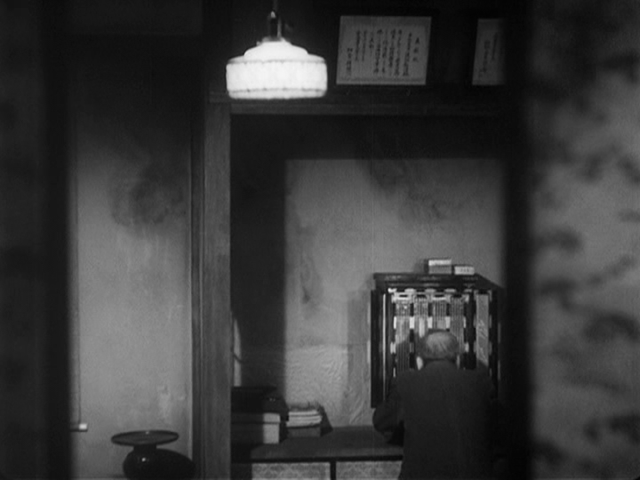
One thing I loved about the movie was the cinematography.  There was some awesome use of deep focus, which we seem to get hardly any of in movies today: shots in which almost everything is in focus; what’s close to the screen and what’s far away.  Here are some shots I particular liked:

Watanabe’s head is taking up half the screen, but our focus is on the guys on the other half, as they look at him and are surprised and not very pleased to see him back at work.

A few similar shots, with only three people in each shot, each at varying distances and heights, making each pleasing:

A couple shots with more people, all arranged so we can see all their faces clearly, and know what they’re focusing on:

I love all the enormous stacks of paper in that office in the first shot; probably a bit tongue-in-cheek to show how wasteful such work is, with paper and energy and time. And I love the composition of that second shot, with the faces all arrayed so nicely and clearly. Who these days would take the time to create a shot like that?

Some nice frames-within-frames:

(OK, that last one’s a bit of a joke – because it’s literally a frame.  Heh heh heh.)  I especially love that playground shot.  Symbolic?

Here was a great little sequence.  In the first shot, we have our characters talking in the foreground, a man sitting behind them, and other people way in the back.  As the conversation continues and intensifies, Watanabe moves and blocks out those people way in the back.  As the conversation intensifies even more for Watanabe, he switches sides, coming closer to the camera and turning from the speaker.

Some nice “shots from behind”:

There were some nice two-way dialog shots in which, with the deep-focus, the background between the two characters was quite clear, almost to the point of distraction, yet the subject matter of the conversations kept the attention on the characters’ interactions:

Here’s a very nice silhouette shot.  The focus (and subject matter of the characters’ dialog) is the sky.  Too bad it’s not in color.

This was an interesting moment in the film.  Watanabe is walking downstairs; he’s just had a flash of inspiration.  He’s just come to terms with his death.  It’s a pivotal moment in the film.  It’s the “break into three” after the “all the lost” moment.  So he rushes down the stairs and the people behind him are singing “Happy Birthday” in English to a character who’s off screen.  But the song might as well be for him.  It’s such obvious use of . . . some thematic device.  I almost burst out laughing.  (Actually, not almost, I did burst out laughing.)  He finally comes to terms with his impending death, and this group of happy young people are singing “Happy Birthday.”  It’s almost silly.  I certainly would never have thought of something like that.

In the shot afterwards, we see the girl he was just talking to.  She’s not sure what just happened.  But, with the deep focus, it looks as if she’s watching that group of happy people across the room, looking down on them.  A group of privileged young people around her age that she’ll never be a part of.  It’s almost rather sad.  Someday, when mortality is knocking on her door, she may suffer the same inner-trials as Watanabe.  We don’t really leave her character on a happy note.  Or maybe she’s just sad that Watanabe took her toy bunny.

Here’s an excellent mirror shot.  How else can you have two characters facing each other, yet not facing each other?  Gotta love shots like these.

Then we zoom in on the mirror so we have this great line-up of talking heads with shiny glassware lined up underneath.  Nice.

And, finally, my favorite shot.  Watanabe is dead, and this character has vowed to be more like him, or at least how he was after he changed in the months before his death.  Here, this character just had an opportunity to hold true to his vow.  He stands up and looks at his coworkers as if to say: “C’mon!  Did Watanabe teach us nothing?”  But then he cowardly changes his mind and sits back down, slowly disappearing behind the enormous stacks of paper, letting himself sink back into the drudgery of life.  Sadly, nothing will change for this man anytime soon.

Facebook Parenting… is sad

Ugh, this just makes me sort of sick. I obviously am in no place to judge the whole situation, but I can judge the side of it shown in the video. If your child treats you with disrespect and breaks your heart (or at least embarrasses you publicly), you do not respond in kind. That is irresponsible, immature, and objectively morally wrong. Seeing people applaud the man fills me with sadness. Why would you ever applaud someone hurting someone else? Even if this punishment was just, it would be a tragedy for it to be needed.

According to posts made later by this man, everything is OK, the teen is not scarred for life, the computer wasn’t that important, etc. That’s good, but it doesn’t excuse the objectively bad parenting, and him claiming “because that’s the way I was raised” as justification seems to imply baseless judgment. Do you think you were raised perfectly?

I’m not saying that I think parents can be perfect all the time, but they do have the higher position in the relationship, and they should at least try to use that position to admit their imperfections, ask for forgiveness when necessary, love unconditionally, guide with behavior, and keep themselves from descending into petty shouting matches or games of revenge. Easier said than done, of course, but they should at least agree that that is the standard they should hold themselves to. If this father doesn’t realize what he did was wrong, what will the child learn? How will the vicious cycle break?

Finally, here’s Inigo Montoya to sing you a song…

Work started on Melody Generator 2.0

I’ve finally started working on a new version of my Melody Generator for Android. I’m pretty much rewriting all of the code for it, attempting to make the algorithm work more efficiently. Currently, parts of the program work by generating random sets of data and then looking through the data to see what’s usable. It works, but it can be pretty wasteful. (A bit Monte Carlo-ish — which is easier to program for melody generation, but not really needed.) I’m trying to redesign those parts so that they’ll just go “bing, bang, boom, done!” straight through, wasting no time generating and analyzing random piles of possibly unusable data. The new algorithms should also make it easier to add new features to the generator in the future.

Also, the resulting melodies should, according to my theory of melody, sound better, but I haven’t re-programmed enough of it to test it yet. (My theories work well enough for me as a human, but I think the ultimate test of completeness for a musical theory is getting a computer program to do it so all your human-based biases are sure to be out of the way.) If interested, let me know what new features you’d like to see… here are the features I’d like to add for Melody Generator 2.0 (in no particular order):

1. Any key possible, major or minor
2. 2-bar, 4-bar, 8-bar, 16-bar melodies possible (maybe more)
3. Triplets possible (16th note, 8th note, quarter note, half note)
4. Chromaticism possible
5. Pentatonic scale only possible
6. Note amount preference (do you want more notes or less notes?)
7. Syncopation preference (more or less syncopation?)
8. Fix interface problems (e.g. text buttons too small, etc.)
9. A few more bass note accompaniment options (e.g. play arpeggios?)

Heh… that’s a lot of work to do. It will take some time. Anyway, for now, I’m still on step one: rewrite the algorithms. Stay tuned…

Evolution cares not about overpopulation

Every now and then I’ll hear someone say something like: “This [insert trait here] makes perfect evolutionary sense! It prevents overpopulation!” But it shouldn’t take much thought to realize that this doesn’t make much sense.

Firstly, any given trait of any given animal cannot be said to exist only by having provided an evolutionary advantage to past generations. That is, some traits can be passed on from one generation to the next despite being a burden to the quality of that organism’s life, as long as it does not too greatly hinder the reproduction of the population as a whole.

Secondly, how would overpopulation reduce reproduction of the population as a whole anyway? Overpopulation comes about when the ability to breed is easier than the ability for all members of a population to access needed resources to live long enough to continue breeding. This will prevent the reproduction of some members of the population, but it would not affect the reproduction of the population as a whole. Therefore no evolutionary traits could possibly be passed on to prevent overpopulation. If a trait by itself hinders reproduction, it won’t be passed on. Overpopulation does not hinder the reproduction of the species as a whole — therefore it causes no evolutionary effect in and of itself. (The fight for needed resources may have evolutionary effects if those without the necessary access to the resources die off, but the cause of the scarcity of the resources is irrelevant; it doesn’t matter if the scarcity of a resource is caused by overpopulation, by competition from other populations, or if the resource is just naturally scarce.)

Every population will continue to reproduce until it reaches the limits of its needed resources, or until the limits of the resources change or the population is gobbled up by some other population (or controlled by humans). In this way, you could say it is natural for every population to breed until overpopulation occurs. The only population that can escape this nature is the human population, because we can make the conscious decision to not breed.

So, if you ever find yourself asking: “Hmmm, I wonder why [insert trait here] is passed on from generation to generation even though it does not aid reproduction?” and then find yourself answering: “Oh, to prevent overpopulation!” — please take a moment to consider your lack of logic and amend your thinking ways.

Rewriting the literary classics!

If movies have remakes, why don’t books have rewrites? I guess I will start the trend. I will first rewrite both Lord of the Rings and Peter Pan in one book. Frodo is a flying hobbit with a magical ring that prevents him from getting old, and he goes on an adventure with the lost fellowship boys. This is gonna be awesome… stay tuned.

Update: I got a cease and diseased order by a certain dead fantasy author’s estate, so I guess I will never try to rewrite anything again.

E-books need a subscription service

I would think an ideal business model (from a consumer perspective) would be a monthly or yearly fee (I’d probably be willing to pay up to $20 a month) for unlimited access to hundreds of thousands of books. No need to digitally recreate the “library check out” process that places artificial limitations on digital resources. You pay the fee, you get access. Once you stop renewing your subscription, no more access. Your monthly fee goes to the service to keep it running, and to the publishers of the books you spent the most time reading (or flipped the most pages of, or something).

Unfortunately, just as movie studios are stingy about letting audiences have too many streaming options, I doubt most publishers would be willing to allow such access to large catalogues. And this sort of business won’t work if the size of the catalogue isn’t vast enough to attract audiences. It must compete with physical libraries after all.

For now, the only thing that could pry me away from small stacks of physical paper would be easier access to a vaster selection for a cheaper price.

Stephen Fry on musical snobbery and classical music

Someone posted this on Facebook, and I quite liked it…

It’s a bit raunchy though, but it’s Stephen Fry. I would recommend listening to it, but not actually watching it, because the camera man will drive you insane. I don’t agree with his philosophical theories on the origins and purposes of dance, but that’s beside the matter. I’m not sure what the specifics are of the notion he is responding to, but I still agree with the main message… I think…

(And Mozart died before he was put in a grave…)

On morally-warped anti-bullying sentiments

I strongly agree in the wrongness of bullying in any form, but I’m also frightened and saddened by the number of morally-warped anti-bullying articles on the web. I don’t think it’s bullying that is the only cause of suffering in many situations. It’s also the fault of this emerging “complete sexual liberation” culture that’s encouraging young people to think about their natural sexual attractions in specific ways, such as:

1. It defines you, it’s part of you.
2. You should tell people about it and be completely open about it.
3. You should actively pursue it; you should not feel guilty in gratifying your desires as long as you don’t hurt anyone else.
4. People who don’t support this gratification are evil; it means they don’t support you as a person.

Each of these is so morally warped, it should not be surprising that many minds naturally struggle against them, shy away from even thinking about them at all, or agree with them so strongly that, when questioned about them, their minds bubble into a boiling rage.

Think about if, instead of sexual attractions, the four points above were about the natural feeling of envy. Who would agree that any of the four things listed above are good?

I offer these corresponding corrections instead:

1. If a desire pops into your mind naturally, it is not part of you at all. You had no choice in the matter. How can it be said to define you?
2. This is really just a precursor to number 3.
3. The idea is that if you harm no one, no harm is done. This is obviously false, as you can easily harm yourself just by letting your mind linger on the wrong sorts of thoughts. After all, a feeling of despair and self-doubt doesn’t directly hurt anyone else, does it? But who argues that that is OK? The next question is: how can fulfilling your sexual desires be harmful to yourself? That’s a huge question that, if one were seriously interested, one could Google around and find answers more carefully and logically written than I have time to write. But it should not be hard to understand why letting yourself be a slave to your uncontrolable natural desires rarely leads to good things in the long run, whether sexual, social, or material in nature.
4. This is just completely illogical. Otherwise there would be no such thing as forgiveness. (Well, I guess some people don’t even really believe in that.)

There are stories out there about young people telling their loved ones about their sexual attractions and then their loved ones being accepting, “I still love you,” and that’s it. Is that it? Are there no stories of parents and children having talks on the morality of sex? Of how one doesn’t have to fear being hated even in the case of strong moral disagreements?

Society is sliding down a pretty scary slope, and it’s all the more nightmarish because so many people are closing their eyes and smiling.

The digital future of music composition…

Some predictions about the future of music:

In the not-so-far-away future, anyone will be able to compose symphonies, concertos, string quartets, etc., with the quality of a Mozart piece. It will not be thought of as a special talent. Although computer software will not be required for this to happen, computer software will exist with the ability to aid the composer in this task, even doing the bulk of the work for them if they so desire.

With this software, a user will be able to let the computer do as much or as little of the work as he pleases. He will be able to input a melody and have the program orchestrate and flesh it out into a complete piece. He will be able to choose among the styles of various classical composers, combine styles, or create his own style. He will be able to choose the piece’s length and instrumentation.

There will be a “Compose Mozart Symphony” button.

Users will be able to compose musical pieces that go on forever, guiding them in realtime, instructing them to crescendo or switch themes or change keys whenever they wish; automated composing will have the ability to be truly interactive.

This will probably happen in your lifetime, in the next couple of decades… be prepared!

Peering over the Cliffs of Insanity

I will confess: my Animation Mentor classes have not been going well. They haven’t been going awfully, but my work is struggling. I’ve been in an anxious panic mode lately because I’m afraid my work is not going to be nearly good enough to send out to studios. But anxious panic mode only makes the work worse; it makes me work slower and more anxiously. It makes animating anything an awful tedious chore, when it should be fun and interesting. While animating, my mind focuses on other things I’d like to do: watch a movie, play a game, compose music, work on my novel, work on my cartoon series pitch, work on my melody generator, etc. Things I just hardly have any time to do… and when I do have time to do them, I do them knowing I’m eating into animation time.

I won’t complain too much about my job; it’s provided me the money for tuition to learn animation in first place. But it’s the sort of job that can really drive you mad because you can’t really concentrate on anything. And I think most human minds cherish the ability to concentrate on something; to really get lost in a project. Even mopping a floor is a nicer job when your thoughts don’t have to be interrupted every ten seconds. And having your thoughts consistently interrupted mentally wears you down, so you don’t have as much drive or energy to do anything later on when you do have time. It would also be nice if I had more regular hours. As it is now, I can’t get into any sort of routine. It’s mornings these days, evenings these days, weekends these days. Blagh!

And then there’s the Animation Mentor graduation in California. Part of me thinks it would still be fun to go, but another part of me isn’t sure it’s worth the trouble, time, and money. I have yet to get to know any classmates as well as I would like; certainly not enough for a trip out to California to seem like something I must do. I’d rather save my money and try to get a pitch meeting for my cartoon series idea…

Anyway, fortunately, so I don’t completely fail out of Animation Mentor and/or go completely insane, I’ll be taking a leave-of-absence for at least a month and a half (maybe more?), starting two weeks from today. I can’t wait to have all that extra time to put into animation and polishing my shots. And hopefully the time and energy to pursue my other creative endeavors.

While I look forward to the leave, it makes these last two weeks of work complete torture. It’s like the last days of school before summer vacation — the mind can concentrate on little else besides the presumed luxury of the impending freedom.

In other news, I rewrote my novelette from 2009 called Dreamgiver, which is now out on submission.

I also caught site of this: Strange Chemistry Open Door 2012. A pro publisher accepting submissions from unagented authors? Definitely looks interesting. They’ll be accepting submissions during the last half of April 2012. So last week I posted on Facebook a request for first readers and sent the first half of my novel-in-progress Moonrise Ink out to five or six friends. My hope is to use their feedback to help me finish the book, then rewrite the portions of it that will need rewriting, and I’m pretty confident I’ll have a draft finished by April so that I can try submitting it. That doesn’t leave as much time for editing as I would like, but I think it may still be worth a shot.